


 Home
Home Blog
Blog
Table of Content
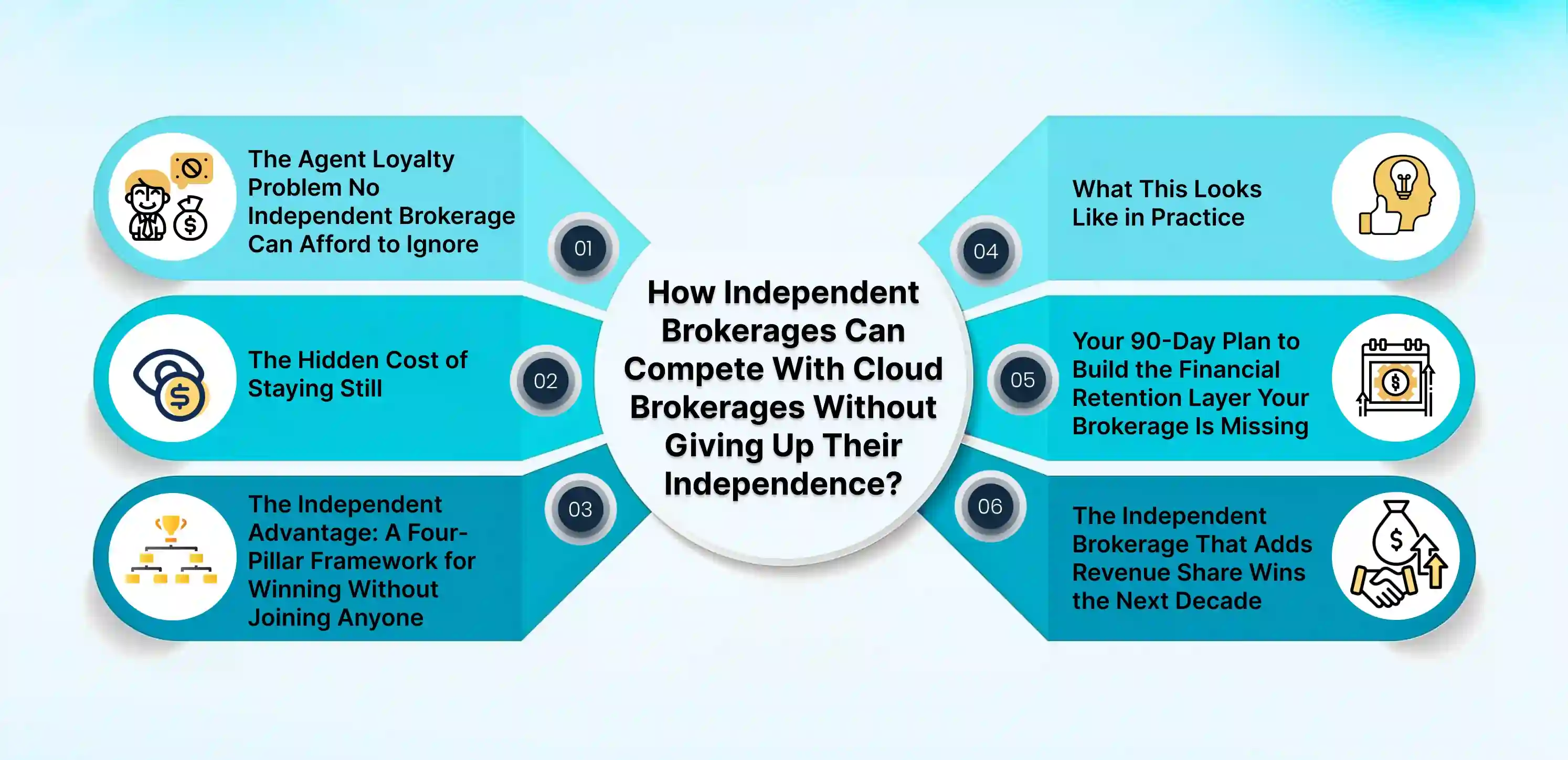
- Introduction
- The Agent Loyalty Problem No Independent Brokerage Can Afford to Ignore
- The Hidden Cost of Staying Still
- The Independent Advantage: A Four-Pillar Framework for Winning Without Joining Anyone
- What This Looks Like in Practice
- Your 90-Day Plan to Build the Financial Retention Layer Your Brokerage Is Missing
- The Independent Brokerage That Adds Revenue Share Wins the Next Decade
- Frequently Asked Questions
of brokerage leaders say recruiting top agents is their #1 challenge
of agents switched brokerages in 2025 — almost half the industry's production in motion
in sales volume lost by the top-100 brands despite aggressive recruiting
Picture this scenario: a broker-owner you know has spent six years building genuine loyalty with a top producer. This agent has closed 40+ deals annually, mentored newer agents, and referred three colleagues to the brokerage. Then one Tuesday morning, she sends a two-sentence email. She's leaving to join a platform that offers her passive income from agents she recruits. She's not angry. She's not burned out. She did the math.
That conversation is happening in brokerages across Florida, Texas, Nevada, and every high-growth market in the country right now. And according to Courted's 2026 State of Brokerage Report, the top-100 real estate brands collectively recruited $276 billion in agent production last year — but simultaneously lost $233 billion. The scoreboard is no longer just headcount. It's what you're keeping, and why agents are choosing to stay.
The good news: independent brokerages are not powerless in this conversation. They are, in fact, uniquely positioned to win it — provided they understand what has changed, and take one specific strategic step in response.
Key Takeaways
- Brand Ownership is a Structural Advantage. Cloud agents build someone else's brand. Independent brokerages own their reputation and local relationships — assets that compound over time and can't be replicated by any national platform.
- Revenue Share on Your Terms, Under Your Brand Independent brokerages can launch a branded revenue share program without joining any cloud model. It directly counters the passive income pitch — and is the single most impactful retention move available right now.
- Culture is a Competitive Moat. Agents choose brokerages on emotion as much as economics. Independents already have the warmth cloud platforms can't replicate. Add revenue share and you have the complete package.
- Turn Disillusioned Cloud Agents Into Your Best Recruits A growing pool of productive agents have left cloud platforms disappointed by virtual-only support and lost connection. An independent with revenue share offers exactly what they wanted — plus everything they missed.
1. The Agent Loyalty Problem No Independent Brokerage Can Afford to Ignore
For most of the past decade, the independent brokerage value proposition was clear and competitive: better culture, stronger local relationships, more personal support, and a commission structure that respected agent production. Those things still matter. But the conversation has evolved in a way that commission structures and culture alone cannot answer.
Cloud-based brokerage models introduced something structurally new: the passive income pitch. Agents are being offered the opportunity to earn money not just from their own deals, but from every deal closed by the agents they recruit. For a productive agent with a strong network, this represents a fundamentally different financial future — one that exists whether they close a deal that month or not.
This is not a trend confined to a few markets. The Delta Media Group 2026 Real Estate Leadership Report, which surveyed more than 100 brokerage leaders collectively responsible for over two-thirds of U.S. home sales, found that recruiting top agents is the #1 challenge for 63% of brokerage operators. Inman's Intel Index independently confirmed that recruiting and retention have surpassed interest rates and regulation as the top concerns for broker-owners — for the second year running.
Average total sales volume of an agent who switched brokerages in 2025. Losing one top producer isn't a personnel issue — it's a revenue event. And when that agent joins a revenue share platform, they become a recruiter for that platform, often targeting their former colleagues next.
The Agent Movement Index — the number of experienced agents switching brokerages each month — was at its lowest level since 2016 last year. That might sound like good news. It isn't. What it means is that agents who are moving are making deliberate, financially motivated decisions. These are not job-hoppers. These are top producers who have done the math and decided that their current brokerage cannot answer the question: What do I build financially over the next ten years?
3. The Independent Advantage: A Four-Pillar Framework for Winning Without Joining Anyone
Here is the strategic reality that cloud brokerage growth narratives prefer you not to dwell on: independence is a structural advantage, not a consolation prize. The broker-owners who are winning the next cycle are the ones who stopped thinking of their independence as a limitation and started treating it as a feature — then systematically added the one financial tool that cloud platforms have used to grow.
The framework has four pillars. Cloud platforms naturally offer one of these pillars. Independent brokerages can build all four.
Brand Ownership
Agents who join a cloud platform are building that platform's brand and network — not their own market identity. Your brand, your reputation, and your local relationships are assets that compound over time and cannot be replicated by a national platform. Every agent you recruit is an investment in your brand's equity, not someone else's.
Revenue Share on Your Terms
Independent brokerages can implement a branded revenue share program — structured to fit their economics, designed under their own name, without surrendering ownership or identity. This is the single most impactful move available to an independent broker-owner in the current market. It directly counters the passive income pitch on equal terms.
Culture as a Competitive Moat
Research by Mike DelPrete (February 2026) found that agents use both practical and emotional factors when choosing a brokerage — and that the emotional gap is larger than the economic gap for most decision-makers. "The ideal brokerage combines boutique-style warmth with enterprise-level polish." Independent brokerages have the first. Add revenue share and you have both.
Recruiting the Disillusioned
A growing segment of productive agents have tried cloud platforms and found the reality doesn't match the pitch: virtual-only support, crowded uplines, lost personal connection. Independent brokerages with a revenue share program can now target this group with a compelling counter-offer: the financial benefit they wanted, plus the personal experience they missed.
A. The One Move That Changes Everything: Branded Revenue Share
Of the four pillars, revenue share is the one that transforms the recruiting conversation immediately and measurably. The other three pillars are already present in most high-performing independent brokerages — they are being underutilized because the financial pillar is missing from the pitch.
Here is what changes when an independent broker-owner adds a branded revenue share program:
The recruiting conversation flips. Instead of defensively explaining why your brokerage is better than a cloud model, you open with: "We offer revenue share under our brand, on our terms, with the culture and support you're not going to get in a virtual environment." Agents come to you asking how it works, instead of you chasing them.
Your existing agents become recruiters. Revenue share turns every agent into an active, incentivized recruiter for your brokerage. When a $50 annual passive income payment from a new recruit grows to $2,000 after that recruit closes their first ten deals, agents actively grow your brokerage on your behalf.
The retention math changes permanently. An agent who is earning revenue share income from colleagues they recruited into your brokerage has a compounding financial reason to stay — one that grows larger every year they remain. They are not just your agent. They are a stakeholder in your brokerage's growth.
B. Independent Brokerages with Revenue Share vs. Cloud Brokerages: Head-to-Head
| Factor | Cloud Brokerage Model | Independent + Revenue Share |
|---|---|---|
| Revenue share / passive income | ✓ Platform-branded | ✓ Your brand, your terms |
| Brand ownership | ✗ Platform brand only | ✓ 100% your brand |
| In-person culture & support | ✗ Primarily virtual | ✓ Full in-person option |
| Local market authority | Partial National brand | ✓ Deep local identity |
| Control over economics | ✗ Platform-determined | ✓ Broker-owner controls |
| Agent mentorship & coaching | Varies Agent-led | ✓ Broker-directed |
| Recruiting agents leaving cloud models | ✗ Cannot offer | ✓ Strongest counter-offer |
4. What This Looks Like in Practice
The brokerages implementing this strategy are not large franchise operations. They are independent firms — typically 50 to 500 agents — that made a deliberate decision to add a revenue share layer to their existing model without changing anything else about how they operate.
A community-rooted independent brokerage in a competitive Florida metro launched a branded revenue share program in 2025. Within six months, two things happened that had never happened before: agents started proactively asking about the program during recruiting conversations (before the broker had to bring it up), and three long-tenured agents who had been exploring other options chose to stay specifically because of the financial stake they were building at the brokerage.
A 200-agent Texas independent with a strong training culture added revenue share and reported that its recruiting close rate on experienced agents improved measurably — because the conversation now had a financial answer that matched the emotional one they had always been able to give.
These are not outliers. They are early movers in a window that is still open. The RealTrends 2026 Verified Rankings showed independent brokerages growing their market share to 28.79% — the data confirms that independence is viable and competitive. What the same data shows is that the independents growing fastest are the ones building financial retention systems, not just cultural ones.
Platforms like RightAlly are built specifically to give independent broker-owners the infrastructure to design, launch, and manage a revenue share program under their own brand — without requiring a technology rebuild, a legal team, or a franchise agreement. The operational layer is handled. The broker-owner focuses on the brokerage.
5. Your 90-Day Plan to Build the Financial Retention Layer Your Brokerage Is Missing
The most common reason independent broker-owners haven't added revenue share yet is not skepticism about the model — it is uncertainty about where to start. The roadmap is more straightforward than most broker-owners expect.
| Phase | Timeline | Actions | Output |
|---|---|---|---|
| Audit | Days 1–30 | Map your current agent economics. Calculate: what would a 5–8% revenue share on your brokerage's monthly commission income mean per agent per year? Run the numbers for your top 10 recruiters specifically. | Your brokerage's revenue share opportunity number — the figure that changes your recruiting pitch |
| Design | Days 31–60 | Decide on your tier structure. How many tiers (typically 3–5)? What percentage per tier? How are tiers unlocked — by recruits, by production, or both? Keep the structure simple enough for an agent to explain to a recruit in 60 seconds. | A one-page revenue share program document your agents can share during recruiting conversations |
| Launch | Days 61–90 | Communicate the program to existing agents first — they become your first advocates and your first participants. Update all recruiting materials. Every conversation now includes the revenue share story. Technology handles the tracking and payment distribution automatically. | A live revenue share program, active agents earning passive income, and a transformed recruiting conversation |
One critical note on technology: tracking revenue share payments manually across 50 to 500 agents across multiple tiers is not sustainable. Spreadsheets fail, calculations drift, and agent trust erodes when payments feel uncertain. Purpose-built brokerage growth platforms handle this infrastructure automatically — every agent sees their earnings in real time, every payment is calculated accurately, and the broker-owner has a dashboard view of the entire program's performance.
The brokerages that launch revenue share programs and stall are almost always the ones that tried to run them manually. The ones that scale are the ones that are built on purpose-built infrastructure from day one.
See How RightAlly Builds Revenue Share Into Your Independent Brokerage
Book a 20-minute call. We'll show you exactly how the program works for your brokerage's specific size, market, and economics — and how to launch it in under 30 days without disrupting what's already working.
6. The Independent Brokerage That Adds Revenue Share Wins the Next Decade
The market has spoken clearly. The market has spoken clearly. Recruiting and retention are the defining competitive challenges for independent broker-owners in 2026. The agents most valuable to your brokerage — your top producers, your long-tenured veterans, your natural recruiters — are receiving passive income pitches from cloud platforms every week. Culture and commission structure answer part of that conversation. Revenue share answers the rest.
Independent brokerages do not have to choose between their identity and their competitive position. The financial tool that cloud brokerages built their growth on is available under your name, on your terms, without surrendering the brand and culture you have spent years building. The only question is whether you build it before or after you watch your next top producer make that calculation.
The window to be a first-mover in your market on this is still open. It will not be open indefinitely.
Frequently Asked Questions
Yes. Independent brokerages can implement branded revenue share programs without joining a cloud brokerage model. Purpose-built platforms allow broker-owners to design, launch, and manage a revenue share program under their own brand name, with their own tier structure and economics — typically within 30 days.
Independent brokerages compete most effectively by combining their natural advantages — brand ownership, culture depth, local market expertise, and in-person support — with the financial retention tools that cloud brokerages built their growth on. Adding a branded revenue share program is the single most impactful step an independent broker-owner can take to directly counter cloud brokerage recruiting.
The most effective strategy is to give agents a financial reason to stay that is specific to your brokerage — one that grows over time. Culture and commission structure answer part of the question. A branded revenue share program, where agents earn passive income based on agents they recruit into your brokerage, answers the rest. This directly counters the passive income pitch that cloud brokerages use to recruit your top producers.
With purpose-built brokerage growth software, independent broker-owners can design and launch a revenue share program in under 30 days. The process involves three phases: auditing your current economics (Days 1–30), designing your tier structure (Days 31–60), and launching to existing agents first before updating recruiting materials (Days 61–90).
Independent broker-owners can build a revenue share program under their own brand without joining any cloud model. This preserves full brand ownership, market positioning, and business control while giving agents the long-term financial stake they are increasingly demanding. The result is a brokerage that offers what cloud platforms offer financially — and what cloud platforms fundamentally cannot offer culturally.
Share this blog


Popular topics
Efficiency
Growth
Compliance
Technology
Agents
Trends



 +1 (765) 896-5271