


 Home
Home Blog
Blog
Table of Content
Summary
Discover the strategies and practices that set the top 1% of brokerages apart and learn actionable steps to apply the same techniques to grow your own real estate brokerage successfully.
You recruit a promising new agent, watch them struggle through their first few months, and then lose them to a competitor before they ever reach their potential. The cycle repeats, costing you time, money, and momentum in building your team.
The real estate industry faces a critical retention problem. According to the National Association of REALTORS®, the median agent retention dropped from six years in 2022 to five years in 2024. For newer agents, the numbers are even more concerning. Many leave the profession entirely within their first year. And the trend is accelerating faster than we can think.
But why do brokerages like eXp Realty and REAL not face similar issues? They have demonstrated that when mentorship and revenue sharing work in tandem, it creates a self-reinforcing cycle of growth, retention, and profitability. So, let's get into the specifics of how you can emulate this model at your brokerage.
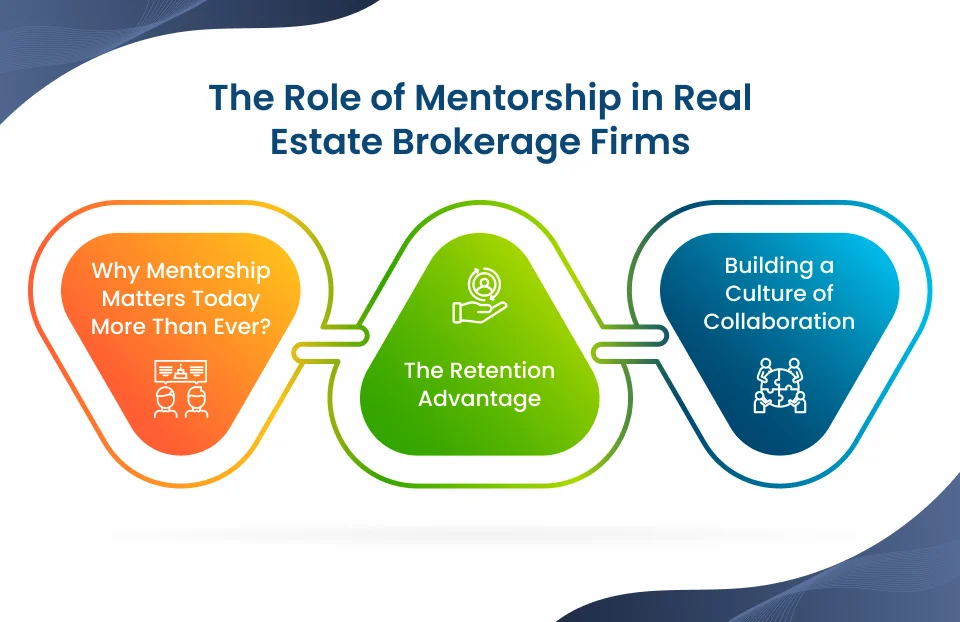
1. The Role of Mentorship in Real Estate Brokerage Firms
Traditional real estate brokerage mentorship often feels like an afterthought. Just give a quick orientation, a few training sessions, and a "good luck" handshake. But the most successful brokerages understand that real estate brokerage mentorship must be intentional, structured, and aligned with business objectives.
a. Why Mentorship Matters Today More Than Ever
The gap between earning a license and becoming a productive agent has never been wider. Pre-licensing education covers legal requirements and vocabulary, but it doesn't teach agents how to generate leads, navigate their first listing presentation, or negotiate effectively under pressure. Passing the real estate licensing exam is like passing the written portion of a driver's test; you still need to learn how to actually drive.
This knowledge gap creates significant pain points for brokerages. Without proper guidance, new agents:
- Take longer to close their first transaction
- Make costly mistakes that damage client relationships
- Require excessive broker supervision
- Leave the profession before generating meaningful revenue
Most broker-owners aren’t trying to do it all. They’re trying to stop doing the same things over and over:
- Basic onboarding questions
- Contract and timeline coaching
- “What do I say to the seller?” role-play moments
- Preventable transaction mistakes
NAR’s brokerage guidance on recruitment and retention explicitly calls out coaching and mentorship as a retention lever. Agents stay where they feel supported.
Also Read: What the Top 1% Brokerages Do Differently (and How You Can Do Too)
And when mentorship is done well, it becomes a recruiting magnet as well. Formal mentorship programs can boost morale, help agents gain confidence, and even support brokerage growth by attracting talent.
Above all, agents who engage in mentorship and strategic guidance consistently outperform their peers. In 2024, agents using the Luxury Presence platform averaged 25 transactions leveraging mentorship, which was more than double the industry average of 10 transactions per year. This was while topping $24 million in average sales volume, nearly 10 times the national average of $2.5 million.
That's the true power of mentorship.
b. The Retention Advantage
Research also demonstrates that mentorship programs deliver measurable retention results. Strategic mentorship initiatives have been adopted by 84% of Fortune 500 companies specifically because they work. In fact, a pattern becomes clear when you notice that 90% of Fortune 250 companies, 96% of Fortune 100 companies, and 100% of Fortune 50 companies have them.
Simply put, mentorship initiatives facilitate knowledge transfer while strengthening team dynamics and keeping top talent engaged. In real estate specifically, brokerages with structured mentorship programs see new agents reach productivity milestones faster and stay with the firm longer. Guide Real Estate in Aurora, Colorado, found that their formal mentorship program became a magnet for attracting talent. Since implementing their program, 35 agents have successfully completed it, creating a pipeline of well-trained, confident professionals who contribute to the brokerage's bottom line.
c. Building a Culture of Collaboration
Perhaps the most overlooked benefit of real estate team management through mentorship is the cultural transformation it creates. When experienced agents serve as mentors, they model the behaviors and values you want throughout your organization. This creates what is called a "culture of giving back", where knowledge sharing becomes the norm rather than the exception.
This collaborative environment addresses one of the industry's most persistent challenges, wherein agents report dissatisfaction with current coaching and mentorship models. By creating structured, supportive mentorship frameworks, brokerages can differentiate themselves in a crowded marketplace and become the firm where agents actually want to build their careers.
2. How Mentorship Enhances Revenue Share Performance
The true magic happens when you align agent mentorship programs with revenue share models. This combination creates a powerful incentive structure that benefits everyone in the value chain, including brokers, mentors, mentees, and clients.
a. Understanding Revenue Share Basics
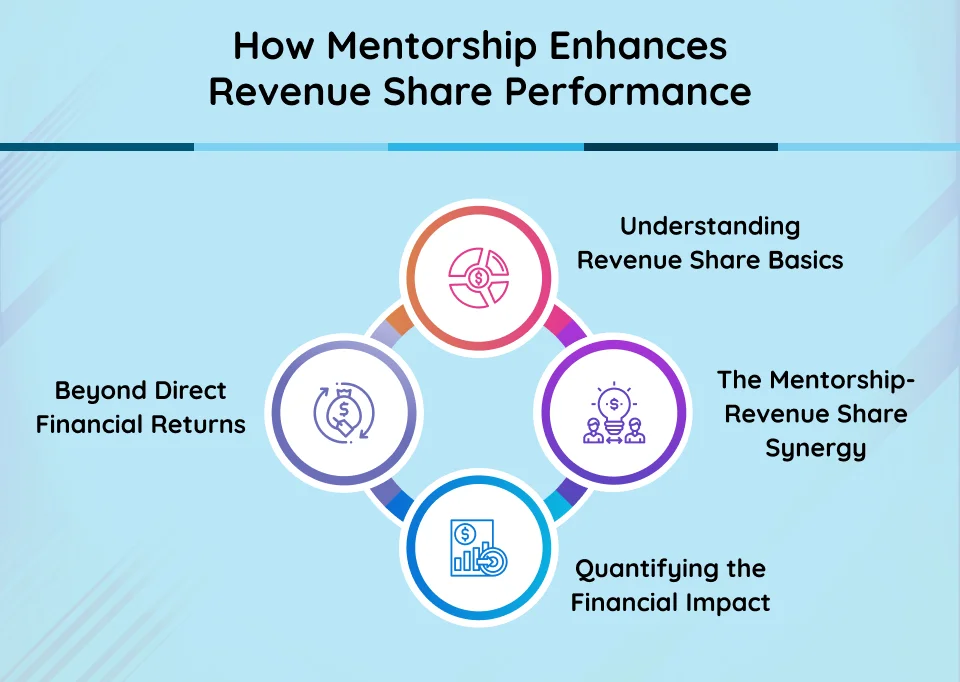
Revenue share models represent a fundamental shift in how brokerages grow. Rather than spending heavily on traditional advertising and recruitment, brokerages allocate that budget to agents who help grow the company one relationship at a time. The genius of revenue share is that it outsources recruiting to the people best positioned to do it, i.e., successful agents who understand what makes a brokerage attractive.
So, how does this model typically work? When an agent joins the brokerage through another's sponsorship, the latter receives a percentage of the company dollars (the brokerage's share of commission) they generate. The percentage and tier structure vary by brokerage, but the principle remains consistent across models.
On top of offering 85% commission to the agent managing a transaction, REAL Broker pays up to 60% of its monthly revenue back to other sponsoring agents through revenue share, the highest percentage in the industry. They offer as much as $4,000 annually for every capping agent a person directly sponsors. Likewise, eXp Realty shares 50% of company dollars through its seven-tier system. As an agent attracts more agents and they build their own networks, the sponsoring agents earn revenue share from agents several levels deep in your organization.
Also Read: What is a Revenue Share and why is it gaining popularity in Real Estate?
b. The Mentorship-Revenue Share Synergy
This is where a prime differentiation begins to appear. When you combine revenue share with quality mentorship, you create aligned incentives that didn't exist in traditional brokerage models.
Consider this scenario:
You sponsor a new agent into your brokerage. They're generating $40,000 in gross commission income (GCI) annually. Through the revenue share model, you might earn approximately $1,400 per year from their production. But what if you invested time mentoring them, like helping with lead generation strategies, practicing scripts, and refining their listing presentations?
If your guidance helps them double their production to $80,000 in GCI, your revenue share increases proportionally.
Suddenly, you have a vested financial interest in their success. You're not mentoring out of pure altruism (though that's admirable). You're building a business asset. And the mentee benefits from experienced guidance that accelerates their career trajectory.
This creates a virtuous cycle:
1. Top-performing agents recruit other quality agents because your mentorship program is a compelling value proposition.
2. All agents invest time and expertise in the development of their recruits because it directly impacts their income.
3. They succeed faster, earning more while building loyalty to you and the brokerage.
4. The recruited agents sponsor their own agents, creating additional tiers in your brokerage network.
5. All top-performing agents' passive income grows while they continue focusing on their own production.
c. Quantifying the Financial Impact
The numbers demonstrate the power of this model. In a REAL-like revenue share model, if an agent sponsors just three producing agents into their Tier 1, they can potentially cover their own annual cap. This means the sponsor can keep 100% of their commissions after reaching their cap, transforming their economics entirely. Such factors significantly impact the motivation to recruit and train others.
Another important aspect here is that a fraction of recruiting agents can accelerate your brokerage to an exponential growth trajectory. For instance, RightAlly's data suggests that roughly 14% of agents actively recruit and attract one or more agents to any brokerage, while an overwhelming majority attracts none. Yet, the small percentage of agents who embrace both mentorship and revenue sharing generate significant passive income streams and grow brokerage teams from 10 to 800 in less than a year. Top producers earn six-figure annual revenue share while maintaining their own robust production.
Also Read: How to implement a Revenue Share Program for Your Real Estate Brokerage Firm
The revenue share model further creates financial stability that commission-only income cannot. Real estate earnings fluctuate based on market conditions and deal cycles. Revenue share provides a more predictable income stream that continues even during slower production months, giving agents financial breathing room and peace of mind.
c. Beyond Direct Financial Returns
The benefits extend beyond the direct revenue share checks. Brokerages implementing strong mentorship frameworks within revenue share structures experience
Enhanced Agent Engagement
Mentors stay more connected to the brokerage, attending training, participating in leadership opportunities, and remaining active in company initiatives.
Improved Lead Quality
When you're financially incentivized to help agents succeed, you're more likely to share referrals, introduce them to your sphere of influence, and connect them with quality opportunities.
Knowledge Multiplication
As mentored agents develop expertise, they become mentors themselves, creating an exponential knowledge transfer effect throughout your organization.
Competitive Recruiting
The combination of quality mentorship and revenue share opportunity becomes a powerful differentiator. Top agents considering a move want to know they'll receive support AND have the opportunity to build additional income streams.
3. Structuring an Effective Mentorship Program
Creating a mentorship program that actually drives results requires thoughtful design and consistent execution. The difference between programs that thrive and those that fail often comes down to structure, expectations, and accountability.
a. Define Clear Program Components
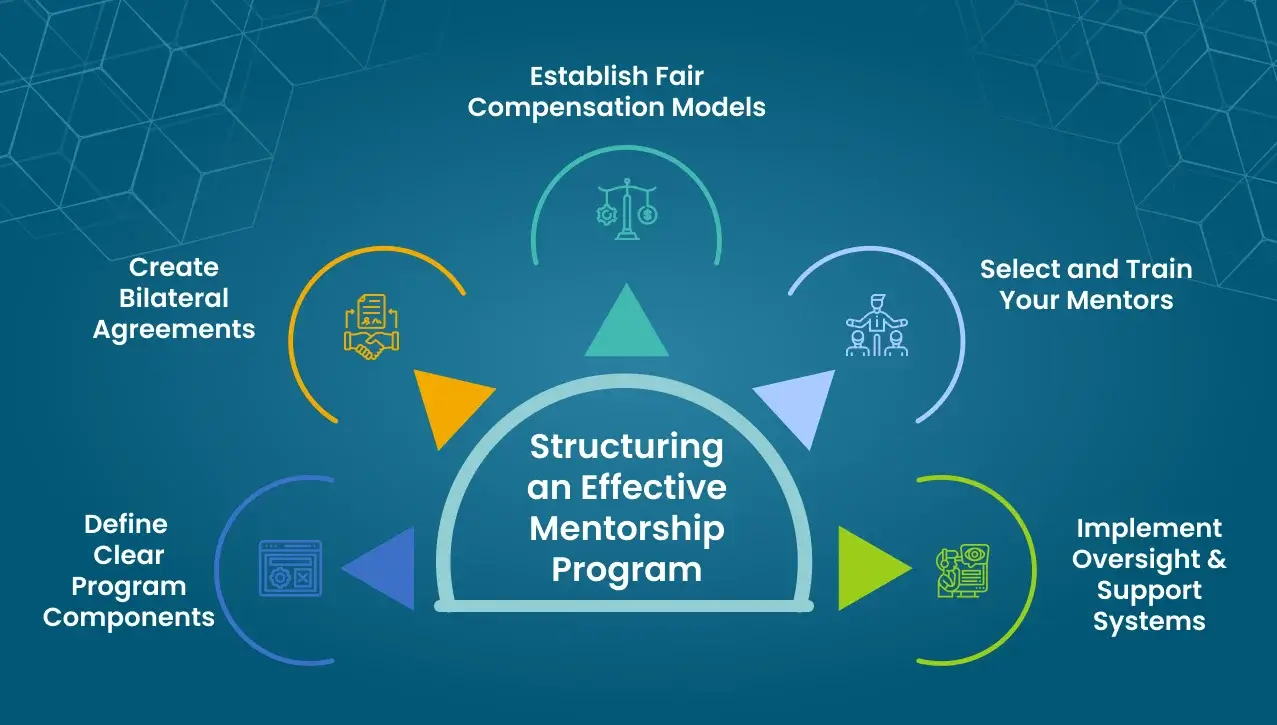
Successful real estate coaching and training programs share common elements that separate them from informal, ad-hoc mentoring:
Duration and Milestones
Tailor program length to agent experience and your market's transaction volume.
For example, Whissel Realty Group bases its mentorship duration on the fact that their agents average 10-15 deals annually. New agents might remain in the program through their first three transactions, while experienced agents joining from another brokerage might only need support through one deal to learn the systems.
eXp Realty's mentor program works with agents who haven't completed at least three transactions within the past 12 months, providing structured support through this critical early stage.
Curriculum and Learning Objectives
Don't leave learning to chance. The best agent onboarding and training programs include comprehensive curricula covering:
- MLS navigation and property research
- Comparative market analysis preparation
- Buyer and seller consultation frameworks
- Contract writing and negotiation strategies
- Transaction coordination and compliance
- Lead generation and conversion systems
- Technology platforms and tools mastery
- Business planning and goal setting
A great example here is eXp's GO! Mentee Curriculum, which is a robust two-part program incorporating content and feedback from mentors, brokers, and program staff. It provides new agents with the fundamental knowledge required to start and build successful careers.
Meeting Cadence
Establish regular touchpoints to maintain momentum. Most effective programs require weekly check-ins, whether in-person or virtual, supplemented by on-demand availability for urgent questions. Mentors should also shadow key activities like listing appointments, showings, and negotiations to provide real-time coaching.
Also Read: Why Real Estate Teams Are Embracing Multi-Tier Incentive Structures?
b. Create Bilateral Agreements
Vague expectations doom mentorship relationships. Create formal mentorship agreements outlining responsibilities and accountability for both parties.
For mentors, clearly define:
- Minimum meeting frequency (e.g., weekly one-on-ones)
- Availability expectations (response time to questions)
- Required shadowing activities (attending listings, offers, etc.)
- Knowledge sharing obligations (systems, scripts, resources, etc.)
- Reporting requirements to program coordinators
For mentees, specify:
- Preparation requirements for mentorship sessions
- Action item completion between meetings
- Practice and skill development exercises
- Communication protocols and responsiveness
- Progress documentation and reporting
These agreements prevent "he said, she said" problems and ensure everyone understands what success looks like. They also provide clear grounds for intervention if the equation isn't working.
c. Establish Fair Compensation Models
Most mentorship models fail in real estate because they overlook the financial aspect associated with it. Mentor compensation also requires careful balancing. Pay enough to make mentoring financially worthwhile, but not so much that it burdens new agents during their critical early earning period.
Common compensation structures include:
- Transaction splits: Mentors receive 20-50% of commission on deals where they provide significant support (percentage varies based on mentor involvement)
- Monthly fees: Fixed monthly payment from mentee or brokerage to compensate for time investment
- Referral splits: Higher percentage splits on leads or referrals that the mentor provides
- Hybrid models: A combination of a monthly support fee plus transaction splits
Consider having your brokerage subsidize mentorship costs. For example, covering 50% of mentor payments reduces the burden on new agents while still compensating mentors fairly. This investment pays dividends through improved retention and faster time-to-productivity.
In revenue share models, the revenue share itself often serves as mentor compensation, eliminating the need for additional fees while perfectly aligning incentives. However, additional incentives stimulate training, development, and time to productivity.
Also Read: 8 Mistakes to avoid when launching a Revenue Share Model
For instance, all agents falling below a certain threshold (like three transactions in a rolling window of twelve months) must enroll in the training program, wherein they receive reduced commission for a predetermined number of transactions while they're mentored. This commission is shared with the mentor as compensation for their time and effort.
d. Select and Train Your Mentors
Not every experienced agent makes a good mentor. The best mentorship programs for brokerage growth carefully select and develop their mentor pool.
Key mentor qualifications should include:
- Consistent production track record (minimum transaction volume)
- Strong ethical reputation and professionalism
- Willingness to share knowledge and support others
- Patience and teaching aptitude
- Systems and processes that can be replicated
- Availability to commit to the program requirements
Provide mentor training covering:
- Effective coaching techniques
- Your brokerage's specific systems and standards
- How to give constructive feedback
- When to let mentees struggle vs. when to intervene
- Documentation and reporting requirements
- Conflict resolution approaches
e. Implement Oversight and Support Systems
Mentorship programs require active management to stay effective. Designate a program coordinator (ideally someone leading your dedicated mentoring department while having an education and leadership background) who:
- Matches mentors and mentees strategically
- Conducts regular check-ins with both parties
- Addresses challenges and concerns proactively
- Recognizes and celebrates program successes
- Tracks metrics and program outcomes
- Makes adjustments when relationships aren't working
Weekly meetings with mentors help ensure they're maintaining the right mindset and processes while providing a forum to share challenges and best practices. This oversight prevents small problems from becoming agent-threatening issues.
4. The Common Challenges and How to Overcome Them
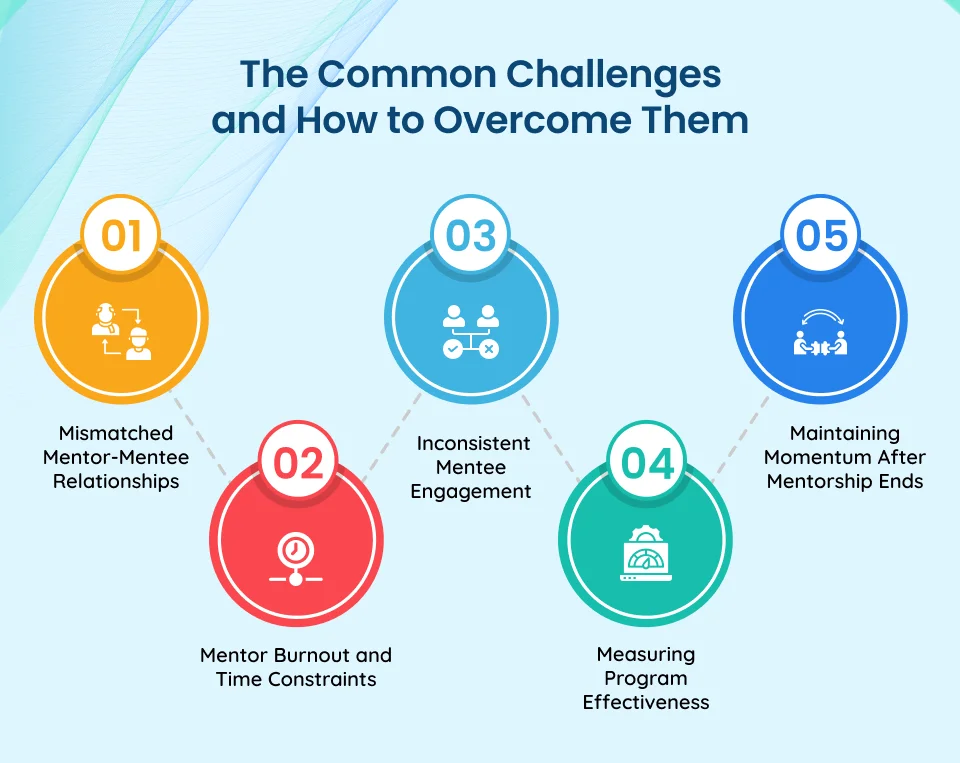
Even well-designed mentorship programs encounter obstacles. Understanding common challenges and having strategies to address them keeps your program on track.
a. Mismatched Mentor-Mentee Relationships
Despite careful planning, sometimes mentor-mentee chemistry just doesn't work. Personality conflicts, communication style differences, or misaligned expectations can derail relationships.
Solution: Act quickly when fit issues emerge. Don't let mismatched pairs struggle for months. Reassign mentors promptly. Your bilateral agreement should include provisions for relationship changes, removing stigma from the process. Regular program coordinator check-ins help identify issues early, before frustration builds.
Create a diverse mentor pool, so you have options when making new matches. Consider factors like geographic proximity, specialty areas, personality types, and availability that are beyond just production numbers when pairing mentors and mentees.
b. Mentor Burnout and Time Constraints
Productive agents are busy. The time required for quality mentorship, including meetings, shadowing, coaching, problem-solving, etc., can become overwhelming, especially when mentors work with multiple mentees simultaneously.
Solution: Set realistic expectations about mentor capacity. Most mentors can effectively work with 2-3 mentees at once; beyond that, quality suffers. Ensure compensation fairly reflects time investment.
Provide mentors with systems and resources that make their work more efficient. Template documents, training videos, standardized curricula, and tech tools reduce the time required to deliver value. In revenue share models, remind mentors that their time investment builds long-term passive income. This reframes mentoring as business development rather than a burden.
Recognize and celebrate mentor contributions publicly. Awards, recognition events, and leadership opportunities demonstrate that the brokerage values their service, increasing satisfaction and reducing burnout.
c. Inconsistent Mentee Engagement
Some mentees fail to do the work by missing meetings, not completing assignments, or not implementing feedback. This wastes mentor time and produces poor outcomes.
Solution: Screen mentees during recruitment. Make clear that your mentorship program is a privilege for dedicated individuals, not a right for all. During interviews, assess commitment levels and motivation.
Include mentee responsibilities and consequences in your bilateral agreement. If a mentee consistently underperforms, the agreement should provide for program dismissal or mentor reassignment. This protects mentor time and maintains program quality.
Implement accountability mechanisms like progress tracking, assignment completion verification, and regular goal reviews. When mentees know they'll be held accountable, engagement improves.
d. Measuring Program Effectiveness
Without clear performance metrics for mentorship programs, it's difficult to know whether your program is working or justify continued investment.
Solution: Establish key performance indicators (KPIs) from the outset, like:
- Time to first transaction for mentees
- Transaction volume in the first 6, 12, and 24 months
- Retention rates (mentored vs. non-mentored agents)
- Lead conversion rates
- Client satisfaction scores
- Graduation rates from the mentorship program
- Mentor satisfaction and retention
- Revenue per agent (mentored vs. non-mentored)
Track these metrics consistently and analyze trends. Share results with stakeholders, including mentors, leadership, and even mentees themselves, to demonstrate impact and identify improvement opportunities.
Use these insights to refine your program continuously. If certain curriculum components consistently fail to resonate, revise them. If particular mentors consistently produce exceptional outcomes, study their approaches and share best practices.
e. Maintaining Momentum After Mentorship Ends
Agents graduate from formal mentorship but struggle without ongoing support, sometimes regressing or leaving the brokerage shortly after program completion.
Solution: Create a graduation pathway that maintains connection without requiring intensive mentorship. Some of the options include:
- Alumni programs connecting past mentees for peer support
- Advanced training tracks for continuing education
- Quarterly check-ins with former mentors
- Leadership development opportunities (mentees becoming mentors)
- Ongoing access to resources and systems
- Reassigning mentors as sponsors of the mentee
In revenue share models, the relationship naturally continues since sponsors remain financially invested in agent success. Encourage graduated agents to maintain regular communication and celebrate their continued growth.
5. Tools and Technology to Support Mentorship
Modern technology transforms mentorship from a resource-intensive challenge into a scalable competitive advantage. The right tools streamline administration, enhance communication, and provide data insights that strengthen your program. For brokerages adopting revenue share models, specialized software becomes essential infrastructure.
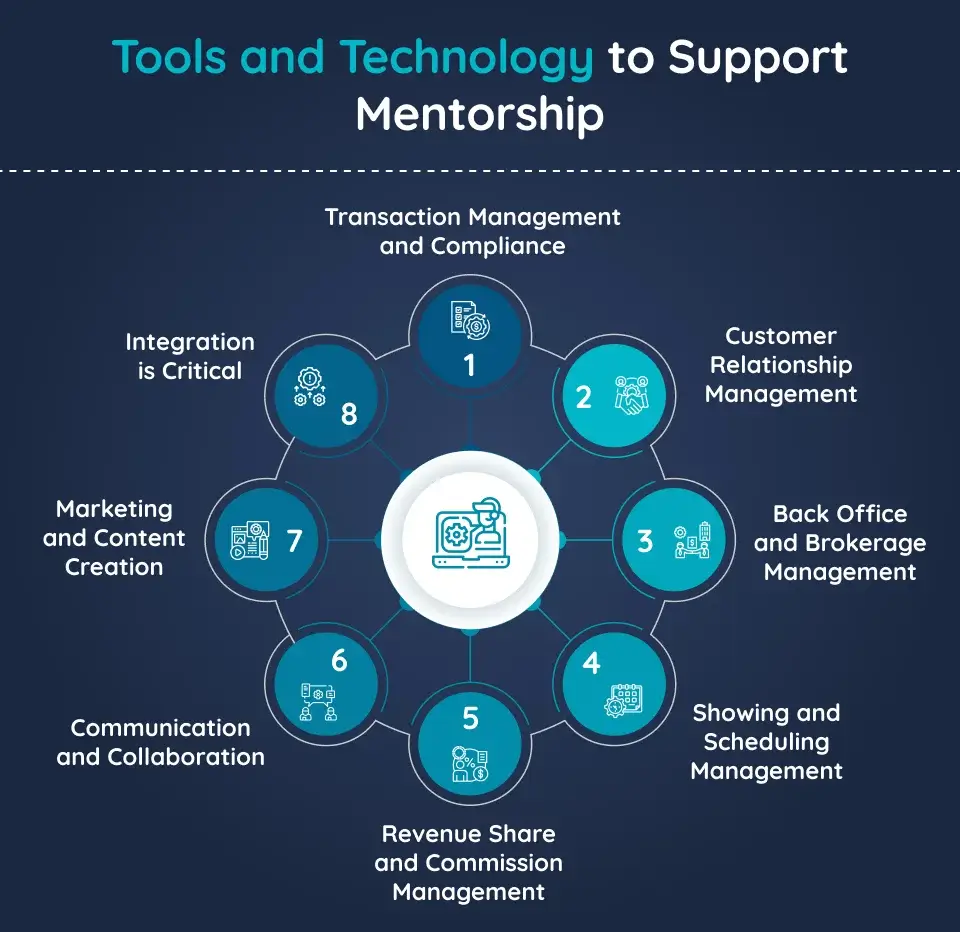
a. Transaction Management and Compliance
Transaction management platforms form the operational backbone of real estate brokerages, ensuring mentors and mentees handle deals efficiently and compliantly.
Dotloop
This Cincinnati-based platform streamlines the buying and selling process by enabling agents to create, share, edit, and electronically sign documents in a single system. Trusted by thousands of brokerages, Dotloop improves efficiency, compliance, and collaboration. For mentorship programs, it provides a centralized place where mentors can review mentee transactions in real-time, ensuring nothing falls through the cracks.
SkySlope
Based in Sacramento, SkySlope is the leading transaction management platform that simplifies document handling, compliance, and auditing. It allows agents to manage contracts, e-signatures, and property documents in a single cloud-based system with secure storage and streamlined workflows. The audit trail features make it invaluable for brokers overseeing mentorship programs, as they can quickly review transactions and provide guidance.
DocuSign
The industry-leading e-signature platform accelerates the closing process and ensures compliance. By enabling secure document signing from any device, DocuSign reduces paperwork errors and improves client satisfaction. For new agents in mentorship programs, mastering DocuSign early accelerates their time to productivity.
Customer Relationship Management
Real estate-specific CRMs help agents manage leads, nurture relationships, and track their pipelines.
Follow Up Boss (FUB)
Follow Up Boss emphasizes lead distribution and routing, making it especially valuable for teams and brokerages. For mentorship programs, FUB allows sponsors to share leads with mentees strategically while tracking conversion rates and providing coaching based on actual pipeline data.
BoldTrail
Previously KvCore, BoldTrail is ranked #1 by over 250,000 agents. It is a complete real estate platform built for modern brokerages. It offers personalized workspaces for digital workflow automation, task management, and reporting to improve productivity across teams.
b. Back Office and Brokerage Management
Efficient back-office operations allow mentors to focus on coaching rather than administrative tasks.
Brokermint
Based in Santa Barbara, Brokermint is an all-in-one back-office and transaction management software for brokerages and teams. It centralizes transaction workflows, commission tracking, and compliance reporting into a single platform, providing real-time visibility into business operations. This visibility helps program coordinators track mentee progress and mentor engagement systematically.
BoldTrail Back Office
Deemed the next-generation of Brokermint, BoldTrail Back Office provides an industry-leading combination of back-office and accounting solutions specifically designed for today's real estate brokerages. It eliminates busy work, duplicate data entry, and mistakes while simplifying and accelerating back-office operations.
c. Showing and Scheduling Management
Efficient showing coordination separates productive agents from those stuck in administrative chaos.
ShowingTime
Headquartered in Chicago, ShowingTime automates property showing scheduling for real estate agents. It eliminates the phone tag and coordination challenges that often bog down new agents, allowing them to focus on buyer consultations and relationship building.
d. Revenue Share and Commission Management
For brokerages operating revenue share models like eXp Realty and REAL Broker, specialized commission management software is critical. If you're still calculating revenue share payouts in spreadsheets, you're limiting growth potential and risking expensive errors.
The complexity of multi-tier revenue sharing, caps, overrides, and varying commission splits across hundreds or thousands of agents demands platform-level automation. Manual calculations don't just consume administrative resources; they destroy agent trust when errors occur.
RightAlly
Purpose-built revenue-sharing software solutions like RightAlly help traditional brokerages adopt commission models similar to eXp Realty and REAL Broker. It helps you implement the end-to-end systems needed to attract and retain agents with a revenue share model, onboard them efficiently, and improve retention through automation and data-driven processes.
RightAlly also seamlessly connects with transaction management tools like SkySlope and Dotloop, accounting systems like QuickBooks, and other brokerage management platforms. Smooth data flow across your tech stack eliminates duplicate entry and reduces errors.
e. Communication and Collaboration
Virtual mentorship requires reliable platforms that facilitate both formal training sessions and quick daily interactions.
Zoom/Microsoft Teams
Video conferencing tools enable face-to-face mentorship sessions regardless of location, particularly valuable for cloud-based brokerages or those with geographically dispersed teams.
Slack
Real-time messaging keeps mentors and mentees connected for quick questions and support. Creating dedicated mentorship channels facilitates peer learning and community building.
f. Marketing and Content Creation
New agents need tools that help them compete professionally without requiring design expertise or massive budgets.
BombBomb
This Colorado Springs-based video messaging platform helps agents create personalized video emails and texts to improve client engagement. Mentors can demonstrate effective video usage, helping mentees build stronger client relationships from day one.
Canva
Easy-to-use design tools help agents create professional marketing materials without expensive designers. Mentorship programs should include training on tools like Canva to accelerate new agent marketing capabilities.
g. Integration is Critical
The most effective technology stacks feature seamless integration between components. When your transaction management system, CRM, back-office platform, and revenue share software share data automatically, you eliminate manual entry, reduce errors, and gain comprehensive insights into both agent performance and program effectiveness.
Look for platforms like RightAlly that offer native integrations or robust API access, enabling custom connections. This integration capability often matters more than any single feature when building your mentorship program infrastructure. The goal is creating a unified ecosystem where data flows naturally, providing complete visibility into each agent's development journey and your program's overall health.
Also Read: How Strategic Expense Management Can Boost Your Brokerage Finances?
RightAlly helps real estate brokerages streamline transactions with dedicated coordination.
Free your agents from paperwork, cut compliance risks, and focus on growing your brokerage.
6. Conclusion
In conclusion, the brokerages winning today aren't just offering competitive splits. They're the ones building ecosystems where mentorship and revenue share work together. Experienced agents mentor because they're financially invested in new agent success. New agents stay because they receive genuine support and see a clear path to building their own networks. Technology automates the complexity, making what once required massive overhead now possible for any brokerage.
The model works. eXp Realty and REAL Broker have proven it at scale. Your competitors are already implementing these systems. The question isn't whether it will work for you as well, but whether you'll adopt it before the best agents in your market choose a brokerage that already has.
Frequently Asked Questions
Mentorship and revenue share create aligned incentives where sponsors earn passive income based on their recruits' production, motivating them to invest time in training and development. When mentors help their recruits increase production, their revenue share earnings grow proportionally, turning mentorship into a strategic business investment rather than just an altruistic gesture.
The most effective programs combine clear duration milestones (typically through the first 3 transactions), comprehensive curriculum, weekly check-ins with shadowing opportunities, and bilateral agreements defining expectations for both parties. Success requires dedicated program coordination, careful mentor selection, fair compensation (through transaction splits, monthly fees, or revenue share), and consistent tracking of key metrics.
Revenue share models can function without formal mentorship, but they significantly underperform compared to programs combining both elements. Without mentorship, new agents take longer to become productive and leave at higher rates, undermining the network growth that makes revenue share valuable.
Establish key performance indicators from the outset, such as time to first transaction, transaction volume at 6/12/24 months, retention rates (mentored vs. non-mentored), lead conversion rates, and revenue per agent. Track both mentor and mentee satisfaction through regular surveys, monitor graduation rates, and calculate ROI by comparing additional revenue from improved performance against program costs.
Share this blog


Popular topics
Efficiency
Growth
Compliance
Technology
Agents
Trends




 +1 (765) 896-5271