


 Home
Home Blog
Blog
Table of Content
- Introduction
- What Is Revenue Share in Real Estate? (Definition for Broker-Owners)
- The Independence Myth: Why Most Broker-Owners Think They Can’t Do This
- How the Economics Work: Where the Money Comes From
- Three Revenue Share Programme Structures for Independent Brokerages
- The 5 Most Common Revenue Share Objections — and the Honest Answers
- Is Revenue Share Legal? Tax and Compliance Basics for Broker-Owners
- How to Launch Your Revenue Share Programme This Quarter: 4 Steps
- The Independent Brokerage Revenue Share Advantage
- Frequently Asked Questions About Independent Brokerage Revenue Share
Key Takeaways
- Revenue share is a business model, not a cloud brokerage requirement. Independent brokerages can create their own programme instead of joining another brokerage simply to access revenue-sharing opportunities.
- Design the programme around your brokerage economics. Establish how much revenue can be shared, who qualifies, how payouts are calculated, and how long agents can participate.
- Use revenue share as a recruiting differentiator. Offering agents an opportunity to build additional income can help an independent brokerage compete with cloud brokerages that promote similar incentives.
- Protect the value of your independent brand. A brokerage can combine revenue sharing with its local reputation, leadership, culture, training, and personal agent support rather than replacing those advantages with a cloud brokerage model.
- Automate the programme as it grows. Once multiple agents, recruiting relationships, transactions, and payout levels are involved, automated tracking and calculations can reduce administrative work and payout errors.
If you’ve been watching agents get recruited away by cloud brokerages offering revenue share, you’ve probably wondered: can I do this inside my own brokerage? The answer is yes — and most independent broker-owners don’t know it.
Almost everything written about revenue share in real estate is written for agents deciding whether to join a cloud brokerage. This article is written for broker-owners who want to build a revenue share programme inside the independent brokerage they already own — without surrendering their brand, their culture, or their independence.
That distinction matters enormously. Cloud brokerages did not invent revenue share. They popularised it. The model itself — sharing a portion of company revenue with the agents who help the brokerage grow — has existed in various forms for decades. What cloud brokerages did was formalise and market it aggressively. Independent brokerages can do the same thing. They just need a framework to do it properly.
The Independence Myth: Why Most Broker-Owners Think They Can’t Do This
The most common misconception about revenue share among independent broker-owners is this: “Revenue share is what cloud brokerages offer. If I want to offer it, I have to join one.”
This is incorrect — and it is costing independent brokerages agents, recruiting momentum, and competitive positioning every day.
Cloud brokerages built their growth models around revenue share as a recruiting and retention tool. But the legal and operational mechanics of revenue share are not exclusive to any brokerage model. An independent brokerage — whether you have 20 agents or 200 — can design, launch, and run its own revenue share programme. The only requirement is that you have company dollar to distribute and a clear structure for how it works.
The reason most independent broker-owners don’t offer revenue share is not that they legally cannot. It is that no one has given them a practical framework for implementing it themselves. Instead, the only content available on the topic is written by cloud brokerages recruiting independent broker-owners to transition their entire operation — bringing their agents with them — in exchange for access to the cloud brokerage’s existing revenue share infrastructure.
That trade — your independence for their infrastructure — is not the only option. Independent broker-owners who build their own revenue share programme get the same agent retention benefit, the same recruiting advantage, and the same passive income architecture — without surrendering the brand and culture they spent years building.
How the Economics Work: Where the Money Comes From
The question most broker-owners ask first is: “Can I actually afford to do this?” The answer almost always surprises them, because the programme is designed to be self-funding — funded from new production growth, not from existing revenue.
The basic economic structure
In a typical independent brokerage revenue share programme, here is how the math work at the simplest level:
- A new agent joins your brokerage, referred by Agent A who is already on your roster.
- The new agent closes a transaction generating $500 in company dollar (after the agent’s split).
- Under a 5% revenue share structure, Agent A receives $25 from that transaction.
- The brokerage retains the remaining $475 — still more than it would have had without the new agent.
The programme does not cost the brokerage money it already had. It distributes a percentage of new company dollar generated by agents who joined because of the programme. If the programme works correctly, the brokerage is always net-positive: it gains more in new production than it pays out in revenue share.
A worked example for a 50-agent independent brokerage
| Year | New Agents Recruited via RS | Avg Company Dollar per Agent | Total New Company Dollar | Revenue Share Paid Out (5%) | Net Brokerage Gain |
|---|---|---|---|---|---|
| Year 1 | 6 agents | $8,000 | $48,000 | $2,400 | $45,600 |
| Year 2 | 14 agents (cumulative) | $9,000 | $126,000 | $6,300 | $119,700 |
| Year 3 | 24 agents (cumulative) | $9,500 | $228,000 | $11,400 | $216,600 |
The revenue share payout grows as the programme succeeds — but the brokerage net gain grows faster, because the programme is self-selecting for productive agents who generate real company dollar. A broker-owner who is worried about the Year 3 payout of $11,400 should be more focused on the $216,600 in net new company dollar that programme generated.
The affordability objection answered directly
The programme does not reduce existing agent splits. It does not come from the broker-owner’s personal income. It is funded from company dollar on new agent production — production that would not exist without the programme. Brokerages that structure the programme correctly find it is almost entirely self-funding from Year 1 and compoundingly profitable by Year 3.
See What Revenue Share Could Generate for Your Brokerage
Model your programme economics in 3 minutes — Year 1, Year 2, and Year 3 projections based on your specific agent count and production numbers.
Run Your NumbersThree Revenue Share Programme Structures for Independent Brokerages
There is no single correct structure for an independent brokerage revenue share programme. The right model depends on your brokerage’s size, production profile, and recruiting goals. Here are three structures that work at different stages of brokerage development.
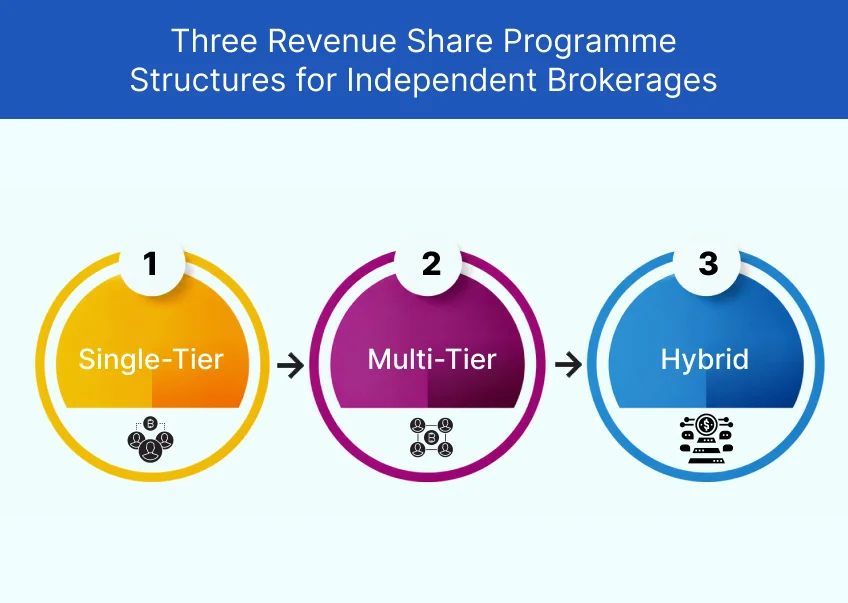
How it works: An agent earns revenue share only from agents they directly recruited — one level deep. No multi-tier network structure.
Typical rate: 3–5% of company dollar generated by the directly recruited agent, paid per transaction while the recruited agent is active.
Why it works for smaller brokerages: Simple to explain, simple to administer, and simple to model. Recruiting agents can see exactly what they earn without needing to understand a multi-tier network. Lower total payout as a percentage of company dollar — appropriate for brokerages where margin per agent is tighter.
Example: An agent recruits two agents. Each generates $10,000 per year in company dollar. Agent earns $500/year per recruited agent = $1,000/year in passive income. Brokerage nets $19,000 in new company dollar.
How it works: An agent earns revenue share from agents they directly recruited (Tier 1) and from agents those agents subsequently recruit (Tier 2, sometimes Tier 3). Each tier pays a smaller percentage.
Typical rates: Tier 1: 5% / Tier 2: 3% / Tier 3 (optional): 1–2%
Why it works for mid-size brokerages: Creates stronger retention incentives — agents with a growing Tier 2 network have compounding passive income that is much harder to walk away from than a single-tier payment. The recruiting conversation also becomes more compelling: agents can show recruits a clear pathway to meaningful passive income over time.
Administration note: Requires a tracking system to manage tier relationships and calculate payouts accurately per transaction. This is where a purpose-built platform adds significant operational value over manual spreadsheet-based tracking.
How it works: Combines multi-tier revenue share with production milestones that unlock higher tiers or bonus income. Agents who hit production thresholds get access to deeper tiers or higher percentages.
Why it works for larger or high-growth brokerages: Aligns passive income incentives with production performance — the agents earning the most from revenue share are also the brokerage’s highest producers. Creates a natural culture of peer accountability: agents want the agents around them to produce because it directly affects their own income.
Complexity note: The most powerful model but also the most complex to design and administer. It requires clear documentation of tier unlock rules and a reliable system for tracking both production milestones and network relationships.
Revenue Share Model Comparison: Single-Tier vs. Multi-Tier vs. Hybrid
| Model | Best For | Typical Rate | Admin Complexity | Comparable to |
|---|---|---|---|---|
| Single-Tier | Under 10 agents | 3–5%, one level | Low — spreadsheet-manageable | Simple referral bonus programmes |
| Multi-Tier | 10–150 agents | 5% / 3% / 1–2% across tiers | Medium — needs tracking software | eXp Realty's multi-tier model (broad structural similarity) |
| Hybrid | 150+ agents | Multi-tier + production milestones | High — needs dedicated platform | Structures resembling equity-tiered cloud brokerage programmes |
The 5 Most Common Revenue Share Objections — and the Honest Answers
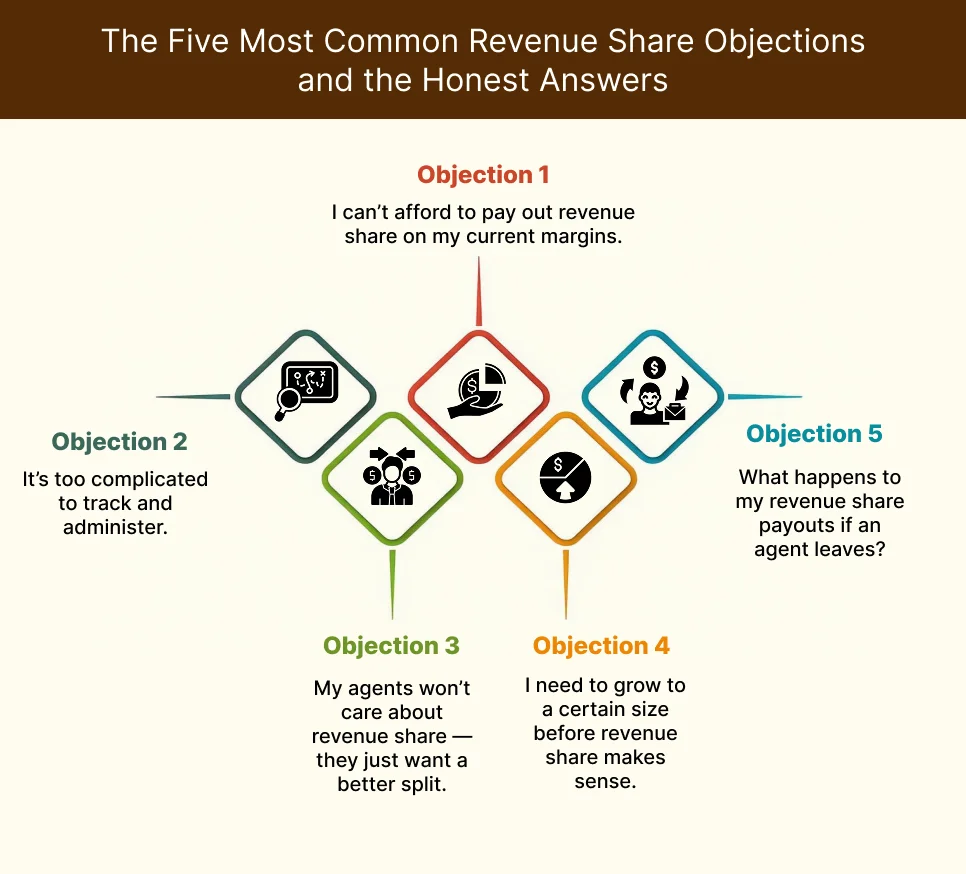
Objection 1: “I can’t afford to pay out revenue share on my current margins.”
This objection misunderstands the funding source. Revenue share is not paid from your existing company dollar or from the margins on your current roster. It is paid from company dollar generated by new agents who joined because of the programme. If no new agents join through the programme, there is no payout. If they do join and produce, the payout is a fraction of the new company dollar they generated. The brokerage is always net-positive on the transaction.
Objection 2: “It’s too complicated to track and administer.”
A single-tier programme for a 10-agent brokerage can be tracked in a spreadsheet and administered in under an hour per month. Complexity scales with programme complexity — if you start with Model 1 above, you are tracking one relationship per recruited agent and one payment per transaction. Brokerages that move to multi-tier programmes do need purpose-built tracking infrastructure, which is exactly what platforms like RightAlly are designed to provide.
Objection 3: “My agents won’t care about revenue share — they just want a better split.”
Your highest producers will care significantly. The agents who have already built a network, who already refer colleagues, who already operate as informal mentors — these agents will immediately see the financial value of formalising those relationships into a revenue share structure. The agents who exclusively want a better split are not the agents revenue share is designed for. Revenue share is a retention and recruiting tool for your productive core, not a universal benefit.
Objection 4: “I need to grow to a certain size before revenue share makes sense.”
The reverse is closer to the truth. Revenue share works best as a growth mechanism — it accelerates agent acquisition and retention from the moment you launch it. Brokerages that wait until they are large enough miss the compounding effect of starting early. A 25-agent brokerage that launches a revenue share programme this quarter will have a materially stronger retention and recruiting position in 24 months than a 25-agent brokerage that waits.
Objection 5: “What happens to my revenue share payouts if an agent leaves?”
In a well-structured programme, revenue share is contingent on the recruited agent’s continued production at your brokerage. If an agent leaves, the referring agent stops earning revenue share on that person’s production. This is not a flaw — it is the mechanism that makes revenue share a retention tool. Agents who have built meaningful revenue share income are highly motivated to keep the agents around them engaged and producing, because their own income depends on it.
Map Your Recruiting System With Our Team
Book a call to walk through your current recruiting pipeline, apply the Scorecard framework to your last 12 months of hires, and map what a structured recruiting system could look like for your specific brokerage model.
Book a CallIs Revenue Share Legal? Tax and Compliance Basics for Broker-Owners
Revenue share programmes are legal for independent brokerages in the large majority of U.S. states, but the specifics depend on your state's real estate license law and how you structure payments.
Licensing
Most states require that revenue share payments go only to actively licensed real estate agents, and that payments be tied to production (transactions), not simply to the act of recruiting itself. Paying an unlicensed person for referring clients or agents can trigger state-level restrictions in many jurisdictions.
Tax treatment
Revenue share income is typically reported as 1099 non-employee compensation, separate from the agent's transaction-based commission income. Consult your CPA to confirm treatment for your brokerage's specific structure and entity type.
Documentation
A written, agent-signed revenue share agreement — outlining eligibility, payout triggers, and what happens if an agent leaves — is standard practice and reduces both legal exposure and agent disputes.
This section is educational and general in nature. It is not legal or tax advice. Consult a real estate attorney and CPA licensed in your state before launching a revenue share programme.
Download the Complete Revenue Share Blueprint
Our 28-page Revenue Share Decision Guide walks through the full programme design, pricing frameworks, legal considerations, and launch sequence for independent brokerages — including worked examples at 30, 60, and 100 agent roster sizes.
How to Launch Your Revenue Share Programme This Quarter: 4 Steps
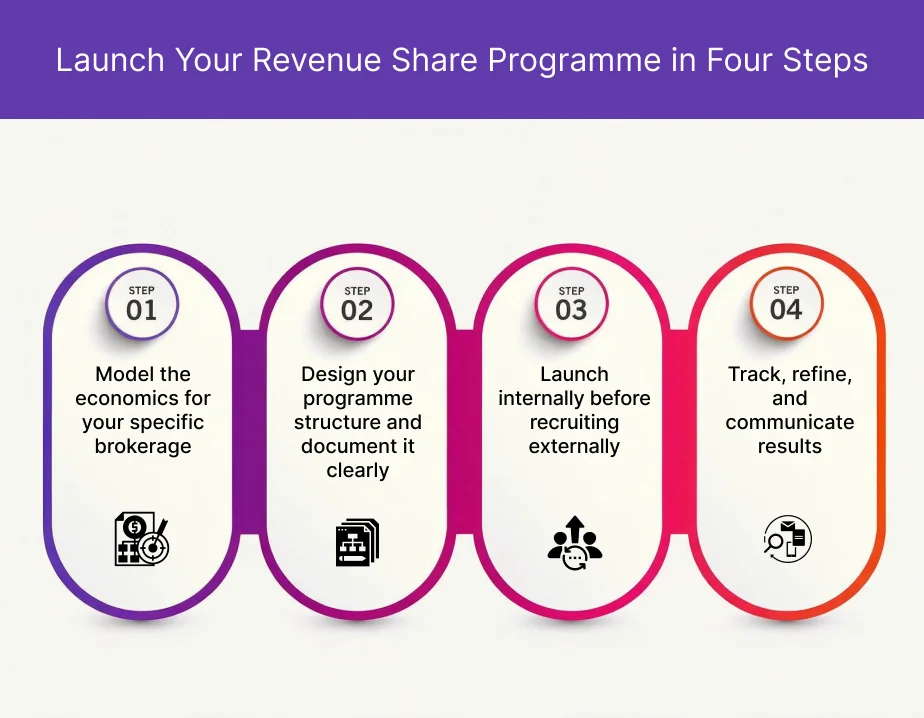
Step 1: Model the economics for your specific brokerage
Before designing a programme, run the numbers on your current company dollar per agent, your agent count, and your realistic recruitment targets for the next 12 months. The revenue share payout percentage should be set at a level that is meaningful to agents but sustainable relative to your projected company dollar growth. Start with the Revenue Share ROI Calculator to build a Year 1, Year 2, and Year 3 projection before committing to a specific structure.
Step 2: Design your programme structure and document it clearly
Choose your model (single-tier, multi-tier, or hybrid), define the payout percentages, set the eligibility rules (who qualifies to earn, what triggers a payout, what happens when an agent leaves, whether a vesting period applies), confirm the structure against your state's license law, and document everything in plain language in a signed agreement. The documentation does three jobs: it protects you legally, it gives agents confidence the programme is real and trackable, and it becomes your recruiting pitch. A one-page programme summary that an agent can read in three minutes is worth more than a 20-page policy document they will never open.
Step 3: Launch internally before recruiting externally
Before using revenue share as a recruiting message to outside agents, present it to your existing roster first. Your current agents are your most credible recruiters — when they understand the programme and see the income potential, they become its most effective advocates. A soft internal launch also lets you identify and fix any structural issues in the programme before it goes external. Give your current roster 30 days to ask questions, run scenarios, and start recruiting before you announce the programme publicly.
Step 4: Track, refine, and communicate results
Revenue share programmes compound. The agents who earn meaningful income in Year 1 become your most motivated recruiters in Year 2. Track the programme metrics quarterly: how many agents are actively recruiting, what is the average revenue share income per participating agent, what percentage of new agent joins are revenue share-referred, and how does the retention rate of revenue share agents compare to non-revenue share agents. Communicate these results back to your roster — real numbers from real agents at your brokerage are the most powerful recruiting tool the programme generates.
Map Your Revenue Share Programme With Our Team
Book a call to walk through your brokerage’s specific economics, design your programme structure, and map the launch sequence for your roster size and market.
Book a CallThe Independent Brokerage Revenue Share Advantage
Cloud brokerages built their growth models on revenue share because it works. It retains agents, it turns your best producers into recruiters, and it creates compounding passive income that makes the brokerage increasingly sticky over time. Those are not benefits exclusive to any particular brokerage model. They are the inherent properties of a well-designed revenue share programme — and they are available to every independent brokerage willing to build the structure.
The independent brokerage advantage is that you get to implement revenue share on your own terms. Your brand stays yours. Your culture stays yours. Your agent relationships stay yours. You build the programme around your specific roster, your specific market, and your specific growth goals — not around the standardised structure of a platform you do not control.
The brokerages that will win the next decade of this market are not necessarily the ones with the biggest brands or the largest agent counts. They are the ones that give agents a compelling reason to stay — financially, culturally, and professionally. Revenue share is the most powerful mechanism available for doing all three simultaneously. The question is not whether you can afford to offer it. The question is whether you can afford not to.
Frequently Asked Questions About Independent Brokerage Revenue Share
Yes, in most U.S. states, provided payments go to licensed agents and are tied to production. Requirements vary by state — confirm with your state real estate commission or a real estate attorney before launch.
Most independent single-tier programmes pay 3–5% of company dollar per transaction to the referring agent. Multi-tier programmes typically pay 5% at Tier 1, 3% at Tier 2, and 1–2% at Tier 3.
Yes — it's typically reported as 1099 non-employee compensation, separate from commission income. Confirm treatment with your CPA.
Commission cap is the production threshold after which an agent keeps 100% of their own commission. Revenue share is a separate, recurring payment based on the production of agents they recruited — the two are often used together but are not the same mechanism.
Yes. Revenue share is a compensation structure, not a proprietary feature of any specific brokerage brand — any independent brokerage with company dollar to distribute can design and launch its own programme.
A referral fee is typically a one-time payment for a single introduction. Revenue share is recurring and tied to the recruited agent's ongoing production for as long as they remain active and affiliated with the brokerage.
Small single-tier programmes can be tracked manually in a spreadsheet. Multi-tier and hybrid programmes typically require dedicated brokerage back-office or agent recruiting CRM software to calculate tiered payouts accurately.
In most states, yes — payments are generally restricted to actively licensed real estate agents and tied to production, not simply to the act of introducing someone.
Share this blog


Popular topics
Efficiency
Growth
Compliance
Technology
Agents
Trends




 +1 (765) 896-5271