


 Home
Home Blog
Blog
Table of Content
- Introduction
- What Profit Share Is — A Brief Explanation
- The Critical Structural Difference: Gross vs Net
- Revenue Share vs Profit Share: The Broker-Owner Comparison
- When Profit Share Is the Right Choice
- When Revenue Share Is the Right Choice
- The Implementation Reality: What Each Model Actually Requires
- You’ve Chosen Your Model, What Comes Next?
- Frequently Asked Questions About Real Estate Team Infrastructure
Key Takeaways
- Revenue share rewards agents based on brokerage revenue, while profit share depends on profitability. This fundamental difference affects how predictable and attractive each model is to agents.
- Revenue share can provide a clearer earning proposition for agents. Agents can understand what they may earn from the revenue generated by the agents they recruit without having to depend on the brokerage's overall profitability.
- Profit share creates stronger alignment with company performance. Because payouts are tied to net profits, agents have a greater connection to the brokerage's overall financial success.
- The right model depends on your brokerage's financial maturity. A growing brokerage may find revenue share easier to communicate and implement, while an established, consistently profitable brokerage may benefit from a profit-sharing structure.
- Choose the model that supports your recruiting strategy and economics. The goal is not simply to offer an attractive incentive, but to create a sustainable model that benefits agents without putting unnecessary pressure on brokerage margins.
Profit share pays agents a percentage of net profit after overhead — paid only when the brokerage is profitable.
For independent brokerages under ~100 agents or still building margin, revenue share is typically the more reliable and easier-to-administer model.
Two incentive models dominate every serious conversation about brokerage growth: revenue share and profit share. Most of the content comparing them is written for agents deciding which brokerage to join. This article is written for broker-owners deciding which model to build.
The distinction matters. An agent evaluating revenue share is asking: “How much passive income could I earn here?” A broker-owner evaluating the same model is asking: “What does this cost my brokerage, how do I structure it, how do I administer it, and what does it actually do for recruiting and retention?” Those are different questions, and they require different answers.
Both models give agents a form of passive income tied to brokerage growth. Both create incentives for agents to recruit and refer. Both can improve retention meaningfully when implemented well. The difference is where in the brokerage’s revenue cycle the payout is calculated — and for an independent broker-owner making a programme decision, that difference is more consequential than most realise.
This article walks through both models fairly, explains the structural difference that matters most for independent brokerages, and gives you a clear verdict rather than a “depends on your situation” non-answer.
| Model | Calculated From | Paid When | Predictability |
|---|---|---|---|
| Revenue Share | Gross company dollar (before expenses) | Every transaction closed by a recruit, regardless of profitability | High |
| Profit Share | Net profit (after all overhead) | Only in profitable periods, typically quarterly/annually | Low |
The Critical Structural Difference: Gross vs Net
This is the most important section of this article for any broker-owner making a programme decision. The difference between revenue share and profit share is not just philosophical — it is mathematical, and the mathematics have direct operational consequences.
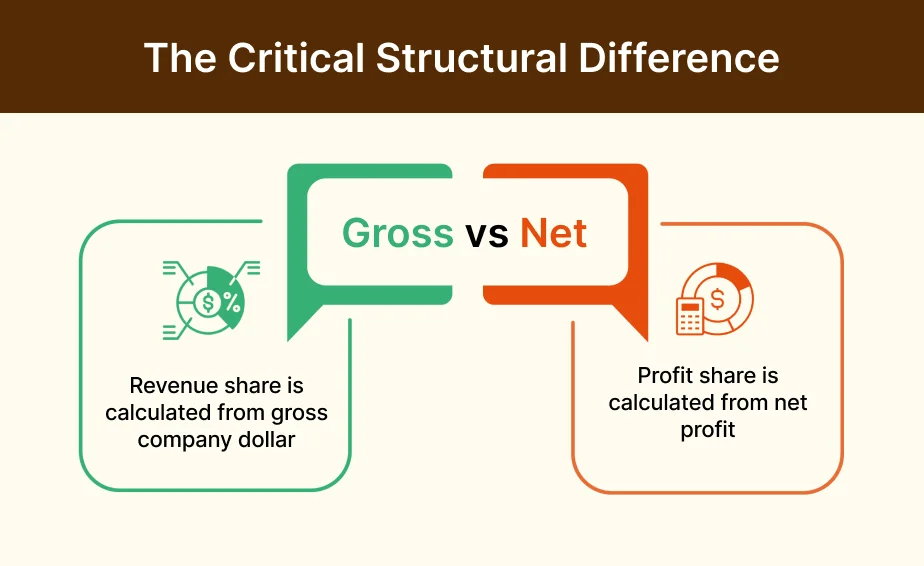
- Revenue share is a brokerage compensation model that pays a percentage of gross company dollar — the brokerage's retained revenue before operating expenses are deducted — to agents on every transaction closed by agents they recruited. Every time an agent in the programme closes a transaction, a defined percentage of the company dollar from that transaction goes to the referring agent. The calculation is transparent, per-transaction, and completely independent of whether the brokerage is profitable in any given period.
- Profit share is calculated from net profit — what remains after the brokerage pays all of its operating expenses at the market centre level. This means the profit share pool grows when the brokerage is profitable and shrinks — or disappears entirely — when it is not.
Overhead spending in a given quarter directly reduces the profit share pool, even when agent production stays flat, because profit share is calculated after expenses rather than before. The practical consequence of this structure is significant: a broker-owner who hires a new staff member, signs an office lease, or invests in marketing directly shrinks the pool, even if agents maintain their exact production levels from the prior quarter. Consequently, from an agent's perspective, passive income can decrease solely due to overhead decisions they neither participated in making nor had visibility into.
For a revenue share programme, none of this applies. An agent earns on every transaction their recruited agents close, regardless of what the brokerage spent that month. The payout is predictable, calculable, and immune to brokerage overhead decisions.
Revenue Share vs Profit Share: A Worked Example
| Scenario | Revenue Share Payout | Profit Share Payout |
|---|---|---|
| Gross company dollar: $500,000 / Net profit: $80,000 (after overhead) | 20% of $500,000 = $100,000 paid to referring agents | 20% of $80,000 = $16,000 paid to eligible agents |
| Brokerage adds $30,000 in new overhead this quarter | No change — still $100,000 | Pool shrinks to $10,000 (20% of new $50,000 net profit) |
Revenue Share vs Profit Share: The Broker-Owner Comparison
The table below compares both models across the dimensions that matter most to an independent broker-owner making a programme decision — not to an agent choosing a brokerage.
| Dimension | Revenue Share | Profit Share |
|---|---|---|
| Calculation base | Gross company dollar — before any brokerage operating expenses | Net brokerage profit — after all overhead and operating costs are deducted |
| Agent predictability | High — agents calculate exactly what they earn per transaction their recruits close | Low — payout depends on brokerage profitability; variable and difficult to forecast |
| Payout in a slow or unprofitable year | Yes — funded from gross revenue regardless of brokerage margin | No — if the brokerage doesn't profit, agents earn nothing even if they produced well |
| Sensitivity to brokerage overhead decisions | None — payout is unaffected by staffing, lease, or marketing decisions | High — any increase in overhead directly reduces the profit share pool |
| Recruiting argument strength | Strong — “you earn X% per transaction your recruits close” is concrete and modelable | Moderate — “you share in our profits” is less concrete and harder for agents to value |
| Implementation complexity | Lower — per-transaction calculation, straightforward tracking, no P&L transparency required | Higher — requires accurate P&L by market centre, periodic reconciliation, overhead transparency |
| Best-fit brokerage stage | Any stage — self-funding from new production; works from Day 1 even with thin margins | Established — needs consistent profitability to deliver meaningful agent income |
| Agent retention incentive | Strong — agents with revenue share income have direct financial reason to stay | Strong — agents invested in brokerage profitability also have reason to stay |
Model Your Revenue Share Programme Economics
See what revenue share generates for your specific brokerage — Year 1, Year 2, and Year 3 projections based on your agent count and production numbers. Takes about 3 minutes.
Run Your NumbersWhen Profit Share Is the Right Choice
Profit share is not wrong. It is the right model in specific circumstances, and dismissing it entirely would give broker-owners an inaccurate picture of the landscape. Here are three situations where profit share is genuinely the stronger choice.

Established brokerages with consistent, predictable profitability
Profit share works when the payout pool is reliable year over year. A brokerage that has operated profitably for five or more consecutive years, with stable overhead and predictable production, can offer agents a profit share programme that delivers meaningful income consistently. The value proposition holds because agents can actually count on receiving it. For brokerages still scaling their margin, the pool is too variable to be credible as a retention tool.
Brokerages where the broker-owner wants agents invested in overhead discipline
Profit share creates a direct incentive for agents to care about brokerage efficiency. When agents know their passive income shrinks if the brokerage overspends, they become vocal about operational decisions in ways they never would under a revenue share model. Some broker-owners find this creates a healthier ownership culture. Others find it creates conflict. Know which outcome you are looking for before choosing the model.
Culture-first brokerages with deep financial transparency
Profit share requires the broker-owner to share financial performance data with the agent base — at minimum the profitability figure that determines the pool. At brokerages where financial transparency is already part of the culture, this is not a barrier. At brokerages where the broker-owner prefers to keep financial details private, profit share creates an uncomfortable obligation or erodes agent trust when payouts are lower than expected and the reasons are not clear.
When Revenue Share Is the Right Choice
Revenue share is the right model for the majority of independent brokerages — and specifically for brokerages that are still growing, still building margin, and need a recruiting tool that works before profitability is fully established. Here is why.
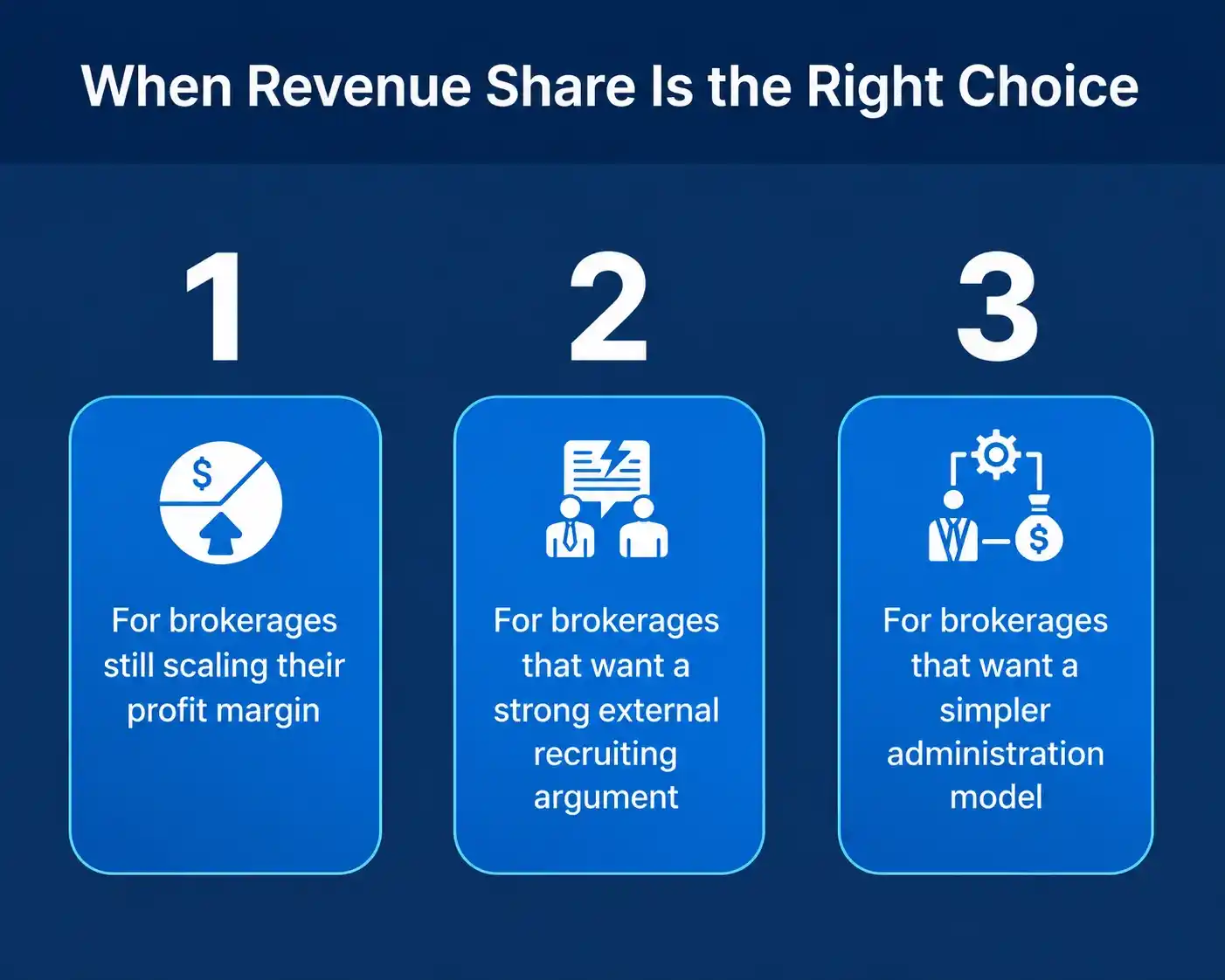
For brokerages still scaling their profit margin
A brokerage that is investing in growth — adding staff, expanding technology infrastructure, building a recruiting function — may not be consistently profitable in Years 1 to 3 of that growth phase. Under a profit share model, agents would earn nothing during this period even if they produced well and recruited actively. Under a revenue share model, they earn on every transaction their recruits close, regardless of what the brokerage is spending on its own growth. Revenue share does not penalise agents for the broker-owner’s investment decisions.
For brokerages that want a strong external recruiting argument
When recruiting an agent from another brokerage, the revenue share value proposition is significantly easier to communicate. You can say: “Every agent you bring to this brokerage generates X percent of their company dollar back to you, on every transaction, for as long as they are here.” That is a specific, modelable number the agent can calculate against their own recruiting network. The profit share equivalent — “you share in our profits, which depend on how the brokerage performs” — is harder to quantify and therefore harder to act on.
For brokerages that want a simpler administration model
Revenue share administration requires: a tracking system for agent referral relationships, a per-transaction payout calculation, and a clear payment schedule. Profit share administration requires: accurate P&L reporting by market centre or brokerage unit, a reconciliation process at the end of each profit period, and a defensible methodology for allocating overhead. For a broker-owner without a full accounting infrastructure, the revenue share administration load is meaningfully lower.
The Verdict for Most Independent Brokerages
Revenue share is the right starting model for most independent brokerages — particularly those with fewer than 100 agents, those still building their profit margin, and those where the broker-owner wants a strong external recruiting argument without exposing internal financial performance.
Profit share becomes the stronger model at established brokerages with consistent multi-year profitability, where the broker-owner is comfortable with financial transparency and wants to build a deep ownership culture among the agent base.
The structural difference — gross versus net — is the deciding factor. If your brokerage’s profitability is still variable, revenue share is more reliable for agents, more implementable for you, and more effective as a recruiting tool.
The Implementation Reality: What Each Model Actually Requires
The comparison table covers the strategic differences. The implementation reality is equally important for a broker-owner deciding which model to build.
Revenue share implementation requires three things:
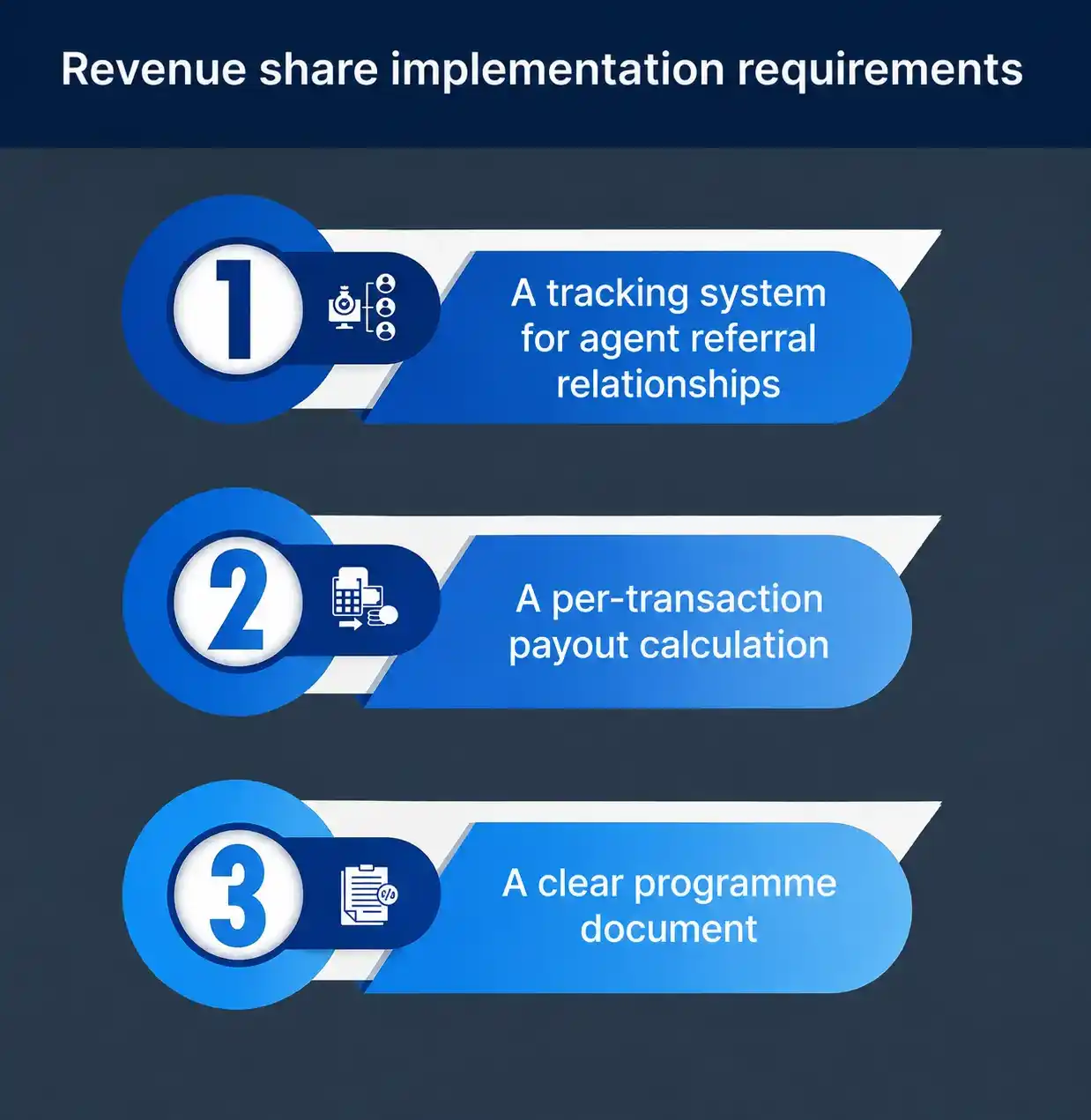
- A tracking system for agent referral relationships — who referred whom, when, and under what tier structure. This can start as a spreadsheet for a single-tier programme at a 30-agent brokerage and graduate to a purpose-built platform as the programme scales.
- A per-transaction payout calculation — applied each time a recruited agent closes a transaction, based on the defined percentage of company dollar. Straightforward and auditable.
- A clear programme document — a one-page summary an agent can read in three minutes that explains the eligibility rules, the payout percentages, and the off-boarding conditions. This is also your recruiting pitch.
Profit share implementation requires:
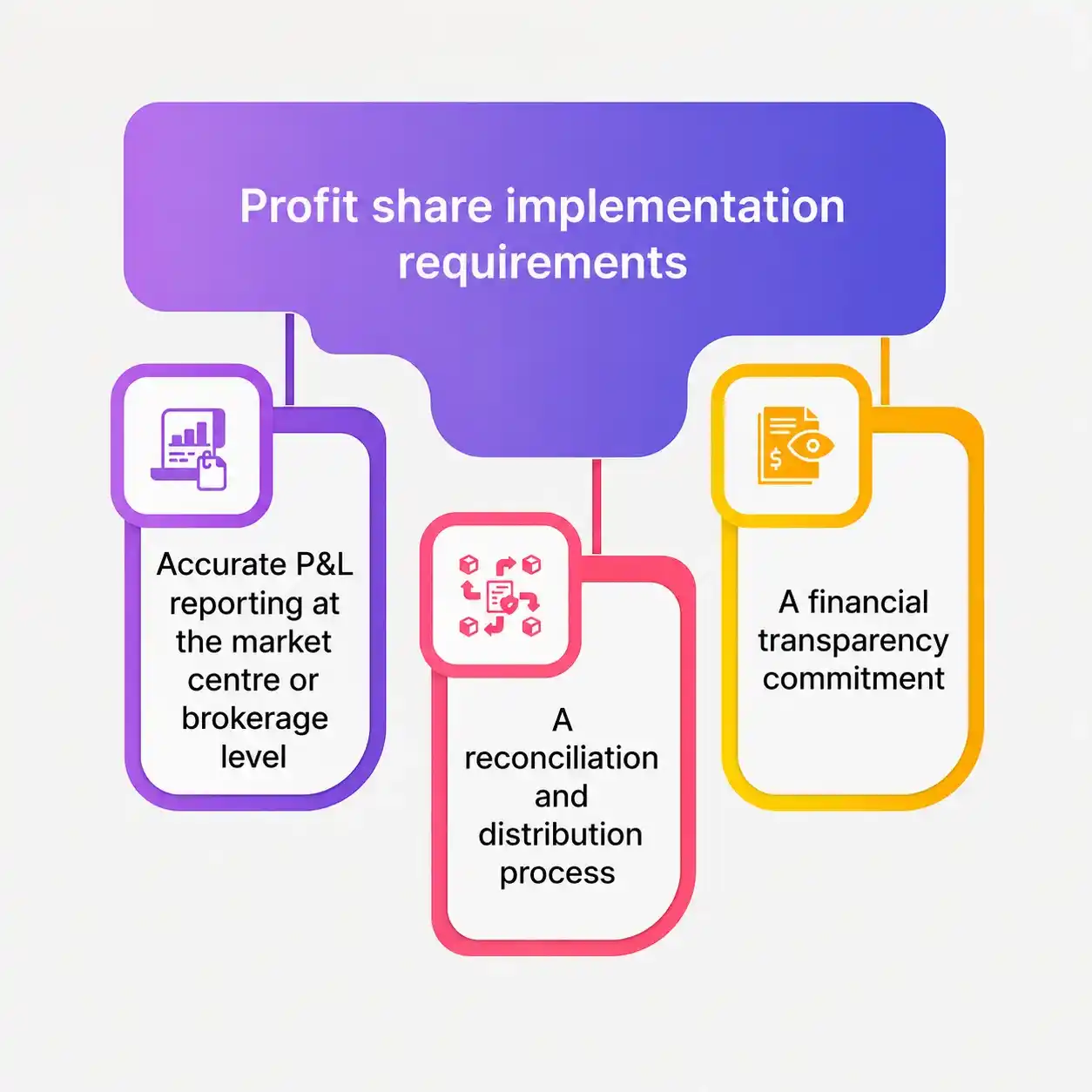
- Accurate P&L reporting at the market centre or brokerage level — the profit share pool cannot be calculated without knowing the net profit figure, which requires reliable, period-end financial reporting.
- A reconciliation and distribution process — typically quarterly or annual, with a methodology for allocating the pool among eligible agents based on production and tenure tiers.
- A financial transparency commitment — agents will want to understand why their payout was higher or lower than expected. This requires either sharing profitability data or providing a clear explanation of the factors that affected the pool.
Neither model is prohibitively complex to run. But for a broker-owner who does not yet have robust financial reporting infrastructure, revenue share is the more accessible starting point.
Download the Revenue Share Blueprint
The complete 28-page guide to designing, pricing, and launching a revenue share programme at your independent brokerage — including programme structures, economics modelling, and legal considerations.
You’ve Chosen Your Model, What Comes Next?
If this comparison has confirmed that revenue share is the right model for your brokerage, the next question is practical: what does it actually cost, and what does the Year 1 economics model look like for a brokerage at your size?
The short answer: a properly structured revenue share programme is funded from new company dollar generated by agents who joined because of the programme. The payout grows as the programme works. The net brokerage gain grows faster. But the detailed maths — including the worked examples at 30, 60, and 100 agents — is what we cover in Part 3 of this series.
If profit share is the model that fits your brokerage’s stage and culture, the implementation framework is different but equally manageable. The key is starting with a clear profitability baseline and a transparent communication commitment to your agent base before you launch.
Map Your Programme Structure With Our Team
Book a call to choose your model, design your structure, and map the economics for your specific brokerage — agent count, production profile, and growth targets included.
Book a CallFrequently Asked Questions
Revenue share pays out from gross company dollar before expenses; profit share pays out from net profit after expenses. Revenue share is predictable and unaffected by brokerage overhead; profit share fluctuates with profitability.
Yes. Revenue share payments are generally reported as 1099 non-employee compensation in the U.S. and are taxable as ordinary income to the receiving agent.
Yes. Some brokerages run a hybrid model, offering revenue share for recruiting incentives alongside a smaller profit share pool for tenured, high-producing agents.
Revenue share structures must comply with state real estate license law and RESPA, which generally prohibit paying transaction-based compensation to unlicensed individuals. Requirements vary by state — confirm with your state real estate commission or broker-compliance counsel before launching.
Share this blog


Popular topics
Efficiency
Growth
Compliance
Technology
Agents
Trends




 +1 (765) 896-5271