


 Home
Home Blog
Blog
Table of Content
- Introduction
- What the Numbers Actually Say About Brokerage Profitability Right Now
- The 3 Hidden Leaks Draining Your Brokerage Margin Right Now
- Revenue Share Isn't a Cost. It's a Self-Funding Profitability System
- What Brokerages Using Revenue Share Are Seeing
- Your 60-Day Plan to Close the Profitability Gap
- The 1.68% Problem Has a Structural Solution
- Frequently Asked Questions
Median brokerage EBITDA margin in 2025 — up from 1.35%, but far below 4.31% in 2021
In annual transaction volume that migrated between brokerages in 2025 — driven by agent movement
Net volume gain by top-100 brands after recruiting $276B but losing $233B — a 1.8% net return
The median real estate brokerage EBITDA margin in 2025 was 1.68% of income. Not revenue — income. On a brokerage generating $2 million in annual commissions after agent payouts, that's $33,600 in operating earnings before the owner takes a salary, services debt, or accounts for depreciation and taxes.
Inman described what's happening inside brokerages right now as a quiet financial crisis. It's quiet because the brokerages still look healthy from the outside. They're recruiting. They're listing homes. Their agent counts look stable. But the margin is gone — eroded by three structural problems that most broker-owners haven't named yet.
This article names them. Then shows how revenue share — not cost-cutting, higher split caps, or additional technology platforms — closes all three simultaneously.
Key Takeaways
- Brokerage profits are thinner than they appear, making long-term growth difficult without structural changes.
- Agent churn, recruiting costs, and technology inefficiencies are the three hidden leaks quietly reducing profitability.
- Revenue share turns agents into growth partners, encouraging recruitment, retention, and engagement.
- A well-designed revenue share model creates compounding growth, helping brokerages scale more sustainably while improving profitability.
1. What the Numbers Actually Say About Brokerage Profitability Right Now
AccountTECH's February 2026 benchmark study analysed the full-year financial results of 157 brokerages — ranging from 50 - 6,500 agents, across traditional legacy brands and independent firms. The headline: median EBITDA margins improved to 1.68% of income in 2025, up from 1.35% in 2024. About 70% of brokerages were profitable in 2025, up from 61% the year before.
That sounds like progress. It is — but the context matters enormously.
That was the median brokerage EBITDA margin in 2021. The industry has spent four years cutting costs and discipline-building to arrive at 1.68% in 2025 — still less than half the margin that existed before the rate cycle hit. The improvement is real. The position is still fragile.
AccountTECH described 2025 as the year of the "efficiency wedge" — a period in which brokerages became profitable again not by growing revenue but by aggressively cutting costs. Traditional drivers of profit growth — higher transaction volume, increasing agent count — were largely absent. Sales volume was flat. Agent counts declined at many firms. The cost of sales (commissions paid to agents) actually rose for the first time in years, putting pressure on gross profit.
The brokerages that survived did so by sharpening their cost structures. They will not be able to cut their way to 4% margins. The efficiency wedge has a ceiling. The next phase of brokerage profitability requires structural solutions — not further compression.
"The brokerages that win over the next cycle will measure net recruited profit per agent, not just recruited volume. The scoreboard is shifting from who recruits the most to who converts recruiting into compounding EBITDA."
— Sean Soderstrom, Co-Founder & CEO, Courted (HousingWire, March 2026)
Do You Know What These Leaks Are Costing Your Brokerage?
The Brokerage Profitability Calculator calculates your annual recruiting cost, agent churn cost, and technology ROI gap in under 3 minutes. See your total hidden profitability leak — before we show you how to close it.
Calculate Your Profitability Gap →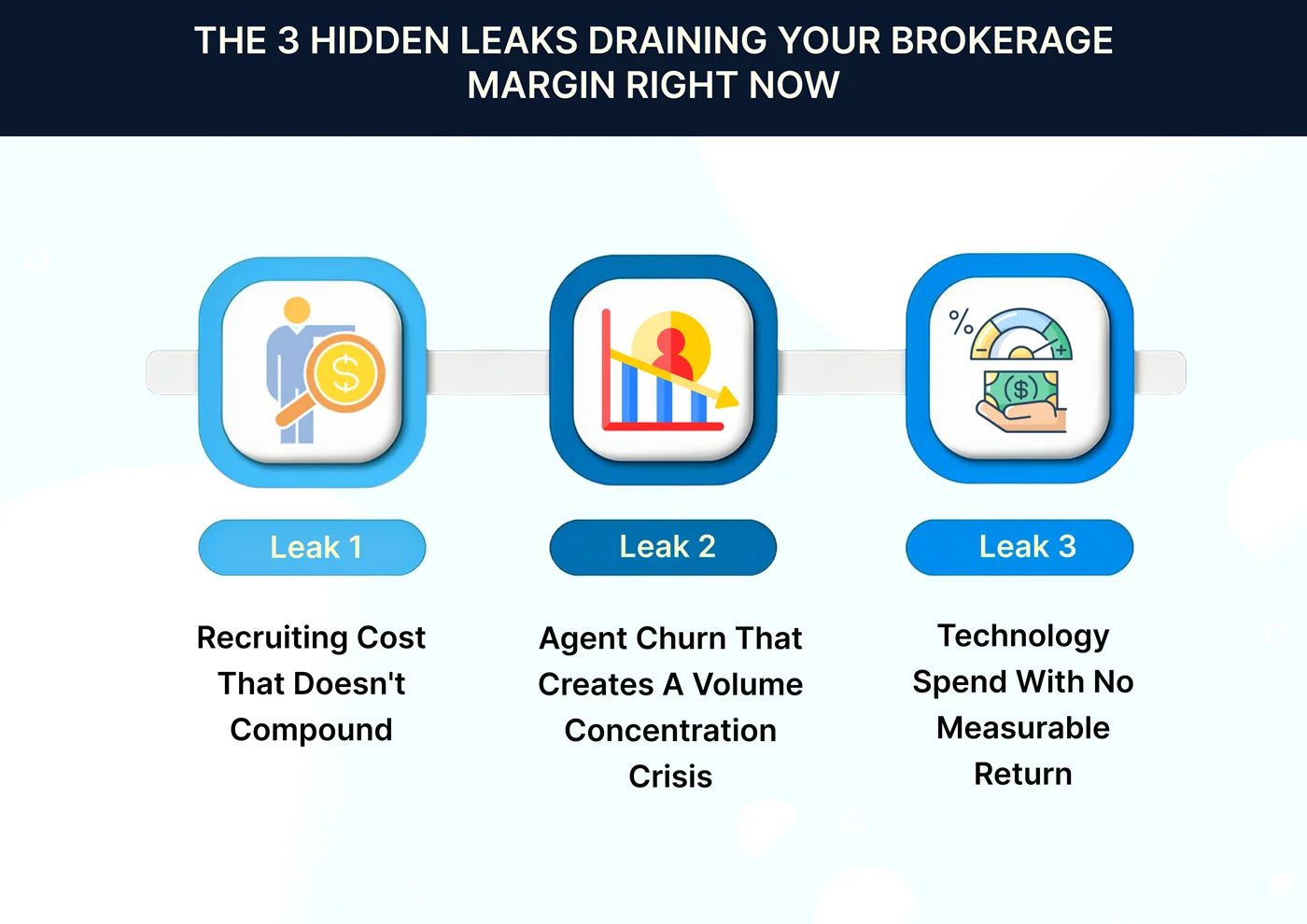
5. Your 60-Day Plan to Close the Profitability Gap
The most common reason broker-owners don't act on this isn't scepticism about the model. It's uncertainty about where to begin. The plan is more straightforward than most expect.
| Phase | Timeline | Actions | Output |
|---|---|---|---|
| Audit | Days 1–14 | Run your profitability numbers. Calculate annual recruiting cost (agents hired × estimated cost per hire). Calculate churn cost (agents lost × average annual GCI contribution × your split). Estimate technology spend against measurable productivity gains. This is your baseline — the number you're solving for. | Your total annual profitability leak in dollars. This becomes the opening line of every conversation with your agents about the programme. |
| Design | Days 15–30 | Decide on your tier structure. How many tiers (typically five)? What percentage of GCI goes to each tier? How do tiers unlock — by recruit count, by production, or both? Design rule: keep it simple enough that any agent can explain it to a recruit in 60 seconds. Excessive complexity kills adoption. | A one-page revenue share programme summary your agents can share during recruiting conversations — before the formal launch. |
| Launch | Days 31–60 | Communicate to existing agents first. They become your first earners and first advocates. Update all recruiting materials. Train agents on how to present the programme to recruits. Track three metrics: recruiting conversations started, new joins who cited the programme, and passive income distributed in Month 1. | A live revenue share programme with agents already earning. A transformed recruiting story. A measurable baseline for Month 2 tracking. |
One operational note that matters: tracking revenue share payments manually across five tiers and 100+ agents is not sustainable. Calculation errors create agent distrust. Manual reconciliation consumes management time. Purpose-built infrastructure handles every payout automatically — every agent sees their earnings in real time, every tier is tracked across every transaction, and the broker-owner has a single dashboard view of programme performance without touching a spreadsheet.
Ready to Close the Gap?
See How Revenue Share Fixes the Profitability Problem for Your Brokerage Specifically. Book a 20-minute call. We'll show you the numbers for your brokerage — your agent count, your GCI, your split — and map out exactly what a branded revenue share programme does to your margin, your recruiting pipeline, and your agent retention.
6. The 1.68% Problem Has a Structural Solution
Cost-cutting built the efficiency wedge. It moved the median EBITDA margin from 1.35% to 1.68%. That's real progress — and it's largely exhausted. The brokerages that break through to 3%, 4%, and 5% margins in the next cycle won't do it by cutting further. They'll do it by building a financial model that compounds.
Revenue share is a structural solution — not a marketing tactic, not a retention perk, not another software subscription. It's the mechanism that turns every satisfied agent into a recruiter, every recruit into a retention anchor, and every transaction into a network-building event. It closes the recruiting leak, the churn leak, and the technology leak simultaneously because it addresses the root cause of all three: the absence of a financial reason for agents to build their future inside your brokerage.
The margin you recover by building that reason is not a cost. It's a return on the one investment that compounds indefinitely.
Frequently Asked Questions
The median real estate brokerage EBITDA margin in 2025 was just 1.68% of income, according to AccountTECH's study of 157 brokerages. Three structural issues drain brokerage margins: high recurring recruiting costs that don't compound, agent churn that destroys volume faster than recruiting rebuilds it, and technology investment that produces adoption without measurable return. These three leaks together prevent most brokerages from building on their growth.
The median brokerage EBITDA margin was 1.68% of income in 2025, up from 1.35% in 2024, according to AccountTECH's benchmark research of 157 brokerages. This compares to a peak of 4.31% in 2021. About 70% of brokerages were profitable in 2025, up from 61% the prior year. Improvement came largely from cost-cutting rather than revenue growth — a strategy that has a ceiling.
Agent churn is one of the most costly profitability leaks in any brokerage. According to Recruiting Insight's February 2026 report, $15.7 billion in annual transaction volume migrated between brokerages in 2025. The top 10% of agents who moved controlled roughly 45% of that volume. For brokerages where 40–60% of total production is tied to a small cohort of agents, a single departure can trigger a volume concentration crisis.
Yes — when structured correctly, revenue share functions as a self-funding profitability system. Passive income agents earn on their recruits' transactions creates a compounding financial reason to stay and recruit. Referral hires stay 70% longer than externally recruited agents. A revenue share programme driving just 10% agent count growth from recruits who wouldn't have joined otherwise typically covers its full cost within the first year, then compounds from there.
The brokerages improving margins without cutting splits are building financial retention systems that reduce churn, creating internal recruiting networks through revenue share programmes, and replacing fragmented technology stacks with integrated platforms that produce measurable outcomes. Revenue share is the structural mechanism that enables all three simultaneously — it reduces recruiting cost, reduces churn, and consolidates technology spend into one system with a single measurable ROI.
Share this blog


Popular topics
Efficiency
Growth
Compliance
Technology
Agents
Trends




 +1 (765) 896-5271