


 Home
Home Blog
Blog
Table of Content
- Introduction
- The Signal: What the Agent Market Is Actually Doing in 2026
- Part 1: Why Top Producers Are Leaving
- Part 2: What These Agents Actually Want — And Why Independent Brokerages Are Already Most of the Answer
- Part 3: How Revenue Share Makes the Independent Brokerage Value Proposition Complete
- How to Position Your Brokerage for This Moment — Four Steps
- The Window Is Open. Here Is What It Takes to Walk Through It
- Frequently Asked Questions About Real Estate Team Infrastructure
Key Takeaways
- Top agents are leaving mega-brokerages because they feel overlooked.
- Agents increasingly value stability and support over simply getting a better commission split.
- Independent brokerages already have most of what top agents want.
- Revenue share can complete the independent brokerage value proposition.
- Brokerages need a clearly structured and easy-to-understand revenue share program.
Something has shifted in the agent market in 2026 that most independent broker-owners haven't fully registered yet — and it is one of the biggest opportunities the independent brokerage model has seen in years.
The conversation I keep having with independent broker-owners goes like this: they are worried about losing agents to large national platforms. They are spending money and time competing for new recruits. They are watching their best agents get approached by cloud brokerage recruiters with revenue share pitches and succession plan narratives.
What most of them don't know is that the reverse is also happening — quietly, steadily, and with increasing momentum. Top-producing agents are leaving mega-brokerages. Not for other mega-brokerages. For smaller, independent firms. And when you talk to those agents about why, the answer almost never starts with the split.
The window for independent brokerages to capture this movement is open right now. The question is whether they have the value proposition to walk through it.
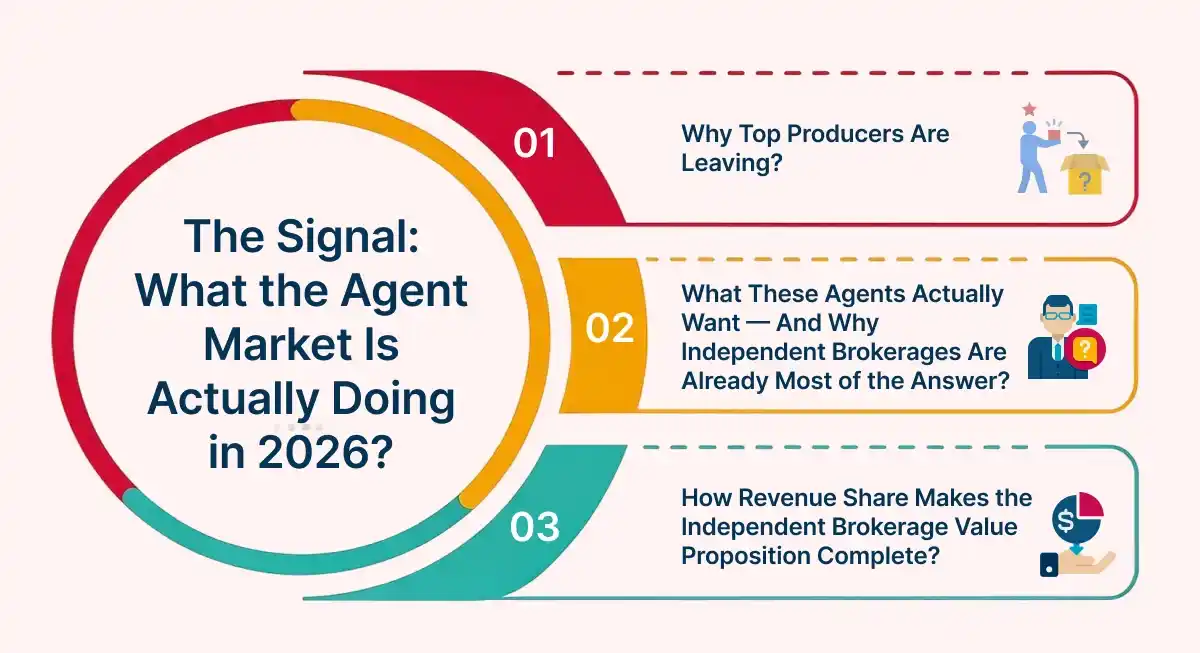
The Signal: What the Agent Market Is Actually Doing in 2026
Agent Movement — August 2026
The 2026 data from brokerage recruiting research confirms what is visible on the ground: agents are moving. Agent mobility accelerated sharply in Q1 2026, with external moves up 25 percent quarter over quarter. Roughly 50,000 brokerage changes are projected nationally for the year.
But the detail that matters most for independent broker-owners is not the volume of movement. It is the direction. Top producers — the agents who have spent years building books of business, client relationships, and local reputations — are not moving to other mega-brokerages. They are moving to smaller independent firms and immediately reporting better experiences.
They are finding personalized support. Real leadership they can reach. Transparent fees and clear economics. Cultures built for growth rather than for scale. Everything the mega-brokerage model struggles to deliver at 20,000 or 30,000 agents.
The agents who are leaving the industry entirely in 2026 — and that number is significant — are not the same agents who are leaving mega-brokerages for independent firms. The agents leaving mega-brokerages for independent firms are the productive professionals. The ones who built real businesses. The ones worth recruiting.
Part 1: Why Top Producers Are Leaving
Understanding why these agents are leaving matters more than simply knowing that they are leaving. Because the reasons reveal exactly where independent brokerages are positioned to win — and what they need to have in place to close the conversation.
| Reason for Leaving | What's Driving It | What the Agent Is Really Asking |
|---|---|---|
| Feeling invisible at scale | Tens of thousands of agents means production is a line in a report, not a relationship with the broker | "Does anyone here actually know my name?" |
| Mergers and consolidation | Culture and leadership shift after acquisitions; 38% YoY rise in internal transfers as agents search for a better fit | "Is this still the brokerage I originally joined?" |
| Need for clarity and stability | Agents are optimizing for a business environment that feels responsive, not for a marginally better split | "Will I be supported here, and does this place have a real future?" |
| Desire for a financial stake | Agents who've had revenue share or stock elsewhere know the difference between contractor and partner | "Am I building equity here, or just collecting a paycheck?" |
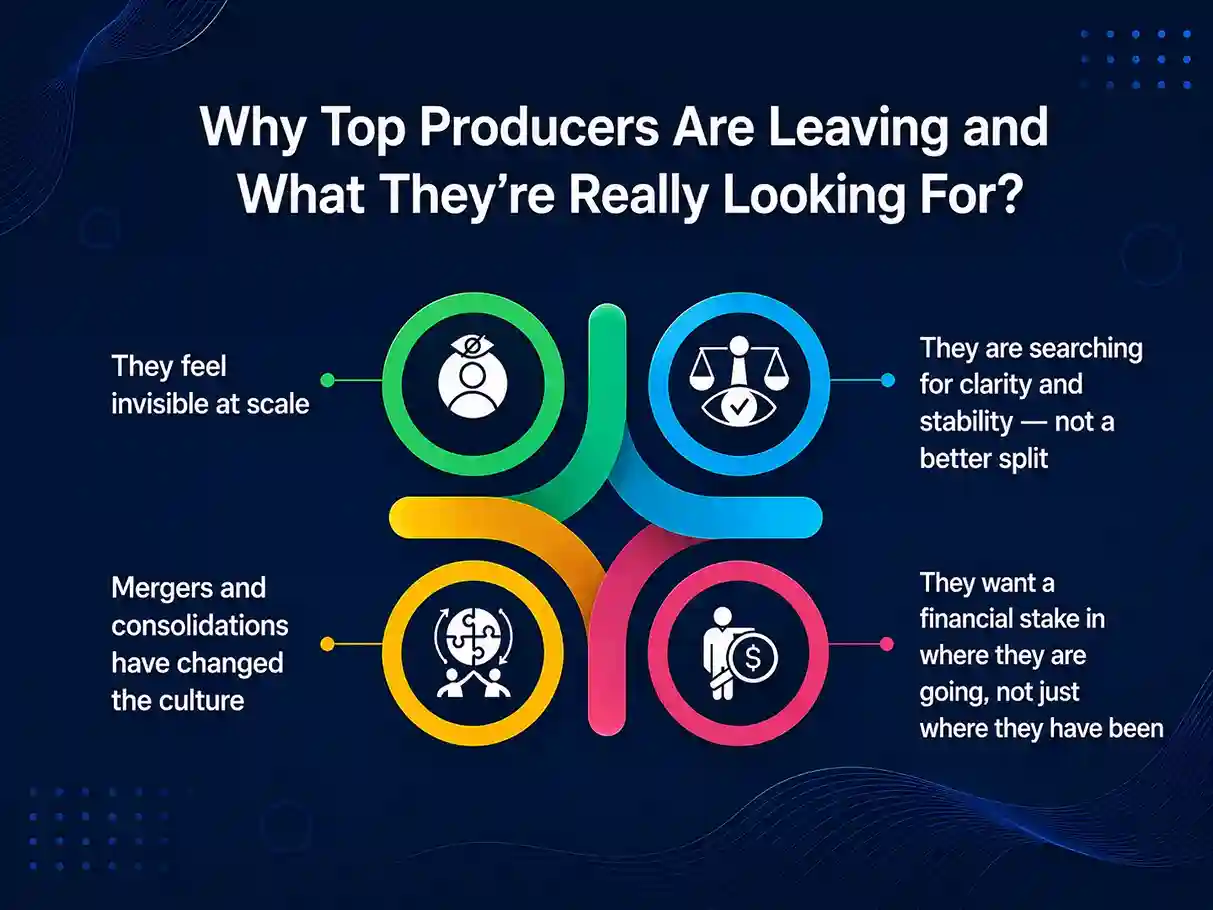
They feel invisible at scale
At a brokerage with tens of thousands of agents, a top producer is still one number among many. They cannot reach their broker when they need a decision made. Leadership changes happen without their input. Their production matters to the quarterly report but not necessarily to the person running the office. For agents who built their business on relationships, that anonymity is corrosive. The appeal of a smaller brokerage where the broker-owner knows their name, their market, and their challenges is not abstract.It is the thing they think about when they lie awake at 2 a.m. deciding whether to make the move.
Mergers and consolidations have changed the culture
The brokerage industry has seen significant consolidation over the past three years. When large brands merge or acquire smaller ones, the culture changes. Leadership changes. Processes change. The agents who chose that brokerage for its specific culture find themselves inside something different from what they signed up for. Industry data shows internal office-to-office transfers rose 38 percent year over year, as agents try to find a better fit without leaving the brand entirely. Many will eventually realize the fit they are looking for does not exist at that scale, and they will leave.
They are searching for clarity and stability — not a better split
The most important insight from this year's agent movement research: the agents who are moving are doing it "less about chasing a bigger split and more about searching for a business environment that feels clearer, more stable, and more responsive to their needs." This changes the competitive dynamic entirely. The broker-owner who thinks they are competing on split percentage is solving the wrong problem. The top producer who is evaluating options wants to know: will I be supported here? Will I matter here? Does this brokerage have a real future I can see?
They want a financial stake in where they are going, not just where they have been
Many of these agents have spent years at brokerages that offered revenue share, stock programs, or other financial participation models. They understand what a financial stake in a brokerage feels like. They know the difference between a brokerage where they are a contractor and a brokerage where they are a partner. When they evaluate their next move, they are looking for both: the personal environment of an independent brokerage and the financial architecture of a platform that rewards their growth and loyalty. This is the gap that most independent brokerages have not yet filled.
Part 2: What These Agents Actually Want — And Why Independent Brokerages Are Already Most of the Answer
When top producers evaluate their options, they describe an ideal brokerage that sounds very much like the independent model. Personal leadership they can reach. A community rather than a platform. Transparent fee structures without hidden costs. A culture of collaboration rather than internal competition. A broker-owner who is invested in their individual success.
What Agents Say They Want When They Leave Mega-Brokerages
- A broker-owner they can actually reach when they need a decision
- An office culture where agents collaborate rather than compete
- Transparent, predictable fee structures they can plan around
- Leadership that knows their name, their market, their goals
- A financial reason to stay and grow roots — not just a split they could match elsewhere
Independent brokerages naturally offer the first four. The local broker-owner who has spent 20 years building relationships in their market has exactly the personal leadership and community culture these agents are searching for. Cloud brokerages and national platforms cannot manufacture that. It requires time, presence, and genuine relationships — all things independent broker-owners have built.
The fifth — a financial reason to stay and grow roots — is what most independent brokerages have not yet built. And it is the reason some of these agents, despite wanting the independent brokerage environment, end up at a platform that offers financial participation even if the culture is impersonal.
Revenue share can supplement an agent's income, but it is not guaranteed income and depends on the performance of agents you recruit. It closes part of the financial-incentive gap independent brokerages face .
| What Top Producers Want | Independent Brokerage Without Revenue Share | Independent Brokerage With Revenue Share |
|---|---|---|
| Personal leadership and accessibility | ✔ Strong advantage | ✔ Strong advantage |
| Collaborative culture, not a platform | ✔ Natural strength | ✔ Natural strength |
| Transparent, predictable fees | ✔ Independent model advantage | ✔ Independent model advantage |
| Local expertise and market connection | ✔ Strongest advantage | ✔ Strongest advantage |
| Financial stake — passive income, long-term incentive | ✘ Missing | ✔ Revenue share provides this |
| Reason to recruit colleagues, grow the network | ✘ No financial incentive exists | ✔ Revenue share creates this incentive |
The independent brokerage that adds revenue share to what it already offers is not competing against mega-brokerages on their terms. It is offering something mega-brokerages structurally cannot: the combination of a genuinely personal environment AND a financial architecture that rewards agent growth and loyalty.
Model What Revenue Share Generates When You Attract Top Producers
See your Year 1, Year 2, and Year 3 projections based on your brokerage's agent count and production profile. Takes about 3 minutes.
Run Your NumbersPart 3: How Revenue Share Makes the Independent Brokerage Value Proposition Complete
A top producer evaluating their next brokerage is making a financial decision as much as a cultural one. They are comparing futures, not just current splits. The question they are asking — even if they don't articulate it this way — is: where will I be better off in three years, not just this year?
Revenue share changes the answer to that question for the independent brokerage. Here is what it adds:
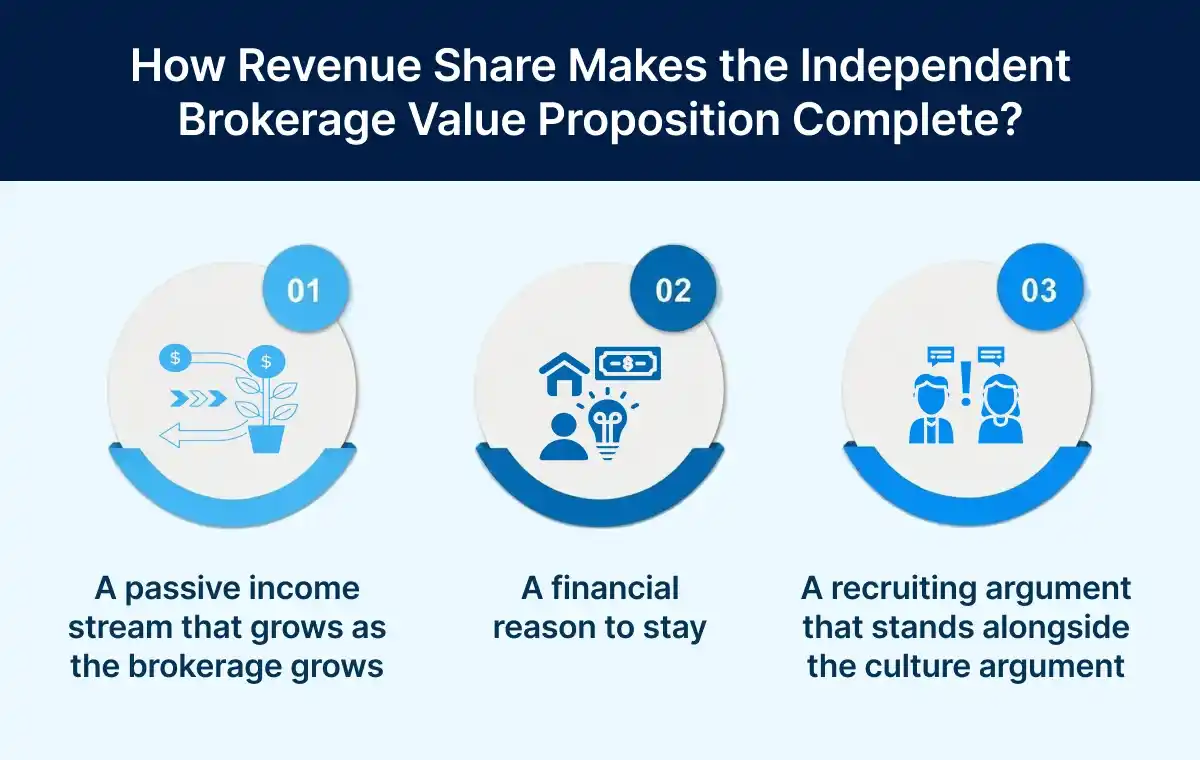
A Passive Income Stream That Grows As The Brokerage Grows
Revenue share can generate ongoing income for agents who recruit others, but payouts vary by brokerage and are not guaranteed or fixed. Ask any brokerage for its actual historical payout data before joining.
When a top producer joins an independent brokerage with revenue share, they are not just joining for the split. They are joining for the passive income their network generates. Every agent they introduce to the brokerage creates an ongoing income stream. That stream grows as those agents produce and as they recruit others. For a producer who has built a strong professional network over years at a mega-brokerage, the revenue share potential is immediate and significant. They arrive with relationships. Revenue share makes those relationships financially productive at their new brokerage.
A Financial Reason To Stay
Revenue share can improve agent retention because leaving forfeits future payouts — though the size of that incentive depends entirely on the brokerage's specific program terms. That passive income disappears if they move. This is the retention mechanism independent brokerages have been missing — not because they lacked culture, leadership, or relationships, but because they lacked a financial reason for agents to stay.
A Recruiting Argument That Stands Alongside The Culture Argument
When an agent at a mega-brokerage is being recruited by an independent firm, the conversation historically goes: "we offer a better environment, more personal support, and a culture you will prefer." Those are real advantages. But they are qualitative. An agent can agree the culture argument is appealing and still choose the platform offering revenue share, because the financial argument is more concrete. With revenue share in place, the independent brokerage can say: 'We offer the environment and a defined passive income structure. Here is exactly what you would earn from the agents you introduce." That is a complete recruiting conversation.
For a more detailed explanation of how to build a revenue share programme at your independent brokerage — including the economic structure and the three programme models — see our foundational guide. And for broker-owners weighing the revenue share vs. profit share decision, the broker-owner comparison is here.
How to Position Your Brokerage for This Moment — Four Steps
The agents who are evaluating options right now are making decisions. They are having conversations with brokerages and forming impressions this month. The brokerage that has a clear, documented value proposition — culture and financial architecture — wins those conversations. The one that says "we are working on something" does not.
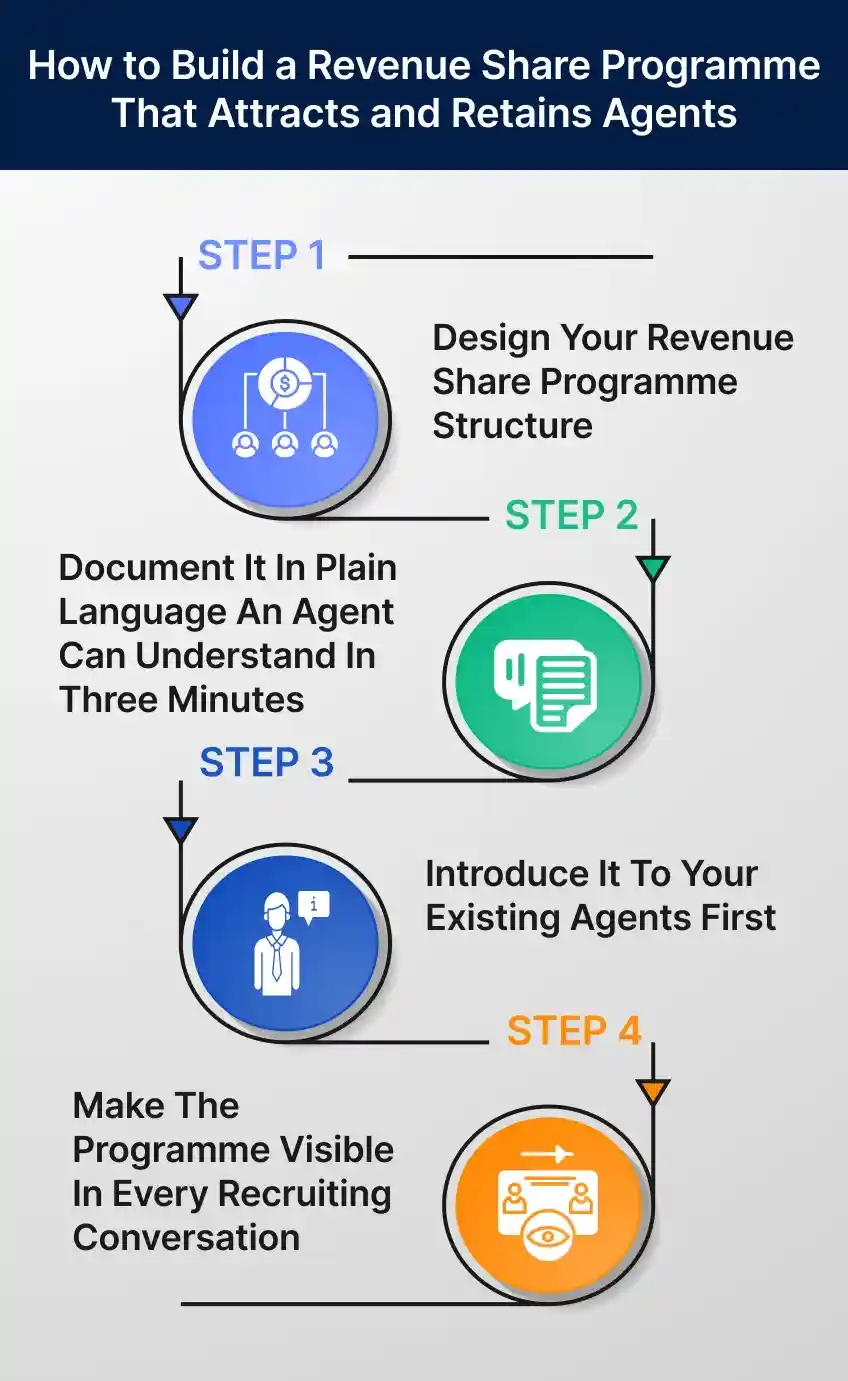
Step 1: Design Your Revenue Share Programme Structure
Choose the model that fits your brokerage size and growth goals. A single-tier programme — agents earn a percentage of company dollar from agents they directly introduce — is the right starting point for most independent brokerages under 50 agents. It is simple to explain and administer, and it creates immediate recruiting and retention incentives without complex infrastructure. Use the Revenue Share ROI Calculator to model the economics for your specific brokerage before you decide on the payout percentage.
Step 2: Document It In Plain Language An Agent Can Understand In Three Minutes
A one-page programme summary is worth more than a 20-page policy document. Agents evaluating a brokerage want to understand the structure quickly. How much do they earn per transaction? From which agents? For how long? What happens if they or the agent they introduced leaves? Answer those four questions clearly and concisely. The documentation becomes your recruiting pitch — something you can share in a recruiting conversation and leave behind for an agent who is evaluating options.
Step 3: Introduce It To Your Existing Agents First
Before using revenue share as an external recruiting message, present it to your current roster. Your existing agents are your most credible recruiters. When they understand the programme and see the passive income potential from the agents they already know in the market, they become its most effective advocates. A top producer who is being recruited away from a mega-brokerage is more likely to choose your brokerage if a current agent they respect tells them about the programme from personal experience. Give your roster 30 days to ask questions and start recruiting before you announce externally.
Step 4: Make The Programme Visible In Every Recruiting Conversation
Add revenue share to how you describe your brokerage to prospective agents. Not as a footnote — as a headline. "We are an independent brokerage with a personalised culture, local leadership, and a structured revenue share programme." That sentence is a complete and competitive value proposition. The agent who has been at a mega-brokerage and knows what revenue share income feels like will lean forward. The agent who has not encountered it before will ask questions — which gives you the conversation you need.
Download the Revenue Share Blueprint
The complete 28-page guide to designing, pricing, and launching a revenue share programme at your independent brokerage — including worked examples, programme structure options, and a step-by-step launch sequence.
The Window Is Open. Here Is What It Takes to Walk Through It
Independent brokerages have always had what top producers say they want most — personal leadership, genuine relationships, local expertise, and a culture of collaboration that no national platform can manufacture. What they have been missing is the financial architecture that makes the value proposition complete for an agent who has experienced revenue share and knows what a stake in a brokerage feels like.
Revenue share adds that architecture. It does not require replacing anything the brokerage already has. It does not require joining a cloud platform or surrendering the independence that defines the brokerage. It requires a clear programme structure, a tracking system, and a one-page document an agent can understand in three minutes.
The agents who are moving right now are making decisions based on what brokerages offer today. The independent brokerage with revenue share in place wins those conversations. The one without it is competing with one hand behind its back — offering the culture these agents want but not the financial incentive they have learned to expect.
RightAlly is built specifically for independent brokerages. It works alongside the CRM and transaction management systems the brokerage already uses, goes live in under 14 days, and starts at approximately $20 per agent per month. The agents who are evaluating their next move right now will not wait for a brokerage to finish building its programme.
Book a Call — Design Your Programme Before the Window Closes
We will map your revenue share programme structure, model the economics for your specific brokerage, and get you live in 14 days — without replacing a single system you already use.
Book a CallFrequently Asked Questions
A recurring percentage of a brokerage's retained commission ("company dollar") paid to an agent for other agents they refer to the brokerage, for as long as those referred agents remain active and producing.
No. A referral fee is a one-time payment tied to a single transaction. Revenue share is ongoing and tied to a recruited agent's continued production over time.
No. Revenue share is typically based on a percentage of company dollar from specific referred agents. Profit share is usually based on overall brokerage profitability distributed more broadly. The right model depends on brokerage size and structure — see our broker-owner comparison guide.
This varies by program and should be defined explicitly in your brokerage's written policy. In most single-tier models, revenue share payments stop when the recruiting agent leaves, since the incentive is tied to their continued affiliation with the brokerage.
Revenue share programs must comply with RESPA and applicable state real estate commission rules, which vary by state. Broker-owners should consult a real estate attorney before finalizing payout structures.
Earnings vary widely based on the brokerage's payout percentage, the production of recruited agents, and how many agents a person refers to. Ask any brokerage for its actual historical payout data rather than relying on projections.
Share this blog


Popular topics
Efficiency
Growth
Compliance
Technology
Agents
Trends




 +1 (765) 896-5271