


 Home
Home Blog
Blog
Table of Content
- Introduction
- Why Agents Recruit — And Why Most of Your Agents Don’t
- The Recruiting Treadmill — And Why Most Brokerages Are On It
- The Mechanism: How Revenue Share Turns Agents Into Recruiters
- What Changes When Revenue Share Is in Place
- How to Build This Without Replacing What Already Works
- The Competitive Shift That Is Available Right Now
- Frequently Asked Questions
Key Takeaways
- Give agents a financial reason to recruit. A well-structured revenue share programme allows agents to earn additional income from the business they help bring into the brokerage.
- Turn your existing agents into a recruiting force. Instead of relying entirely on the broker-owner to attract talent, give agents an incentive to introduce other productive agents from their professional networks.
- Compete on more than commission splits. Cloud brokerages often attract agents with additional earning opportunities, so independent brokerages need to offer value that extends beyond traditional commission structures.
- Use revenue share to strengthen agent loyalty. When agents can build a recurring income opportunity through recruiting, they have another financial reason to stay and grow with the brokerage.
- Build a revenue share model without giving up your independence. Independent brokerages can offer competitive recruiting incentives while retaining control over their brand, culture, operations, and agent relationships.
Revenue share is a compensation structure where an agent earns an ongoing percentage of company dollar generated by agents they recruit to the brokerage — for as long as those agents keep producing.
Here is a pattern that plays out at independent brokerages across the country, quietly, over and over again.
A good agent leaves. Maybe they have been talking to a recruiter from a cloud brokerage for a few months. Maybe they were curious about the revenue share income other agents were describing. Whatever the reason, they go. You wish them well. You start the recruiting process to replace them.
Six months later, that same agent has brought two of your current agents with them.
Not because the cloud brokerage is dramatically better. Not because the splits are significantly higher. But because the moment that agent joined, they were onboarded into a revenue share network. They were given a financial reason to recruit. Every agent they bring to their new brokerage generates passive income for them — so they recruit. And the brokerage they came from is now competing against its own former agents for the people who are still there.
This is not a loyalty problem. It is not a culture problem. It is an incentive design problem — and it is one that independent broker-owners can solve without handing over their independence to solve it.
Why Agents Recruit — And Why Most of Your Agents Don’t
Agents recruit when they have a financial reason to. That is the entire explanation. It is not more complicated than that.
Cloud brokerages understood this and built their entire growth model around it. When an agent at a cloud brokerage introduces a colleague and that colleague closes transactions, the introducing agent earns a percentage of the company dollar those transactions generate. The income is passive, it compounds over time, and it does not require the agent to do anything other than stay affiliated and continue producing.
That financial structure turns every agent in the brokerage into a potential recruiter. Not because they were trained to recruit. Not because they were told to recruit. Because it is in their direct financial interest to do so — and the people most likely to join are the colleagues they already know and trust from their previous brokerage.
At most independent brokerages, agents have no equivalent incentive. They might refer a colleague out of goodwill, or because they know the broker-owner would appreciate it. But there is no financial architecture behind the referral. No ongoing income. No compounding. No reason to prioritise it over everything else they could be doing with their time.
The result is that independent brokerages rely almost entirely on the broker-owner to recruit. The broker-owner builds the pipeline, makes the calls, runs the interviews, extends the offers. It is expensive, time-consuming, and entirely dependent on the broker-owner’s personal capacity and network. When that capacity is stretched — which it almost always is — recruiting slows, the pipeline thins, and the brokerage grows only as fast as one person can personally drive it.
The Recruiting Treadmill — And Why Most Brokerages Are On It
The pattern above has a name. It is the recruiting treadmill — and most independent broker-owners are on it without realising it.
The treadmill works like this: the brokerage recruits to replace, not to grow. An agent leaves, so the broker-owner recruits another agent. That agent stays for a year or two, builds their pipeline, and then either plateaus or leaves for a brokerage with better financial incentives. The broker-owner recruits again. The roster stays roughly the same size. The effort stays roughly the same. The growth does not come.
The 2025 State of Brokerage Recruiting data makes the treadmill visible: top brokerages recruited 1.9 agents for every 1 they lost — but only achieved 1.8% net volume growth. Why? Because incoming agents were 46% less productive than the outgoing agents they replaced. The brokerage was working harder to recruit and ending up with less production.
The treadmill is not a recruiting problem. It is a retention problem masquerading as a recruiting problem. Brokerages that retain their most productive agents do not need to recruit at the same volume. Brokerages that turn existing agents into recruiters multiply their recruiting capacity without multiplying their personal effort.
Revenue share is the mechanism that does both simultaneously.
See What Revenue Share Generates When Your Agents Start Recruiting
Model Year 1, Year 2, and Year 3 projections for your specific brokerage — based on your agent count and production numbers. Takes about 3 minutes.
Run Your NumbersThe Mechanism: How Revenue Share Turns Agents Into Recruiters
The Simple Version
Agent A at your brokerage introduces Agent B. Agent B joins and closes transactions. A small percentage of the company dollar from those transactions goes to Agent A — automatically, ongoing, for as long as Agent B is producing at your brokerage. No ongoing effort required from Agent A. Just the original introduction.
This is revenue share at its most basic level. And what it does to recruiting behaviour is immediate and measurable.
Agent A now has a financial stake in the people around them. They want Agent B to produce because Agent B’s production directly affects their income. They want Agent B to stay because if Agent B leaves, the income stops. And they start thinking about who else in their network might be a good fit — not because the broker-owner asked them to, but because bringing in another good agent is directly in their financial interest.
This is the dynamic that cloud brokerages understood and built their growth models around. And it is not proprietary to any particular brokerage type. Any independent brokerage can implement this structure — without joining a platform, without surrendering their brand, and without rebuilding their existing technology.
The financial mechanism does not require the brokerage to be large. It does not require a massive technology investment. It requires a clear programme structure, a tracking system for agent relationships and payouts, and a one-page explanation an agent can understand in three minutes.
The revenue share model is specifically well-suited to independent brokerages because it is funded from new company dollar generated by new agents — not from the broker-owner’s existing margin. The programme is self-funding from the growth it produces.
What Changes When Revenue Share Is in Place
The shift is not just financial. It is cultural. Here is what the recruiting dynamic looks like before and after:
The broker-owner recruits personally. Agents refer colleagues occasionally, as a favour. New agents join with no financial connection to existing agents. Early-tenure attrition is high — agents leave when a better offer appears. The brokerage grows only as fast as the broker-owner’s personal recruiting capacity.
Existing agents have a financial reason to introduce colleagues. New agents are connected to the agent who introduced them — and to the passive income that introduction generates. Retention improves because agents with passive income tied to the brokerage have a financial reason to stay. The brokerage grows through relationships, not just individual broker-owner effort.
The change that surprises broker-owners most is not the passive income. It is the language. Agents who are connected through a revenue share network start saying we instead of I when they talk about the brokerage. The financial architecture creates a shared stake that changes how agents relate to each other and to the brokerage itself.
That shift — from a collection of individual contractors to a connected team with shared financial interests — is the competitive advantage that independent brokerages have historically been unable to replicate from cloud brokerages. Revenue share makes it replicable.
How to Build This Without Replacing What Already Works
The most common response Srini hears from independent broker-owners when revenue share comes up is a version of the same hesitation: “we’ve already invested in our CRM and our transaction management. We’re not looking to replace everything just to add one capability.”
That hesitation is understandable. And it is based on a misconception about what implementing revenue share actually requires.
Revenue share is not a technology replacement. It is an additional layer — a programme structure that sits alongside the systems the brokerage already uses. The broker-owner does not need to change their CRM. They do not need to change their transaction management platform. They do not need to build custom technology from scratch.
| Component | What it does | Minimum effort to start |
|---|---|---|
| Programme document | One-page rules an agent can read in 3 minutes | A written page |
| Tracking system | Records who introduced whom, calculates payouts | Can start as a spreadsheet |
| Payout process | Schedule for calculating/distributing payments | Tied to existing transaction processing |
What they need is three things:
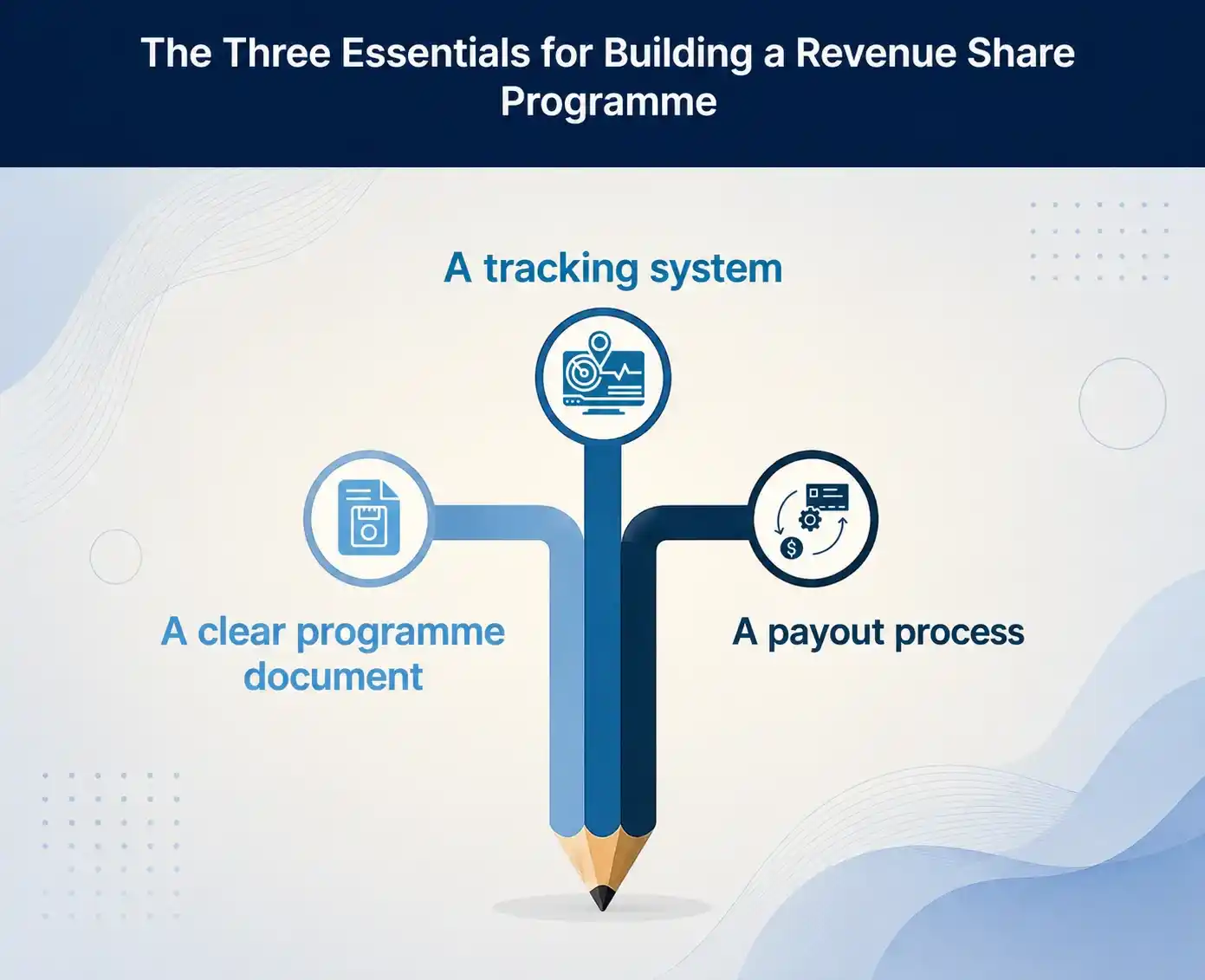
- A Clear Programme Document — a one-page explanation of the programme, the payout percentages, and the eligibility rules that an agent can read and understand in three minutes.
- A Tracking System — a way to record which agent introduced which recruit, and to calculate the payout on each transaction the recruited agent closes. This can start as a spreadsheet for a simple single-tier programme.
- A Payout Process — a defined schedule for calculating and distributing revenue share payments, tied to the brokerage’s existing transaction processing.
For broker-owners who want the tracking, calculation, and administration handled automatically — without building it themselves — RightAlly is a plug-and-play revenue share platform designed specifically for independent brokerages. It works alongside existing CRM and transaction management systems. It goes live in under 14 days. It starts at approximately $20 per agent per month, making the investment accessible to brokerages at any size from 20 agents upward.
The broker-owner who has been watching their best agents get recruited away by cloud brokerages does not need to rebuild their brokerage to compete. They need to add the mechanism that creates the incentive their agents are currently being offered elsewhere.
How much does a revenue share platform cost? Roughly $20 per agent/month, viable for brokerages of 20+ agents.
Download the Revenue Share Blueprint
The complete 28-page guide to designing, pricing, and launching a revenue share programme at your independent brokerage — including programme structures, economics modelling, and a step-by-step launch sequence.
The Competitive Shift That Is Available Right Now
Cloud brokerages did not win agents by being better at real estate. They won agents by being better at incentive design. They understood that agents make decisions based on financial architecture, not just splits and brand recognition. And they built a structure that gave agents a financial reason to recruit, stay, and advocate for the brokerage.
Independent broker-owners have something cloud brokerages cannot manufacture: real relationships, genuine local reputation, personal culture, and the kind of one-on-one connection that a 30,000-agent platform cannot replicate. The agents who are leaving for cloud brokerages are often not leaving because they prefer the cloud model. They are leaving because the cloud brokerage gave them a financial reason to go — and the independent brokerage gave them no financial reason to stay.
Revenue share gives them the reason to stay. And when it does, the dynamic that has been running against independent brokerages — the one where their former agents recruit their current agents — reverses. The agents who stay become recruiters. The brokerage grows through the relationships it has already built. The broker-owner stops running the recruiting treadmill and starts building something that compounds.
That shift is available to every independent broker-owner who is willing to build the structure. It does not require abandoning the independence they spent years building. It requires adding the one thing that has been missing.
Book a Call — Map How This Works for Your Brokerage
We will walk through your specific brokerage, design your revenue share programme structure, and map the path to going live in 14 days — without replacing a single system you already use.
Book a CallFrequently Asked Questions
Revenue share is a compensation structure where an agent earns an ongoing percentage of company dollar generated by agents they recruit to the brokerage — for as long as those recruited agents keep producing.
A commission split is what an agent earns on their own transactions — negotiated between the agent and the brokerage. Revenue share is separate: it's a percentage of company dollar generated by other agents the introducing agent recruited, paid on top of (not instead of) that agent's own commission split.
It can be, when structured correctly — payouts are typically tied to actual production by the recruited agent (not simply the act of referring someone), and non-transaction-based compensation should only go to licensed individuals. Compliance also depends on state licensing law, which varies. This isn't legal advice — broker-owners should have any revenue share program structure reviewed by a real estate attorney before launch.
Payout percentages vary by brokerage and program design, but they're generally a small percentage of company dollar — often in the low single digits per tier — rather than a large share of the recruited agent's commission. Multi-tier programs (see below) usually pay smaller percentages per tier since payouts extend across more levels.
In a single-tier program, an agent earns revenue share only on the agents they directly recruited. In a multi-tier program, an agent can also earn a smaller percentage from agents recruited by their recruits, extending several levels deep. Single-tier is simpler to track and explain; multi-tier can compound faster but requires more sophisticated tracking and a clearer program document to avoid confusion.
With a dedicated platform, typically under 14 days. Building it manually — a programme document, a spreadsheet-based tracking system, and a payout process tied to existing transaction processing — can take longer depending on how quickly the brokerage finalizes its payout structure and eligibility rules.
Yes — the model is generally self-funding, since payouts come from new company dollar generated by newly recruited agents rather than from the broker-owner's existing margin. A simple single-tier version can start as a spreadsheet at effectively no added cost; platform-based options (like RightAlly, starting around $20/agent/month) become more cost-effective as the brokerage scales past roughly 20 agents.
Generally yes — revenue share is typically treated as taxable non-employee compensation, similar to commission income, and would usually be reported to the agent (e.g., via 1099 in the US). Exact tax treatment can depend on how the agent is classified and structured (independent contractor, entity, etc.), so this isn't tax advice — agents and broker-owners should confirm treatment with a tax professional or CPA familiar with real estate compensation structures.
Share this blog


Popular topics
Efficiency
Growth
Compliance
Technology
Agents
Trends




 +1 (765) 896-5271