


 Home
Home Blog
Blog
Table of Content
- Introduction
- The Gut-Feel Recruiting Problem — And What It Actually Costs
- The 11-Persona Framework: Why Every Agent Requires a Different Recruiting Offer
- The Ideal Agent Scorecard: A 1–35 Framework for Every Recruiting Decision
- How to Apply the Scorecard in an Independent Brokerage
- Why the Scorecard and Revenue Share Are the Same System
- Common Recruiting Mistakes That Cost Independent Brokerages Growth
- The Brokerage That Recruits by Diagnosis Wins the Decade
- Frequently Asked Questions
Key Takeaways
- Gut-feel recruiting fails often and costs $15K–$50K per bad hire — only 1–2 of every 10 recruited agents are still active after five years.
- One pitch doesn't fit all agents — the 11-persona framework shows new agents, burned-out producers, and veterans each need a different offer.
- The Ideal Agent Scorecard (1–35 scale) scores candidates on fit, coachability, tech, culture, and friction — replacing gut feel with data.
- Holding a minimum score threshold matters more than hiring volume — a few great-fit agents beat many mediocre ones.
- Good-fit agents drive revenue share success — poor-fit hires are the biggest source of retention and revenue share problems.
Most independent broker-owners use the same recruiting evaluation system: they meet a candidate, have a conversation, and decide whether they “feel like a good fit.” Industry data consistently shows that this system produces the wrong agents at roughly a 4-in-5 failure rate.
The NAR has tracked this for years: only a fraction of recruited agents are still actively producing five years after joining a brokerage. The recruiting conversations feel good. The first six months look promising. And then, quietly, the agent stops transacting, stops showing up, and either leaves or lingers unproductively - costing the brokerage $15,000 to $50,000 in recruiting investment, training overhead, and lost production before the pattern repeats.
Recruiting Insight's April 2026 Real Estate Personas and Avatars guide names the cause directly: “Recruiting is not about convincing people; it is about diagnosing them.” The guide introduces 11 agent personas built from the 2026 Agent Migration Report data and a 1–35 Ideal Agent Scorecard that evaluates recruiting candidates across five quantifiable dimensions. What it gives independent broker-owners, for the first time, is a structured alternative to gut-feel recruiting—a system that connects an agent’s career stage, motivations, and operational profile to a specific brokerage offer before the conversation begins.
This article adapts that framework for the reality of an independent brokerage: a broker-owner who is personally doing most of their recruiting, often without a dedicated team, and who needs a system that is fast to apply, consistent across every candidate, and accurate enough to stop the early-tenure attrition cycle before it compounds another year.
Our experience: In our work with independent brokerages, we've found that recruiting decisions based solely on personality or initial impressions often result in higher early-stage turnover. Broker-owners who introduce a structured evaluation process are generally better positioned to identify candidates who align with their brokerage's culture, systems, and long-term growth goals.
Modern brokerages increasingly rely on integrated brokerage management platforms to standardize recruiting, onboarding, communication, and agent performance management.
The Gut-Feel Recruiting Problem — And What It Actually Costs
The mechanics of gut-feel recruiting are familiar to every broker-owner who has grown a brokerage past 20 agents. A candidate is referred by an existing agent, or responds to a LinkedIn message, or shows up at an event. You have a conversation. They seem motivated, personable, and ambitious. You make an offer. They join. And then - somewhere between months four and fourteen - the production that seemed imminent never quite materialises.
The problem is not that the candidates were dishonest about their ambitions. It is that gut-feel recruiting selects for the qualities most visible in a conversation—enthusiasm, articulateness, likability—while systematically missing the qualities that actually predict whether an agent will produce consistently inside a specific brokerage’s operational model. Those qualities are not visible in a conversation. They require diagnosis.
Across independent brokerages, a common pattern is that highly enthusiastic candidates are often recruited quickly, while factors such as coachability, technology adoption, and long-term commitment receive less attention during the initial conversation. A structured evaluation process helps reduce this bias by encouraging more consistent decision-making.
The cost of this mismatch is significant and largely hidden. Every agent who joins and fails to produce compounds a specific set of brokerage costs: the recruiting time investment, the onboarding overhead, the administrative and compliance burden of a non-producing agent on the roster, and the opportunity cost of the recruiting pipeline slot that productive candidate never filled. EZRecruits’ 2026 analysis puts the total cost at $15,000 to $50,000 per failed hire—making a brokerage of 40 agents losing 8 per year a $120,000 to $400,000 annual drag on profitability before a single transaction is counted.
And crucially: the agents who leave are not always your weakest performers. The Recruiting Insight Q1 2026 data found that a significant share of departing agents were growing their production in the quarter before they left - meaning the brokerage lost agents it had invested in at exactly the moment the return on that investment was beginning to materialise. Gut-feel recruiting does not just bring in the wrong agents. It often fails to retain the right ones because the recruiting conversation never established a genuine fit between the agent's needs and the brokerage's offer.
Model What Better Recruiting Quality Compounds To
Run the Revenue Share ROI Calculator to see what higher early-tenure retention means for your brokerage revenue and revenue share income over 12 and 36 months.
Run Your NumbersThe 11-Persona Framework: Why Every Agent Requires a Different Recruiting Offer
Before introducing structured recruiting frameworks, many broker-owners already have an intuitive understanding that different agents require different support. Organizing candidates into defined personas simply makes that evaluation more consistent, measurable, and repeatable across every recruiting decision.
The Recruiting Insight Personas and Avatars guide organises agents into 11 core profiles based on career stage, production trajectory, primary motivation, and operational preference. The framework is built from the same agent migration data that has driven the Black Hole analysis, internal mobility research, and Q1 2026 production findings - but it applies that data to the recruiting conversation itself rather than to post-hire retention.
The central insight of the personas framework is that there is no single recruiting pitch that works across all agent types. A new licensee excited about building a career needs completely different signals from a brokerage than a veteran top producer whose production has plateaued and who is quietly evaluating whether their current affiliation is worth its cost. Treating them the same in a recruiting conversation is not just ineffective - it actively misdiagnoses what each candidate needs and what the brokerage can deliver.
For an independent broker-owner, four of the 11 personas are particularly relevant to the recruiting decisions that drive brokerage growth:
| Persona Type | Primary Signal | What They Need From a Brokerage | The Right Recruiting Offer |
|---|---|---|---|
| The Rising Producer | Growing production in years 2–5; outpacing peers but hitting a ceiling at current brokerage | Infrastructure, team support, mentorship, a platform that matches their ambition | Team programme access, accountability structure, clear pathway to team leadership |
| The High-Burnout Top Producer | Strong production but declining satisfaction; solo model is no longer sustainable | Leverage, staffing solutions, a way to grow without personal capacity grinding to a halt | Team infrastructure, revenue share income tied to agents they develop, reduced personal overhead |
| The Digital Native | Younger agent, high tech comfort, building personal brand before brokerage brand | Modern technology stack, credibility-building opportunities, mentorship with experienced producers | Tech infrastructure, co-marketing support, formal mentorship programme pairing |
| The Veteran Evaluator | 15+ years experience; questioning whether current affiliation cost justifies the value | Revenue share income, reduced operational friction, a brokerage that respects their experience | Revenue share programme, flexible affiliation model, leadership track or mentorship role |
The diagnostic value of the personas framework is that it gives the recruiting conversation a structure before it begins. Instead of asking “what are you looking for in a brokerage?” and hoping the answer reveals fit, a broker-owner who has identified the candidate's persona in advance can ask targeted questions that surface the specific motivations and friction points that predict whether this agent will produce in this brokerage's operational model.
The Ideal Agent Scorecard: A 1–35 Framework for Every Recruiting Decision
The Ideal Agent Scorecard translates the persona diagnostic into a quantifiable evaluation across five dimensions. Each dimension is scored 1–7, giving a total range of 5–35. The scoring is not about finding the “best” agent in absolute terms—it is about finding the best fit for a specific brokerage’s current needs, culture, and operational capacity.
| THE IDEAL AGENT SCORECARD — 5 DIMENSIONS, 1–35 SCALE | ||
|---|---|---|
| Production Fit | Does this candidate’s current production level and trajectory match what this brokerage needs right now? A top producer may score low if the brokerage lacks the infrastructure to support their volume. A newer agent may score high if the brokerage has strong development programmes. | 1–7 pts |
| Coachability | Does the candidate show evidence of a growth mindset — willingness to receive feedback, history of implementing coaching, openness to the brokerage’s systems and processes? This is the dimension most consistently correlated with long-term retention and production growth. | 1–7 pts |
| Tech Alignment | Does the candidate’s technology comfort and preference match the brokerage’s operational stack? A candidate who is resistant to CRM adoption will struggle in a brokerage built around automated recruiting and transaction management systems. | 1–7 pts |
| Cultural Pillars | Do the candidate’s values, work style, collaboration approach, and professional priorities align with the brokerage’s team culture? Cultural misalignment is the most common undiagnosed cause of early-tenure attrition — it rarely shows in a standard interview. | 1–7 pts |
| Friction Level | How complex is this candidate’s transition? Consider current brokerage relationship, non-compete or referral obligations, licensing status, client pipeline portability, and any personal circumstances that could delay or complicate a productive start. | 1–7 pts |
Once scored, every candidate falls into one of three tiers:
| 30–35 | Ideal Match | Pursue aggressively. Move quickly. This candidate's profile aligns strongly with what this brokerage needs and can support. Prioritise speed in the recruiting process — this candidate is being recruited by others. |
| 22-29 | The Project | Worth pursuing if the brokerage has genuine capacity to develop this candidate. Be honest about which dimensions scored low and whether the brokerage can address them. Do not recruit a Project if the development infrastructure isn't in place. |
| Below 22 | Anti-Persona | Do not recruit, regardless of production numbers or enthusiasm. A candidate scoring below 22 is statistically unlikely to produce consistently in this brokerage's model. The recruiting conversation cost is lower than the onboarding cost of a failed hire. |
How to Apply the Scorecard in an Independent Brokerage
The Scorecard is most powerful when it is used before the recruiting conversation, not after it. Most broker-owners who use a gut-feel system are unconsciously scoring candidates on a version of these dimensions anyway—they just do it after the conversation, when enthusiasm and likability have already distorted the evaluation. The Scorecard externalises that process, makes it consistent across every candidate, and anchors the post-conversation debrief in data rather than impression.
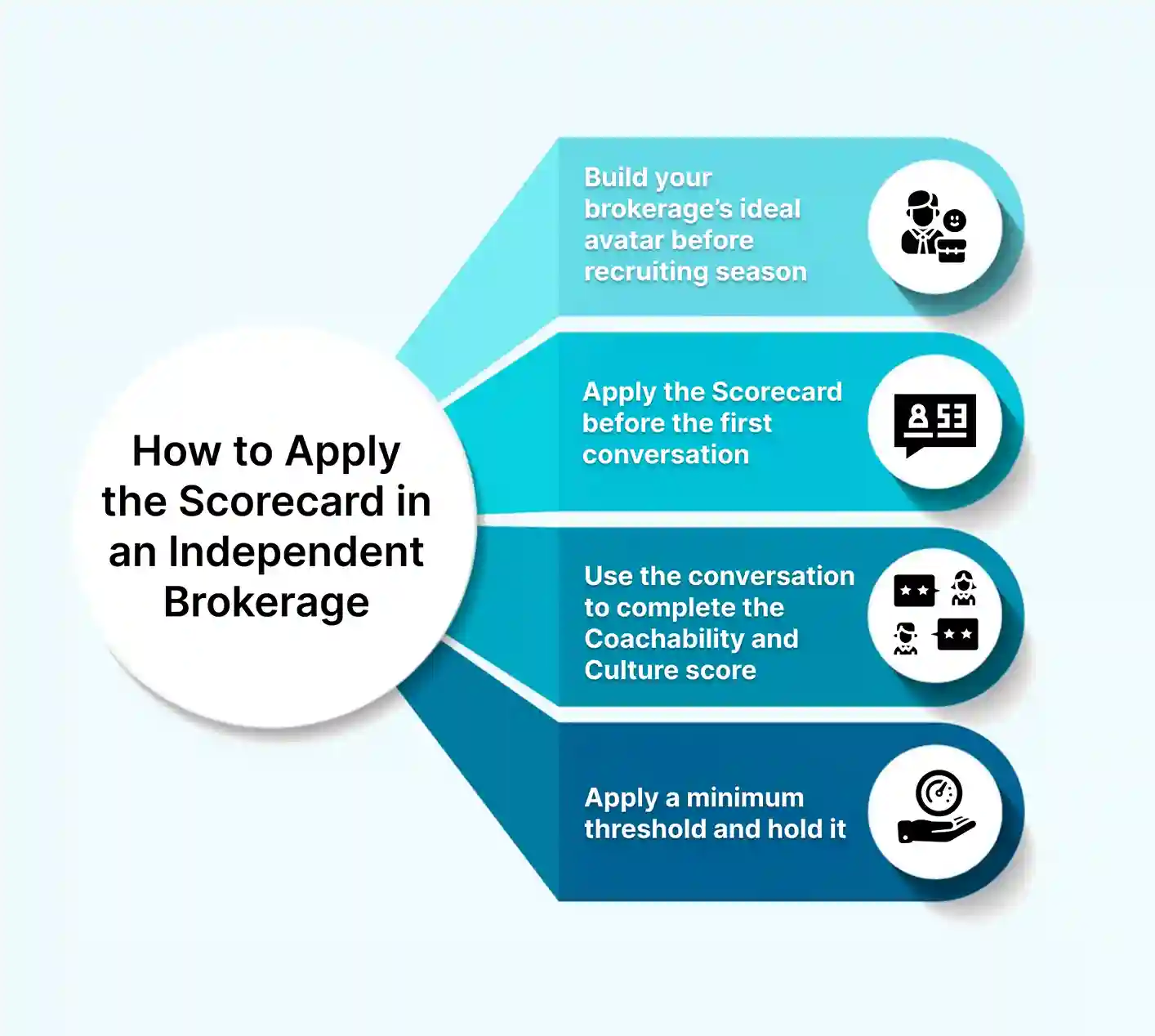
Step 1: Build your brokerage’s ideal avatar before recruiting season
Before evaluating any specific candidate, define what an Ideal Match looks like for your brokerage right now. Which production tier do you need—rising producers to build your base, or high-volume producers to anchor your top line? What is your current technology stack, and what level of tech adoption does it require? What is your brokerage’s operating culture, and which cultural attributes have predicted long-term retention in your highest-performing agents? Answer these questions first, and the Scorecard becomes a calibrated instrument rather than a generic checklist.
Step 2: Apply the Scorecard before the first conversation
Use publicly available production data, MLS records, and social signals to pre-score each candidate on Production Fit and Tech Alignment before you ever speak with them. This prevents the most common gut-feel error: investing recruiting time in candidates who are visibly misaligned with the brokerage’s production needs or operational model. The recruiting conversation then becomes a diagnostic for the three dimensions you cannot score from data alone—Coachability, Cultural Pillars, and Friction Level.
Step 3: Use the conversation to complete the Coachability and Culture score
The recruiting conversation should be structured around questions that reveal the dimensions you cannot pre-score. For Coachability: “Tell me about a time a manager or coach gave you feedback that changed how you work—what happened?” For Cultural Pillars: “What does a great brokerage week look like for you—how much of your time is collaborative versus independent?” These questions produce diagnostic information, not impressions. Score the responses against your avatar before making any offer.
Step 4: Apply a minimum threshold and hold it
The single most difficult discipline in structured recruiting is declining candidates who score below the Anti-Persona threshold—especially when they have high production numbers, strong energy, or a relationship with an existing agent. The Scorecard’s value is precisely that it protects the brokerage from the instinct to recruit volume regardless of fit. Establish a minimum score threshold (most brokerages find 24–26 effective as a floor) and hold it across every candidate. The brokerage that recruits 6 Ideal Matches in a year will outperform the one that recruits 20 mixed-fit agents every time.
The natural question is what happens to candidates who score in the Project tier (22 - 29). This is where internal mobility systems and structured onboarding do their most important work. A candidate who scores 26 overall but 4 on Coachability can become a productive long-term agent if the brokerage has genuine development infrastructure - structured mentoring, accountability pods, quarterly performance conversations, and a culture where coaching is normalised. Without that infrastructure, a Project candidate becomes an expensive experiment.
Download: The Ideal Agent Scorecard
The complete 1 - 35 assessment tool with scoring guidance for all five dimensions, the three candidate tiers, and diagnostic question prompts for each dimension. Built for independent broker-owners, not corporate HR teams. Score any candidate in 10 minutes.
Why the Scorecard and Revenue Share Are the Same System
There is a connection between structured recruiting and revenue share that most broker-owners miss until they have both in place. The agents who score highest on the Ideal Agent Scorecard—strong production fit, high coachability, cultural alignment, and low friction—are precisely the agents who benefit most from a revenue share programme. They are builders. They attract other agents. They stay long enough to develop the agent relationships that generate meaningful passive income.
Conversely, the agents who most frequently generate revenue share income problems are the ones who should have scored low on the Scorecard in the first place: low-coachability producers who resist the brokerage's systems, cultural mismatches who create friction in the team environment, and high-friction transitions who never fully commit to the brokerage's operating model.
A well-built revenue share programme compounds the value of every Ideal Match recruit over time. The broker-owner who recruits by diagnosis, retains agents with revenue share, and builds the team infrastructure that enables agent development is running a brokerage with fundamentally better unit economics than one running gut-feel recruiting and split competition. That is not a positioning claim. It is the operational reality the 2026 data is describing.
Map Your Recruiting System With Our Team
Book a call to walk through your current recruiting pipeline, apply the Scorecard framework to your last 12 months of hires, and map what a structured recruiting system could look like for your specific brokerage model.
Book a CallCommon Recruiting Mistakes That Cost Independent Brokerages Growth
Even experienced broker-owners can make recruiting decisions that lead to higher turnover, increased onboarding costs, and slower brokerage growth. Recognizing these common mistakes can help create a more consistent and effective recruiting process.
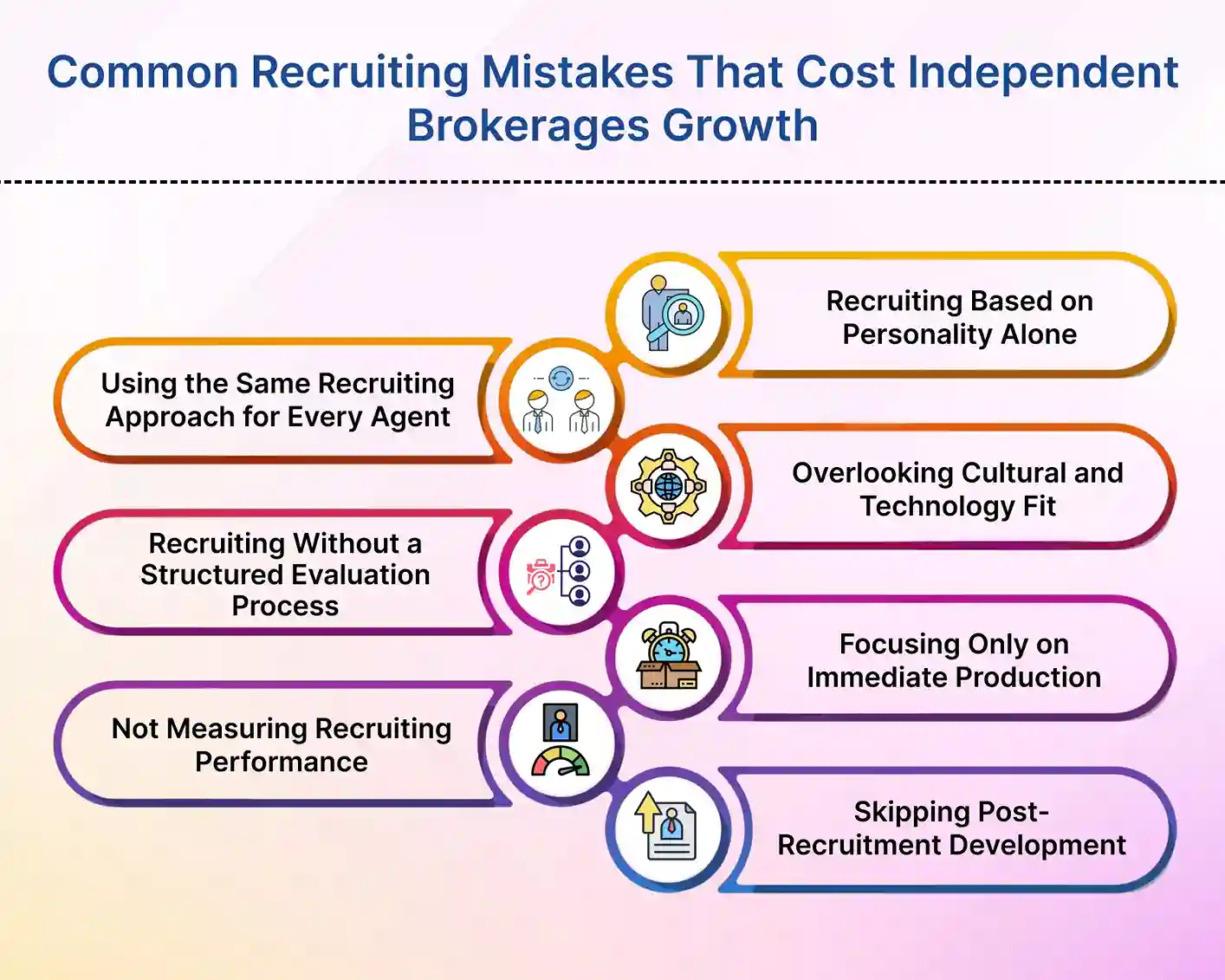
1. Recruiting Based on Personality Alone
A candidate who is enthusiastic and communicates well may not always be the right long-term fit. Recruiting decisions should be supported by measurable criteria such as production history, coachability, technology adoption, and cultural alignment rather than first impressions.
2. Using the Same Recruiting Approach for Every Agent
Newly licensed agents, experienced producers, and veteran brokers have different goals and motivations. A one-size-fits-all recruiting pitch often overlooks what each candidate values most. Tailoring conversations based on agent personas improves engagement and fit.
3. Overlooking Cultural and Technology Fit
An agent with strong production may still struggle if they are unwilling to adopt the brokerage's systems or collaborate within its culture. Evaluating technology readiness and cultural alignment helps reduce early-stage attrition.
4. Recruiting Without a Structured Evaluation Process
Relying solely on intuition can lead to inconsistent hiring decisions. Using a standardized scorecard ensures every candidate is evaluated against the same objective criteria, making recruiting more predictable and repeatable.
5. Focusing Only on Immediate Production
Current production is only one indicator of future success. Long-term performance is also influenced by coachability, adaptability, willingness to learn, and alignment with the brokerage's growth strategy.
6. Not Measuring Recruiting Performance
Many brokerages track the number of recruited agents but fail to monitor retention rates, production growth, onboarding success, and recruiting ROI. Measuring these metrics helps identify what is working and where improvements are needed.
7. Skipping Post-Recruitment Development
Recruiting is only the first step. Structured onboarding, mentorship, regular coaching, and ongoing performance reviews are essential for helping new agents become productive and remain with the brokerage over the long term.
Avoiding these common recruiting mistakes allows independent broker-owners to build a more predictable recruiting system, improve long-term agent retention, and create a stronger foundation for sustainable brokerage growth.
The Brokerage That Recruits by Diagnosis Wins the Decade
The talent pool in independent brokerage recruiting is smaller than most broker-owners assume. Recruiting Insight's 2026 Complete Guide found that in a typical market of 1,000 agents, only 10 to 20 are actively considering a move in any given month. That scarcity means every recruiting conversation is a meaningful allocation of time and relationship capital - and that means the cost of a misdiagnosed hire is not just the $50,000 replacement figure. It is the alternative: the Ideal Match candidate who signed with a competitor while you were onboarding someone who was never going to produce.
The Ideal Agent Scorecard does not eliminate the relationship work of recruiting. The best broker-owners will always win candidates partly because of who they are, how they lead, and what they have built. But the Scorecard ensures that the relationship work is directed at candidates who fit, rather than candidates who seem like they fit. That distinction—between seeming fit and actual fit—is the difference between a brokerage that recruits a lot and one that grows.
Frequently Asked Questions
It's a 1–35 point framework that evaluates recruiting candidates across five dimensions — Production Fit, Coachability, Tech Alignment, Cultural Pillars, and Friction Level — each scored 1–7. Rather than identifying the “best” agent in absolute terms, it identifies the best fit for a specific brokerage's current needs, culture, and operational capacity.
Candidates fall into three tiers: 30–35 is an “Ideal Match” (pursue aggressively), 22–29 is “The Project” (worth pursuing only if the brokerage has real capacity to develop them), and below 22 is “Anti-Persona” (do not recruit, regardless of production numbers or enthusiasm).
Gut-feel recruiting selects for traits that are visible in a conversation — enthusiasm, articulateness, likability — while missing the traits that actually predict long-term production, like coachability and cultural fit. Only 1–2 of every 10 recruited agents are still active in year five, and each failed hire costs a brokerage roughly $15,000–$50,000 in recruiting, training, and lost productivity.
In four steps: (1) define what an “Ideal Match” looks like for the brokerage before recruiting season starts, (2) pre-score Production Fit and Tech Alignment using public data before the first conversation, (3) use the actual conversation to assess Coachability and Cultural Pillars through targeted questions, and (4) set a minimum score threshold (most brokerages use 24–26) and hold to it consistently.
Agents who score highest on the Scorecard — strong production fit, high coachability, cultural alignment — are the same agents who tend to benefit most from revenue share, since they're more likely to stay long enough to build the agent relationships that generate passive income. Conversely, low-scoring agents are the most common source of revenue share problems, since they tend to resist systems and create friction rather than commit fully to the brokerage's model.
Share this blog


Popular topics
Efficiency
Growth
Compliance
Technology
Agents
Trends




 +1 (765) 896-5271