


 Home
Home Blog
Blog
Table of Content
- Introduction
- The Problem: Retention Is Not a Binary Metric
- The Real Cost of Losing an Internal Mover
- Why Internal Mobility Works: The Three-Layer Framework
- What Internal Mobility Actually Looks Like in Practice
- Building an Internal Mobility System: Four Steps
- The Competitive Positioning Opportunity
- The Brokerages Winning Retention in 2026 Are Not Out-Recruiting—They’re Out-Retaining
- Frequently Asked Questions
Key Takeaways
- Internal movers outproduce external hires by 28% — agents who move offices/roles within the same brokerage average $5.47M in production vs. $4.27M for outside recruits.
- They also stay longer — 89% 12-month retention for internal movers vs. 76% for external recruits.
- Most top agents leave over fit, not dissatisfaction — team breakups, market expansion, or career-stage shifts push them out only when there's no internal pathway.
- Watch for friction before resignation — most departures are preceded by 60–90 days of warning signs brokerages could catch and address.
- Revenue share makes staying financially rational — once an agent's income is tied to agents they've developed, leaving means walking away from money already built.
Internal mobility in a real estate brokerage is the practice of helping agents move between offices, teams, leadership roles, or business models within the same brokerage instead of losing them to competitors. Research shows brokerages with structured internal mobility retain more agents and achieve higher production than those relying only on external recruiting.
Most broker-owners measure retention the same way: did the agent leave or did they stay? New data suggests that's the wrong question entirely. Brokerages asking a different question are seeing a 28% production advantage as a result.
The 2026 Annual Agent Migration Report from Recruiting Insight examined 184,097 active agents across four primary MLS regions, monitoring a yearly transaction volume of $15.72 billion. The findings reshaped how top-performing brokerages approach retaining their best talent.
Agents who move internally—changing offices, restructuring team arrangements, or evolving their role within the same brokerage—average $5.47 million in annualised production. Agents recruited from outside average $4.27 million. That’s a 28% production gap in favour of internal movers. And when it comes to retention, internal movers stay at a rate of 89% over 12 months, compared to 76% for external recruits.
This is not a marginal difference. It’s the difference between a productive core that compounds and one that constantly churns.
Internal mobility is a brokerage strategy that allows agents to transition between offices, teams, leadership positions, or geographic markets while remaining within the same brokerage.
The Problem: Retention Is Not a Binary Metric
The conventional retention model works like this: an agent either stays or they go. If they stay, retention wins. If they leave, the brokerage loses, and the recruiting machine kicks back into gear.
This binary framing misses an entire category of retention risk that is accelerating right now. Many of the highest-producing agents in any independent brokerage don’t leave because they hate their broker. They leave because their circumstances evolved and the brokerage didn’t have the infrastructure to accommodate that evolution.
A team lead whose partnership breaks down. A top producer who wants to move to a different market within the brand. A mid-career agent who wants to start building a team structure but can’t see a clear pathway inside the current setup. A veteran producer whose production style has shifted from volume to high-value, and who needs a different operating context as a result.
In each of these cases, the agent isn’t dissatisfied with the brokerage. They’re dissatisfied with a specific arrangement. And if the brokerage doesn’t have a system for facilitating internal movement—a way to help that agent find a better fit within the same ecosystem—the only path available to them is the door how revenue share programs improve long-term retention.
The Real Cost of Losing an Internal Mover
Before examining the solution, it’s worth understanding exactly what a brokerage loses when an internal mover becomes an external departure.
According to the 2026 Annual Migration Report, the top 10% of moving agents accounted for approximately 45% of the $7.01 billion in production volume tracked by the research. Many of these are precisely the agents whose circumstances change mid-career—experienced, well-connected, and productive enough to have options.
When one of these agents leaves rather than transitioning internally, the cost compounds in layers:
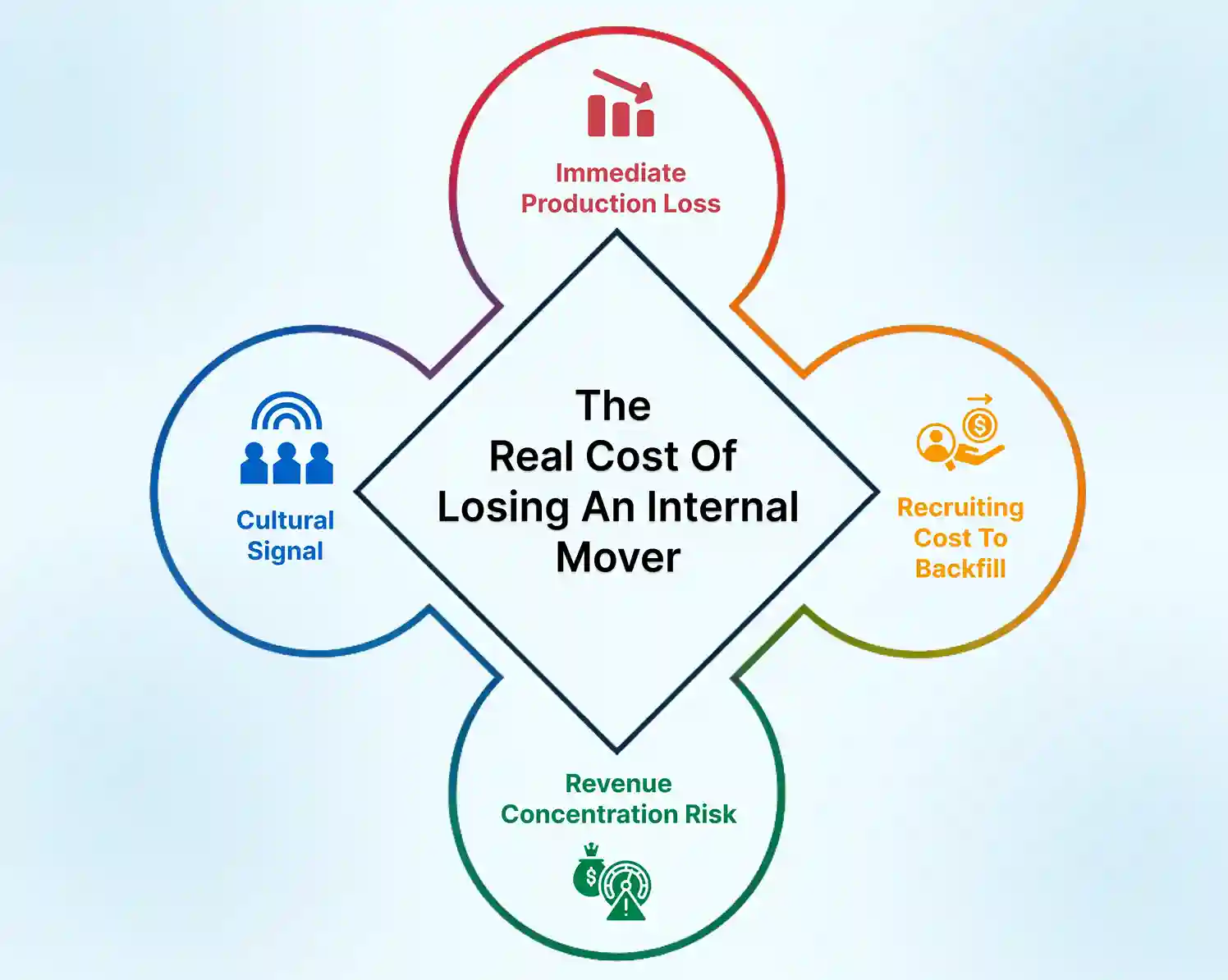
- Immediate production loss: A $5.47M producer doesn’t have a line-for-line replacement waiting in your pipeline. The gap is real and it’s felt in the company dollar immediately.
- Recruiting cost to backfill: The SHRM standard estimate of 6–9 months of salary equivalent for professional replacement applies in real estate too. For an agent at that production level, you’re looking at meaningful recruiting spend and months of ramp-up time before production returns to previous levels.
- Revenue concentration risk: According to Recruiting Insight's data, brokerages where 40–60% of total production relies on a small group of agents face "harsh financial consequences" if any of those agents leave. Most independent brokerages do not realize how concentrated their revenue base is until it shifts.
- Cultural signal: In a brokerage of 40–100 agents, when a productive, respected agent leaves, others notice. If the reason is “they wanted a different setup and couldn’t find it here,” that sends a signal about the brokerage’s flexibility and long-term value to agents in similar situations.
None of this appears on a P&L line item until the damage is already done. But the cost is real—and it’s largely preventable.
Calculate What One Internal Mover Is Worth to Your Brokerage
Use the Revenue Share ROI Calculator to model the production value of retaining a $5.47M producer vs. the true cost of replacing them externally.
Run Your NumbersWhy Internal Mobility Works: The Three-Layer Framework
Internal mobility outperforms external recruiting for three structural reasons that independent brokerages are positioned to exploit better than any national brand.
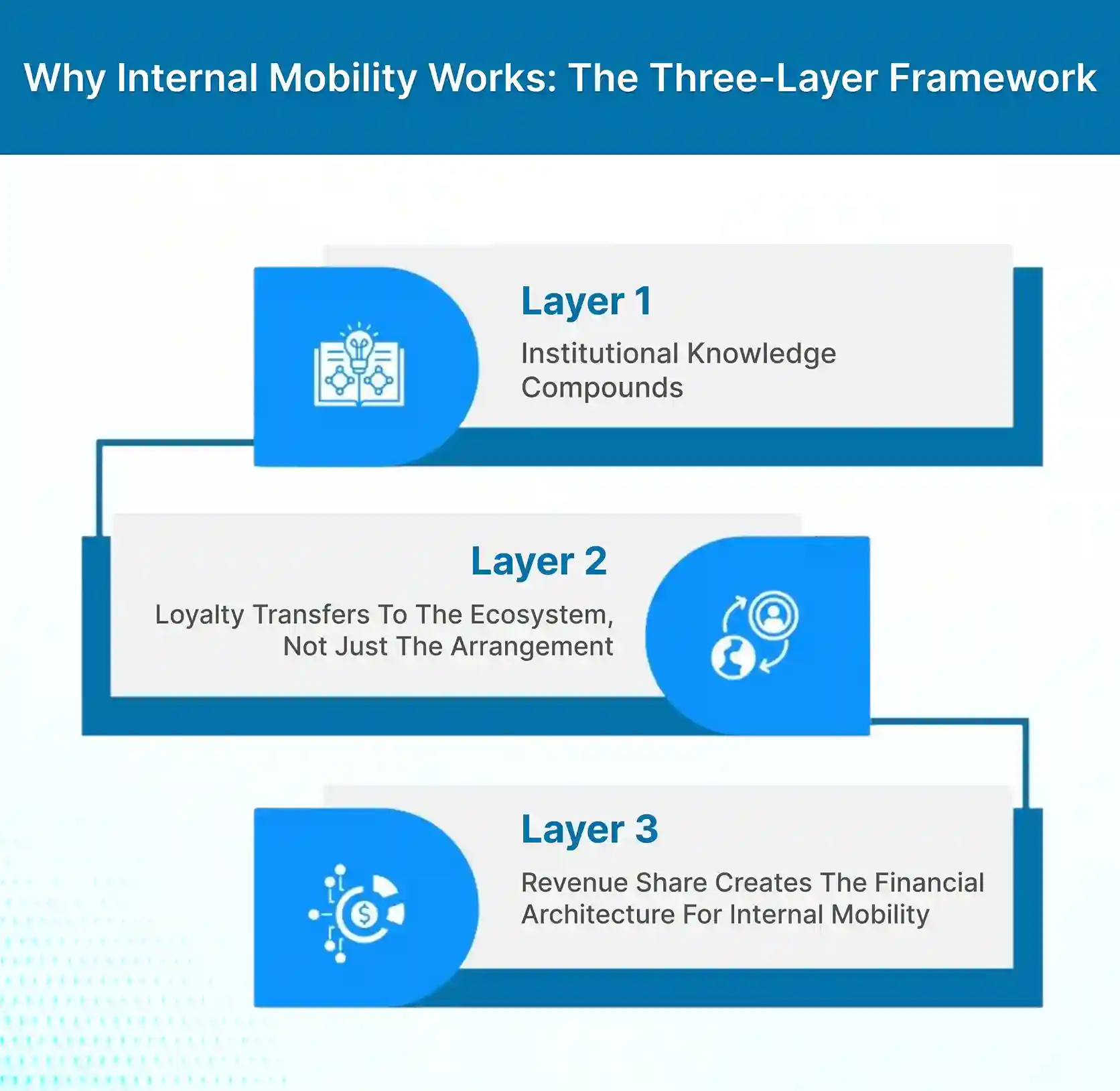
Layer 1: Institutional knowledge compounds
An agent who has been inside your brokerage for two or three years knows your systems, your culture, your compliance requirements, and your support infrastructure. When that agent moves to a new office or team arrangement within the same brand, there is no onboarding gap, no ramp period, and no period of cultural adjustment. They are immediately productive in their new context—which is exactly why the production numbers are higher than for external recruits who need months to reach full operating velocity.
Layer 2: Loyalty transfers to the ecosystem, not just the arrangement
An agent who has been facilitated through an internal transition has direct evidence that the brokerage invested in them as a person, not just as a production unit. That experience creates a qualitatively different kind of loyalty than competitive split matching can ever produce. It also creates a story the agent tells other agents, which is one of the most powerful recruiting tools available to an independent brokerage.
At RightAlly, we've seen independent brokerages achieve stronger long-term retention when they create structured career pathways instead of relying solely on continuous recruitment. Brokerages that proactively support role transitions, team restructuring, and leadership opportunities often retain productive agents who might otherwise explore competing firms.
Layer 3: Revenue share creates the financial architecture for internal mobility
A well-structured revenue share programme changes the internal mobility dynamic in a specific, measurable way. An agent who has built income tied to the agents and production around them has a direct financial reason to stay within the ecosystem even when their personal circumstances change—because the income stream they’ve built only exists if they stay affiliated. This is the structural difference between a brokerage with revenue share and one without: internal mobility isn’t just culturally encouraged, it’s financially rational.
What Internal Mobility Actually Looks Like in Practice
Internal mobility is not simply allowing agents to transfer between offices when they ask. That’s reactive management. The brokerages producing the 89% retention rates are doing something more deliberate: they are actively monitoring for internal friction signals and creating structured pathways for agents whose circumstances are changing before they decide to leave the brokerage.
Here are the four most common internal mobility scenarios in independent brokerages, and what a deliberate response looks like in each:
| Scenario | Friction Signal | Internal Mobility Response |
|---|---|---|
| Team breakup or partnership dissolution | Sudden production dip; conflict between agents; informal conversations about “needing a fresh start” | Proactive conversation before either agent considers leaving; offer a structural reset within the brokerage |
| Geographic expansion desire | Agent asking about licensing in adjacent markets; production shifting toward a different zip code cluster | Facilitate office association in the expanded area; create a structure that keeps the agent in the ecosystem |
| Career stage transition | High producer pulling back on volume; interest in mentorship or team building; lifestyle-driven production shift | Create a formal role evolution pathway—team lead structure, mentor programme, or reduced-commitment affiliation with maintained revenue share income |
| Technology or support mismatch | Complaints about workflow; requests for different tooling; conversations about “how other brokerages do this” | Address the operational friction directly; involve the agent in the solution; use the conversation to strengthen the relationship |
What separates high-retention brokerages from average ones isn’t that they never have agents in these situations. It’s that they see the signal before the resignation conversation and have a framework for responding to it.
Get the Complete Revenue Share Blueprint
Our 28-page Revenue Share Decision Guide walks through the full economics of building a retention-first brokerage—including how to structure a programme that makes internal mobility financially rational for your best agents.
Building an Internal Mobility System: Four Steps
An internal mobility system is not a policy document. It is an operational infrastructure with four components that work together.
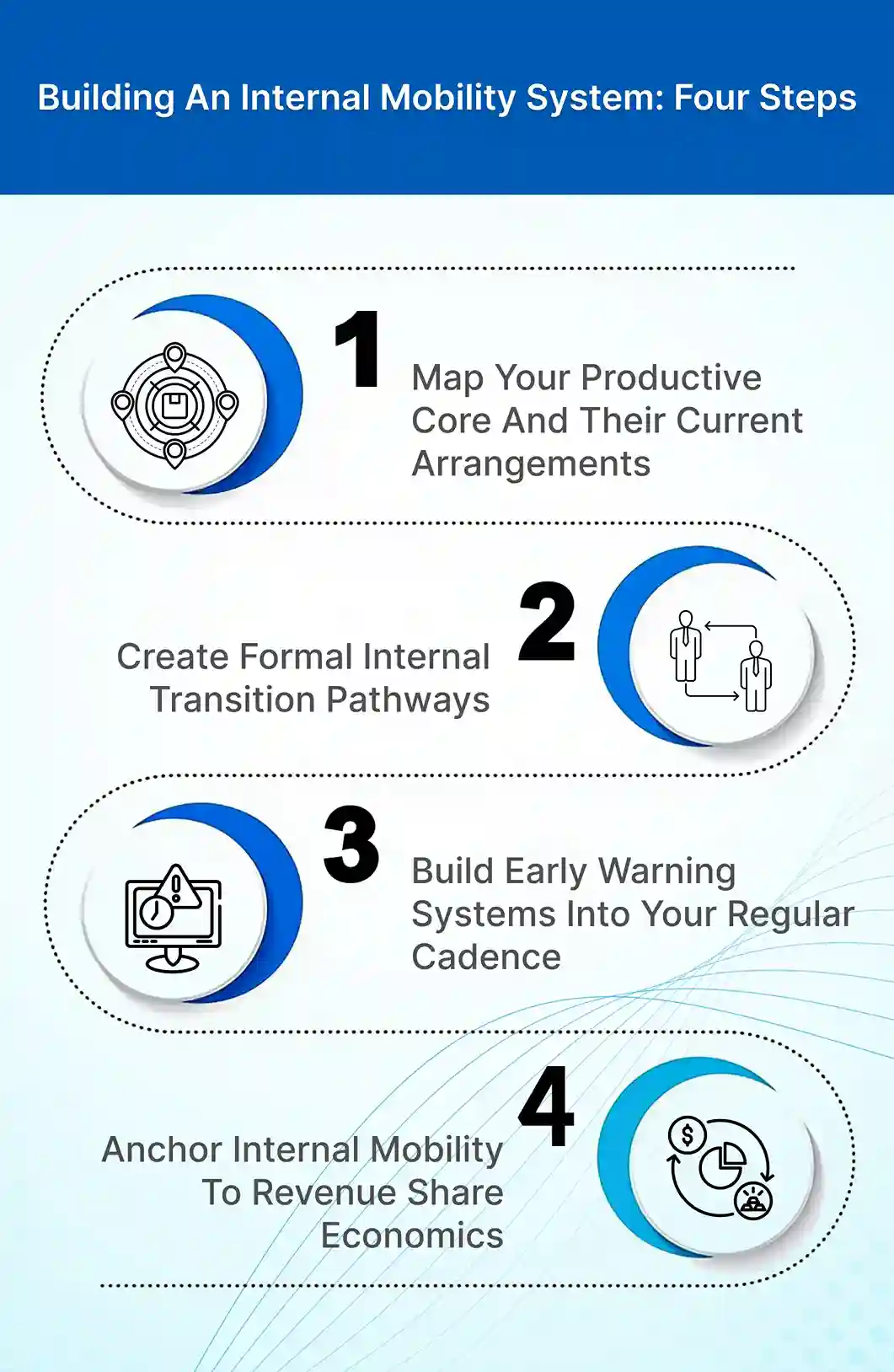
Step 1: Map your productive core and their current arrangements
The Q1 2026 data is consistent across multiple reports: 20% of agents generate the majority of consistent production. Before building a retention system, you need to know exactly who those agents are, what their current arrangements look like, and where the potential friction points are. This is a quarterly exercise, not an annual one. Agent circumstances change faster than annual reviews capture.
Step 2: Create formal internal transition pathways
Internal mobility without a defined pathway is just an agent having a difficult conversation with their broker and hoping for flexibility. Define the pathways explicitly: how an agent can move between offices, how a team lead can restructure their team arrangement, how a veteran producer can transition to a mentorship model. When agents know the pathway exists before they need it, they stay because staying has a visible future.
Step 3: Build early warning systems into your regular cadence
The retention data from Recruiting Insight’s 200 hours of exit interviews is unambiguous: most agent departures were preceded by 60–90 days of friction signals the brokerage didn’t act on. Build quarterly check-in conversations with your productive core into your operating rhythm. Not performance reviews. These should be relationship-focused conversations designed specifically to surface friction before it becomes a departure decision.
Step 4: Anchor internal mobility to revenue share economics
The highest-performing retention systems connect internal mobility to a financial architecture that makes staying economically rational. Revenue share does this by creating income tied to the agents and relationships an agent has built inside the brokerage—income that only exists if the agent stays affiliated. When an agent with meaningful revenue share income considers leaving, they are not just evaluating split competitiveness. They are evaluating the cost of walking away from an income stream they have already built. That is a fundamentally different retention conversation.
The Competitive Positioning Opportunity
Here is the structural advantage independent brokerages have that national brands do not: relationships.
A national cloud brokerage running 50,000 agents cannot maintain broker-to-agent relationships that detect career transition signals 60 days before they become a resignation conversation. That level of relationship-building doesn't scale easily. An independent brokerage running 40 to 200 agents absolutely can—and the ones that do are producing the retention numbers that make their cost-per-acquisition on productive agents significantly lower than any competitor running a headcount-growth model.
The Recruiting Insight Efficiency Ratio data backs this up: the Efficiency Ratio measures incoming production against outgoing production for each brokerage model. Top-performing firms across every model type are achieving ratios above 2.0. Underperformers fall below 1.0. The differentiator is not model label. It is execution—and the retention infrastructure that underpins execution.
Internal mobility is not a soft benefit. It is a measurable, trackable operating advantage that independent brokerages are structurally positioned to execute better than any brand competing on headcount.
Map Your Internal Mobility System With Our Team
Book a call to walk through your current agent arrangements, identify your productive core, and map what a revenue share-backed internal mobility programme could look like for your brokerage.
Book a CallThe Brokerages Winning Retention in 2026 Are Not Out-Recruiting—They’re Out-Retaining
The data from 2026 is consistent across every source that has looked at this market seriously: the gap between high-performing and average brokerages is not a recruiting gap. It is a retention infrastructure gap. The brokerages producing Efficiency Ratios above 2.0 are not doing it by hiring more recruiters. They are doing it by creating systems that keep the productive core inside the ecosystem as those agents’ careers evolve.
Internal mobility is the operational mechanism that makes that possible. Revenue share is the financial architecture that makes it economically rational. And the combination of the two—a brokerage where agents have a clear pathway to evolve their arrangements and a growing income stream tied to their continued affiliation—is a retention system that no competitor can replicate simply by offering a better split.
The 28% production advantage and the 89% retention rate are not industry averages. They are outcomes produced by brokerages that built this infrastructure deliberately. The window to build it before your competitors do is open now.
Frequently Asked Questions About Real Estate Team Infrastructure
Agent retention measures whether an agent stays with the brokerage at all — a binary yes/no metric. Internal mobility is one of the mechanisms that drives retention: it's the practice of helping an agent change offices, teams, or roles within the same brokerage instead of leaving for a competitor. In other words, retention is the outcome; internal mobility is a strategy for achieving it. A brokerage can have decent overall retention numbers while still losing its most valuable agents to external recruiters simply because it never gave them an internal option when their circumstances changed.
Most top-producing agents don't leave because they're dissatisfied with the brokerage itself — they leave because a specific arrangement no longer fits their circumstances and there was no internal alternative. Common triggers include a team or partnership breaking down, wanting to expand into a new geographic market, shifting from high-volume production to a mentorship or team-lead role, or friction with technology and support systems. When a brokerage has no formal pathway to address these changes internally, the agent's only remaining option is to leave for a different firm.
Using the SHRM standard estimate applied to real estate, replacing a professional-level producer typically costs the equivalent of 6–9 months of their production in recruiting spend and ramp-up time, on top of the immediate production gap left behind. For a high-producing agent (for example, one generating $5M+ in annual production), that means months of reduced revenue before a replacement reaches full output — plus recruiting costs, onboarding time, and the compounding risk that comes from revenue being concentrated in a small group of agents in the first place.
Benchmark data from Recruiting Insight's 2026 Annual Agent Migration Report found that agents who moved internally within the same brokerage retained at an 89% rate over 12 months, compared to 76% for agents recruited from outside. As a rough benchmark, brokerages retaining productive agents above the high-80s percentage range over a 12-month period are performing well; retention rates closer to the mid-70s or lower suggest a meaningful gap in internal mobility infrastructure.
Revenue share gives agents an ongoing income stream tied to the production of other agents they've recruited or mentored, and that income only continues if they stay affiliated with the brokerage. This turns retention from a purely relational or cultural matter into a financial one: an agent considering leaving isn't just weighing commission splits, they're weighing the cost of walking away from an income stream they've already built. Combined with internal mobility (a clear pathway to change roles or arrangements without leaving), revenue share makes staying the economically rational choice even when an agent's circumstances change.
Share this blog


Popular topics
Efficiency
Growth
Compliance
Technology
Agents
Trends



 +1 (765) 896-5271