


 Home
Home Blog
Blog
Table of Content
- Introduction
- The Wrong Question Most Broker-Owners Are Asking
- What a Roster of Solo Agents Actually Costs You
- Why Team Infrastructure Produces More: The Three-Layer Explanation
- What Team Infrastructure Actually Looks Like Inside an Independent Brokerage
- Four Steps to Build Team Programme Infrastructure in Your Brokerage
- The Independent Brokerage Advantage in This Shift
- The Brokerages That Act on This Data Now Will Own the Position
- Frequently Asked Questions About Real Estate Team Infrastructure
Key Takeaways
- Teams now outproduce solo agents industry-wide — 2026 RealTrends data shows teams generated $832.69B in volume, surpassing individual agents for the first time, with top teams averaging 3.5x the transaction sides of top solo agents.
- The real lever isn't headcount, it's infrastructure — recruiting more solo agents doesn't close the gap; building operational systems that let agents perform at team level does.
- Solo rosters carry hidden costs — higher production volatility, weaker recruiting appeal, an agent retention ceiling, and capped revenue share upside.
- Team infrastructure works through 3 layers — role specialization (more done per hour), accountability systems (less production variance), and knowledge transfer (faster-ramping new agents).
- Independent brokerages can compete here — this is an execution gap, not a brand-size gap; owners who know their agents personally can build team structures just as effectively as national brands.
For the first time in tracked industry history, real estate teams have surpassed individual agents in both production volume and transaction sides. The data landed three days ago. Most broker-owners haven’t read it yet. The ones who act on it first will have a meaningful head start on everyone else.
The RealTrends 2026 City Rankings, published on July 10, 2026, tracked 74,906 agents and teams across 5,249 cities, totaling $1.63 trillion in sales volume and 2.5 million transaction sides. The headline that matters for independent broker-owners: teams generated $832.69 billion in volume and nearly 1.29 million sides — surpassing individual agents in both metrics for the first time.
This isn’t a consumer story about whether homebuyers should use a team or a solo agent. It’s a brokerage strategy story about what happens to production when brokerages build the infrastructure to support team-level output — and what it costs them when they don’t.
The underlying production gap has been building for years. The RealTrends Verified 2025 rankings showed the top teams averaging 657 transaction sides compared to 185 for top individual agents — a 3.55x production difference. By 2026, teams have scaled to the point where they’re outproducing the entire individual-agent segment at the market level. That number is your Week 6 strategic question: is your brokerage built to capture that production advantage, or are you watching it flow to brokerages that are?
The Wrong Question Most Broker-Owners Are Asking
When an independent broker-owner looks at flat production numbers and asks “how do I grow?” the default answer in most brokerage playbooks is: recruit more agents. Add headcount. Widen the top of the funnel.
The 2026 production data suggests that’s the wrong lever. Brokerages that are pulling away from the pack aren’t doing it by adding more solo practitioners to a roster. They’re doing it by building the operational infrastructure that enables agents to produce at team level — and then recruiting into that infrastructure rather than around it.
The difference matters because it determines what your brokerage looks like to a productive agent evaluating their options. A brokerage that is genuinely structured to support team development — with accountability frameworks, operational support, lead infrastructure, and a financial model that rewards growth — looks fundamentally different from one that is essentially a licensing umbrella with a training calendar attached.
The RealTrends data is telling broker-owners something specific: the industry has voted with its production. Agents who want to build a real business are building it inside team structures. The brokerages winning the next phase of growth are the ones building the infrastructure those agents want to build inside.
What a Roster of Solo Agents Actually Costs You
Running a brokerage as a collection of independent solo practitioners has always carried hidden costs that don’t show up cleanly on a P&L. The 2026 production data makes those costs more visible by showing exactly what agents produce when they operate inside structured team environments versus without them.
Here is what a solo-roster brokerage model costs an independent broker-owner in practical terms:
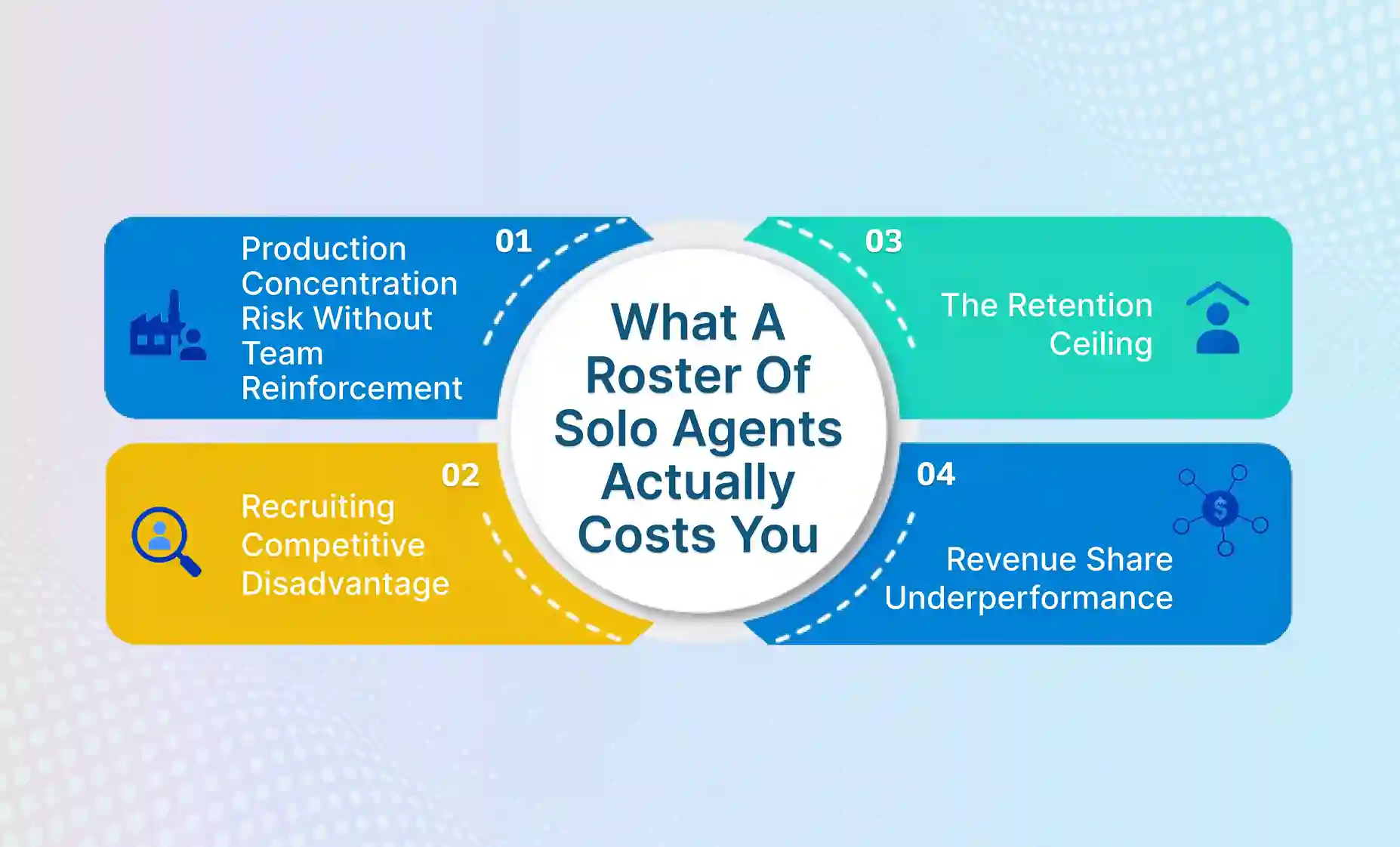
- Production concentration risk without team reinforcement: When your highest producers are solo practitioners, their production is entirely dependent on their individual capacity, health, and motivation. There is no team infrastructure to absorb a slow quarter, a personal disruption, or a market shift. The production volatility in solo-roster brokerages is structurally higher than in brokerages with team frameworks — and it gets more expensive as your productive core gets older and faces succession questions.
- Recruiting competitive disadvantage: Productive agents in 2026 are choosing their brokerage based on what infrastructure exists for them to grow. A brokerage that can articulate a genuine team development pathway — with accountability structures, operational support, and a financial model that rewards building a team — recruits differently than one that offers a split and a desk. The gap between these two value propositions is widening every quarter.
- The retention ceiling: Solo agents who grow their business eventually hit a ceiling. When they do, they have two options: build a team, or stay small. If your brokerage doesn’t have the infrastructure to support team building, the agents who outgrow the solo model leave to find a brokerage that does. You have invested in their development and absorbed their early-career inefficiency — and then lost them at exactly the point where the return on that investment was about to compound.
- Revenue share underperformance: Revenue share programmes generate the greatest long-term value when agents are building teams inside the brokerage — because team-building agents recruit other agents, expanding the production base that the revenue share pool draws from. A brokerage without team infrastructure limits the natural recruiting activity of its most productive agents and caps the upside of any revenue share programme it runs.
None of these costs appear as line items. All of them are real. And all of them compound over time in ways that are visible in the aggregate production data — which is exactly what the 2026 RealTrends numbers are now showing at the market level.
| Factor | Solo Agent Model | Team-Based Model |
|---|---|---|
| Productivity | Limited by a single agent's capacity | Shared responsibilities enable higher overall production |
| Lead Management | An individual agent manages all leads. | Leads are distributed based on availability and expertise |
| Client Service | Depends on a single agent's availability. | Multiple team members provide continuous client support. |
| Transaction Management | Agent handles every stage | Dedicated coordinators streamline operations |
| Knowledge Sharing | Individual learning | Shared expertise and mentoring accelerate growth |
| Scalability | Difficult to scale without hiring | Designed to support sustainable business growth |
| Business Continuity | High dependence on one individual | Team members reduce operational risk and maintain consistency |
While high-performing solo agents can build successful businesses, structured real estate teams typically achieve greater scalability, operational efficiency, and production by dividing responsibilities across specialized roles. This structural advantage helps explain why team-based production has continued to outperform solo-agent models in recent industry research.
Model What Team-Level Production Means for Your Brokerage Revenue
The Revenue Share ROI Calculator lets you run your own numbers in minutes — including what a 3.5x production advantage compounds to over 12 and 36 months for your specific agent count.
Run Your NumbersWhy Team Infrastructure Produces More: The Three-Layer Explanation
The 3.5x production gap between teams and solo agents is not a coincidence of talent distribution. It is a structural outcome produced by three operational advantages that team infrastructure creates and solo models cannot replicate.
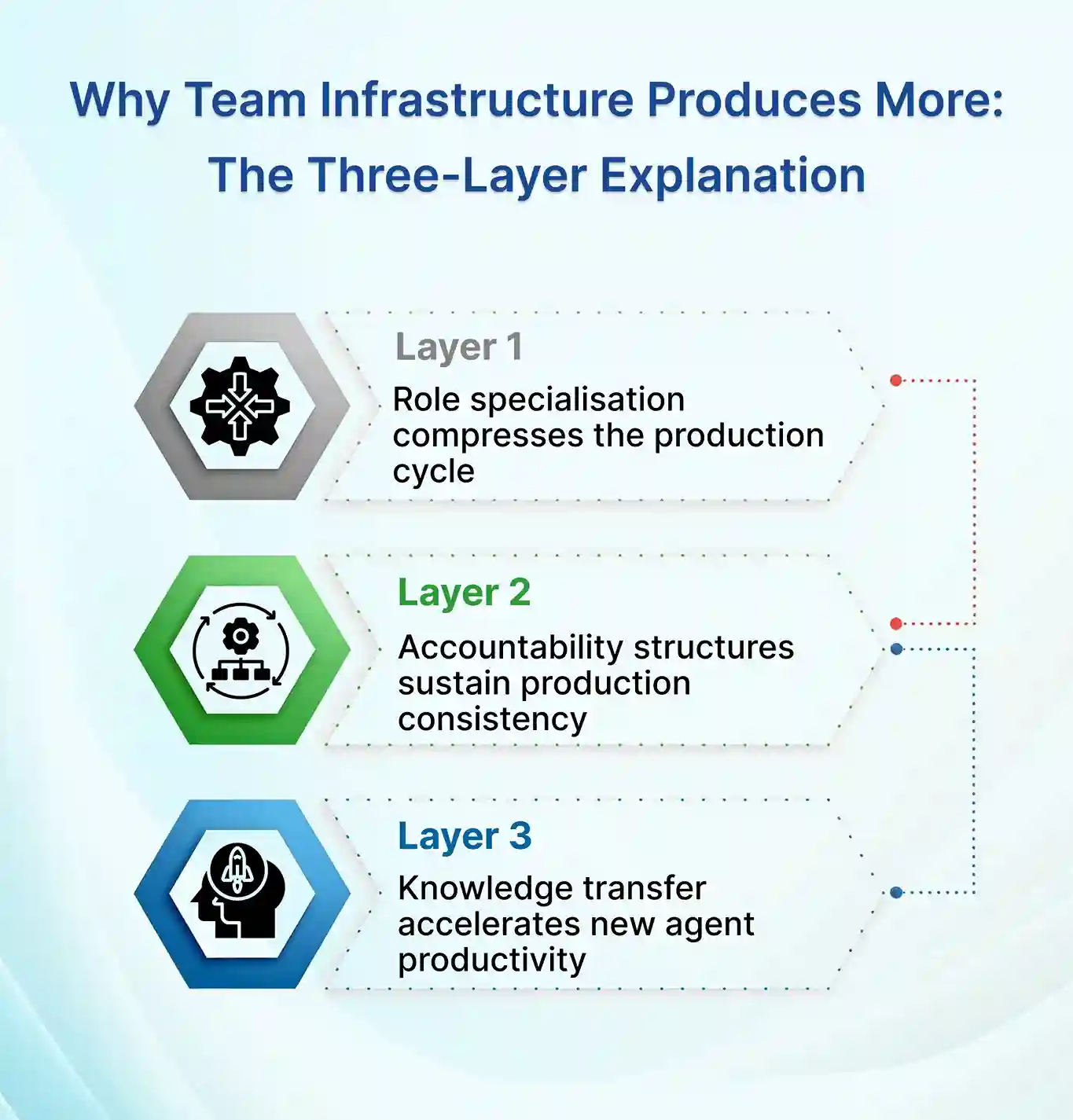
Layer 1: Role specialisation compresses the production cycle
A solo agent manages every step of every transaction personally: lead generation, qualification, showing, negotiation, contract management, coordination through closing, and post-sale follow-up. The time required to manage one transaction leaves less time for the next one. Team infrastructure solves this with role specialisation — agents who focus on lead conversion, transaction coordinators who manage contract-to-close, and administrative support that handles compliance and documentation. The result is more productive hours applied to higher-value activities, which is why teams can produce 3.5x the transaction volume of individual agents without 3.5x the headcount.
Layer 2: Accountability structures sustain production consistency
Solo agents often experience significant fluctuations in production. The Q1 2026 Recruiting Insight data found that roughly 80% of agents exhibit irregular production patterns — strong quarters followed by slow ones, driven by the natural ebb and flow of individual capacity. Team structures interrupt that pattern with accountability systems: daily check-ins on leading indicators, pipeline visibility tools, shared production goals, and peer reinforcement. Consistent accountability doesn’t just improve average production — it reduces the variance that makes individual-agent rosters difficult to forecast and manage.
Layer 3: Knowledge transfer accelerates new agent productivity
The most expensive period in any new agent’s tenure is their first 6 to 18 months — high brokerage overhead, low production, and significant broker attention required. Team structures compress this period dramatically because new agents operate inside a system with experienced agents demonstrating what actually works. They learn from live production rather than classroom instruction. The brokerages that have reduced early-tenure attrition most significantly are overwhelmingly the ones that have created structured team environments where newer agents learn alongside productive ones — not in separate training tracks.
Real estate team infrastructure is the combination of people, processes, technology, leadership, and operational systems that enable multiple agents to work together efficiently and consistently outperform solo agents. It typically includes lead distribution, transaction coordination, CRM systems, accountability frameworks, training programs, performance tracking, and administrative support. Instead of relying on the productivity of a single agent, team infrastructure creates repeatable systems that help brokerages scale production, improve agent retention, and deliver a more consistent client experience.
The Brokerage Profitability Scorecard takes 3 minutes and shows you exactly where the gaps are. Score your brokerage →
What Team Infrastructure Actually Looks Like Inside an Independent Brokerage
“Building team infrastructure” is not a synonym for “allowing agents to form teams.” Most brokerages already permit team formation. What separates the brokerages producing the 3.5x advantage is that they have made deliberate operational investments that make team development possible, sustainable, and scalable — rather than leaving it entirely to individual agents to figure out on their own.
Here is what that looks like in practice across four dimensions:
| Infrastructure Dimension | Passive Approach (most brokerages) | Active Team Infrastructure (3.5x brokerages) |
|---|---|---|
| Lead infrastructure | Agents source their own leads independently; brokerage provides no shared lead programme | Brokerage operates a lead generation programme that distributes qualified leads to team structures based on capacity and conversion performance |
| Accountability structure | Weekly or monthly production meetings; individual agents self-reporting | Structured accountability pods of 4–8 agents, daily leading-indicator check-ins, production dashboards visible to all team members, 1:1 coaching tied to actual pipeline data |
| Operational support | Shared transaction coordinator available on request; agents manage their own back-office | Dedicated TC support integrated into team workflow; compliance and document management handled at team level rather than individually |
| Financial architecture | Standard split structure; no income component tied to team development | Revenue share programme creates direct financial incentive for productive agents to recruit, develop, and retain teammates — compounding the team’s production base without additional broker recruitment cost |
The brokerages at the top of the 2026 RealTrends production rankings are not there because their agents are individually more talented. They are there because they have built operational environments where team-level production is the path of least resistance — and where the financial architecture reinforces staying and growing rather than leaving and going solo.
Download the Revenue Share Blueprint
The full 28-page Revenue Share Decision Guide walks through the financial architecture that makes team infrastructure economically rational for every agent inside your brokerage — including programme structures, economics modelling, and implementation frameworks built for independent brokerage scale.
Four Steps to Build Team Programme Infrastructure in Your Brokerage
Building team infrastructure is a sequenced operational project, not a policy announcement. Brokerages that have done it successfully share a consistent build sequence.
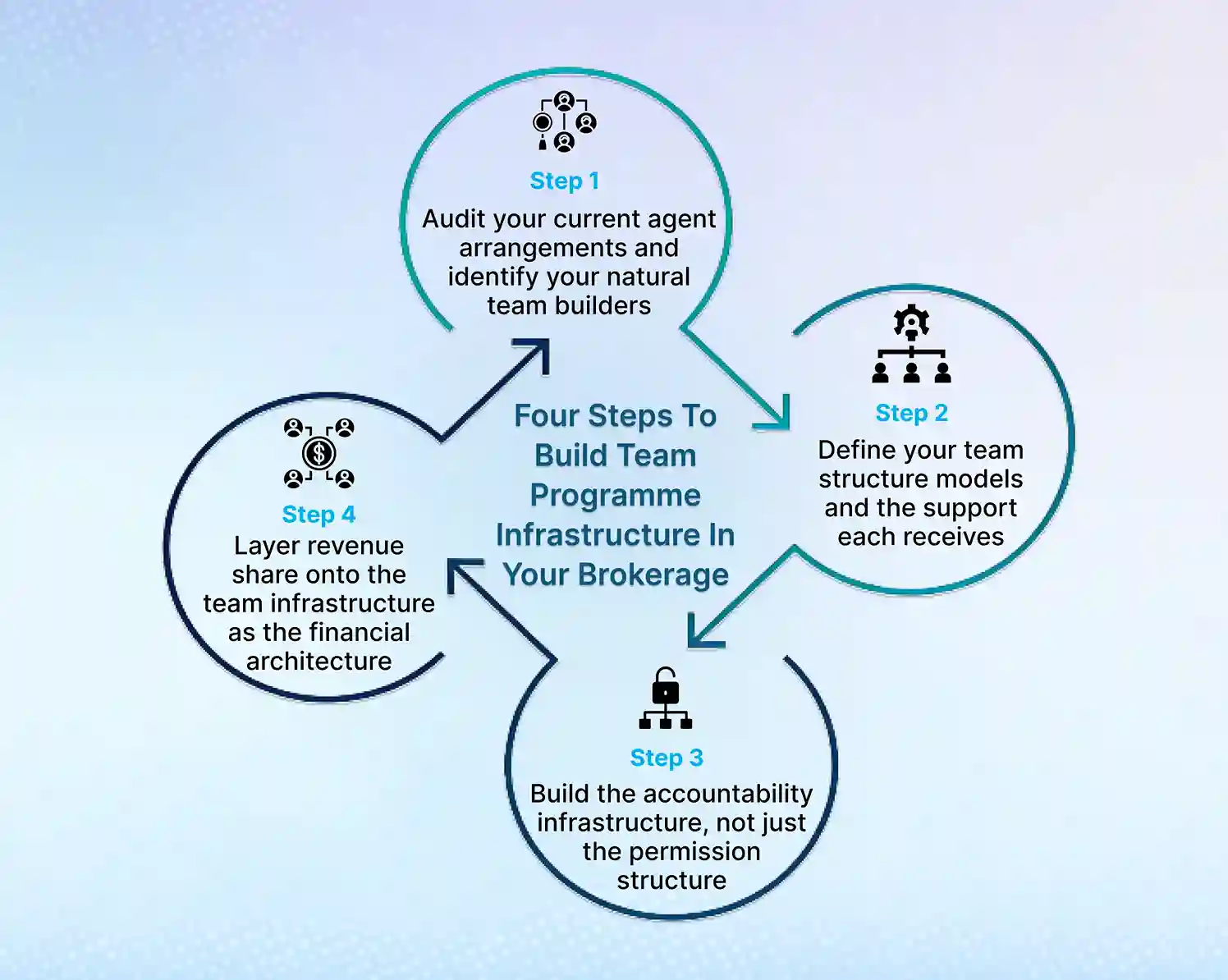
Step 1: Audit your current agent arrangements and identify your natural team builders
Before building infrastructure, map the terrain. In most independent brokerages of 30 to 150 agents, there are two or three agents who are already informally operating like team leads — mentoring newer agents, sharing systems, building referral networks inside the brokerage. These agents are your starting point. They want team structure; they’re already doing the work without the formal support. Identify them, have the conversation, and build your first team programme around their existing informal leadership. The infrastructure you build around them becomes the template for every team programme that follows.
Step 2: Define your team structure models and the support each receives
An independent brokerage can support multiple team structure types without requiring every agent to participate. The core question is: what specific operational support does the brokerage provide to agents who commit to building a team, and what are the thresholds that activate that support? Define this explicitly — lead programme access, dedicated TC support, accountability framework participation, co-marketing resources — and publish it internally so agents can see what team building looks like and what it costs versus what it returns. Clarity about the pathway is what converts a solo agent who is curious about building a team into one who actually starts.
Step 3: Build the accountability infrastructure, not just the permission structure
The operational gap in most brokerages is not that teams aren’t allowed — it’s that there is no accountability infrastructure to make team structures actually function at the production level the data shows is possible. Build the daily rhythms: leading-indicator check-ins, production dashboards, 1:1 coaching cadences for team leads, and shared performance visibility that creates natural peer accountability without requiring the broker to personally manage every agent’s production. Brokerages that have done this consistently report that it reduces early-tenure attrition in the first year and increases productive agent retention in years two through five — exactly the cohort that generates the most long-term brokerage value.
Step 4: Layer revenue share onto the team infrastructure as the financial architecture
Team infrastructure creates the operational conditions for higher production. Revenue share creates the financial conditions for agents to stay inside the ecosystem as that production grows. The combination is what produces the compounding retention and recruiting advantage that the 3.5x brokerages share. A productive agent who has built a team inside your brokerage, who has revenue share income tied to the agents they have developed, and who has an internal mobility pathway when their circumstances evolve — that agent has no rational reason to leave. That is the retention model the 2026 data is describing. Not a competitive split. A compounding ecosystem.
The Independent Brokerage Advantage in This Shift
There is a common assumption among independent broker-owners that team infrastructure is a large-brokerage advantage — that you need the resources of a national brand or a cloud platform to build the operational support that team development requires. The 2026 data does not support this.
The RealTrends 2026 City Rankings show that team production is rising fastest not among mega-brand models but in brokerages that have made deliberate investments in team operational support at the local level. The Efficiency Ratio data from the Q1 2026 Recruiting Insight research is consistent: the gap between high-performing and underperforming brokerages is not a model gap. It is an execution gap. Brokerages with the right systems — regardless of their brand affiliation or size — are outperforming headcount-first models at every level of the market.
The independent brokerage advantage in this shift is the same one that makes internal mobility more effective for independents than for large brands: relationships. An independent broker-owner who knows their 60 agents personally can identify natural team builders, have the development conversations that matter, and build the accountability structures that scale without requiring a corporate infrastructure budget. That relational intelligence, applied to deliberate team infrastructure investment, is a growth model that national brands cannot replicate at the local level.
The 3.5x production gap is not a destination that only large brokerages reach. It is an infrastructure outcome that independent brokerages can produce — when they stop asking “how do I recruit more agents?” and start asking “how do I build the infrastructure that makes every agent in my brokerage produce more?”
Map Your Team Infrastructure and Revenue Share Model Together
Book a call with our team to walk through your current agent arrangements, identify your natural team builders, and map what a team programme plus revenue share architecture could look like for your brokerage — with your numbers, not generic projections.
Book a CallThe Brokerages That Act on This Data Now Will Own the Position
The July 2026 RealTrends City Rankings are three days old. The industry conversation about what this data means for broker-owners has barely started. The brokerages that build team infrastructure in the next 90 days will have a competitive positioning advantage that will be significantly harder to close once the rest of the market catches up.
The production gap itself is not going to close. The structural advantages of team infrastructure — role specialisation, accountability, knowledge transfer, financial architecture — compound over time. The brokerages that are outproducing the market in 2026 built their team infrastructure in 2023 and 2024. The brokerages that will outperform in 2028 are building theirs now.
The question is not whether team infrastructure produces a production advantage. The data has answered that. The question is whether your brokerage is the one that captures it in your market — or whether you are the one watching a competitor do it instead.
Frequently Asked Questions
Real estate team infrastructure refers to the people, processes, technology, and operational systems that enable multiple agents to work together efficiently. It typically includes lead distribution, transaction coordination, CRM systems, accountability frameworks, training programs, and administrative support. A well-designed team infrastructure helps brokerages improve productivity, retain agents, and scale operations more effectively than relying on individual agents alone.
Real estate teams often outperform solo agents because responsibilities are divided among specialized roles, such as lead generation, transaction coordination, and client support. This structure allows agents to focus on high-value activities while improving efficiency, consistency, and overall production. Recent industry data also shows that team-based models generate significantly higher transaction volumes than individual agents.
An independent brokerage can build team infrastructure by identifying potential team leaders, creating structured team models, implementing accountability systems, providing operational support, and offering financial incentives such as revenue share programs. Investing in technology, transaction coordination, and coaching also helps create an environment where teams can grow and perform consistently.
Team infrastructure helps brokerages increase agent productivity, improve retention, reduce operational risk, and create a more scalable business model. It also supports faster onboarding for new agents, encourages collaboration, and enables brokerages to compete more effectively by providing structured systems instead of relying solely on individual performance.
Before recruiting more agents, broker-owners should evaluate whether their brokerage has the operational infrastructure to support sustainable growth. Strengthening lead management, accountability frameworks, transaction support, training, and team development often delivers greater long-term results than simply increasing headcount. A strong infrastructure enables both new and experienced agents to achieve higher levels of productivity.
Share this blog


Popular topics
Efficiency
Growth
Compliance
Technology
Agents
Trends




 +1 (765) 896-5271