


 Home
Home Blog
Blog
Table of Content
Key Takeaways
- The problem isn't recruiting effort — it's incentive. You're the only person in your brokerage financially motivated to recruit. Agents don't help grow the brokerage because there's nothing in it for them directly.
- Revenue share fixes that. When an agent introduces a colleague, a small percentage of company dollar from that colleague's transactions flows back to them automatically — for as long as they produce.
- It drives recruiting, retention, and warmer referrals at once. Agents gain income for recruiting, a reason to stay (they won't walk away from built-up passive income), and their referrals convert better since they come from lived experience, not a sales pitch.
- Results show up in 3–6 months. Language shifts first (agents say “ours,” not “mine”); broker-owner time shifts next, from cold outreach to warm conversations, typically by month six.
- You can build it without replacing anything. RightAlly sets up revenue share in 14 days, no CRM or platform swap, starting at $20/agent/month.
You spent most of this week on recruiting. Calls that went to voicemail. A coffee meeting with an agent who seemed interested and then went quiet. A follow-up that never got a reply. You added up the hours on Friday evening and it was somewhere between eight and twelve, depending on how you count it.
You added one agent this month. Maybe. They are still deciding.
Meanwhile a broker-owner on the other side of your market — one who started with a fraction of your experience and relationships — added three agents in the same period. You know two of them. One was a referral from an agent already on their roster. The other two came through a conversation that one of their agents started without being asked.
(Illustrative example — individual results vary by market, roster size, and how a program is run. This isn't a guaranteed outcome.)
That is not a coincidence. That is a system. And you do not have it yet.
The Real Problem Is Not How Hard You Are Recruiting
Most broker-owners look at their growth problem and see a recruiting problem. They think the answer is more outreach. A better pitch. A bigger event budget. A new recruiting coordinator.
That is the wrong diagnosis.
The real problem is that you are the only person in your brokerage with a financial reason to recruit. Every agent on your roster benefits when the brokerage grows — better resources, stronger brand, more referral opportunities. But none of them have a direct financial incentive to go out and bring someone in. So they don't. Not because they don't care about the brokerage. Because the incentive isn't there.
You are trying to grow a brokerage through one person's effort — yours — when the brokerages that are growing fastest are growing through many people's effort. Not because their broker-owner works harder. Because they built a structure that gives every agent a financial reason to recruit.
The System: How Revenue Share Turns Your Agents Into Recruiters
Here is how it works. Not the theory — the mechanism.
The Basic Structure
An agent on your roster introduces a colleague. That colleague joins your brokerage and starts closing transactions. A small percentage of the company dollar from those transactions — the revenue your brokerage keeps after the split — flows back to the introducing agent. Automatically. On a regular schedule. For as long as the introduced agent is producing at your brokerage.
That single mechanism changes three things simultaneously.
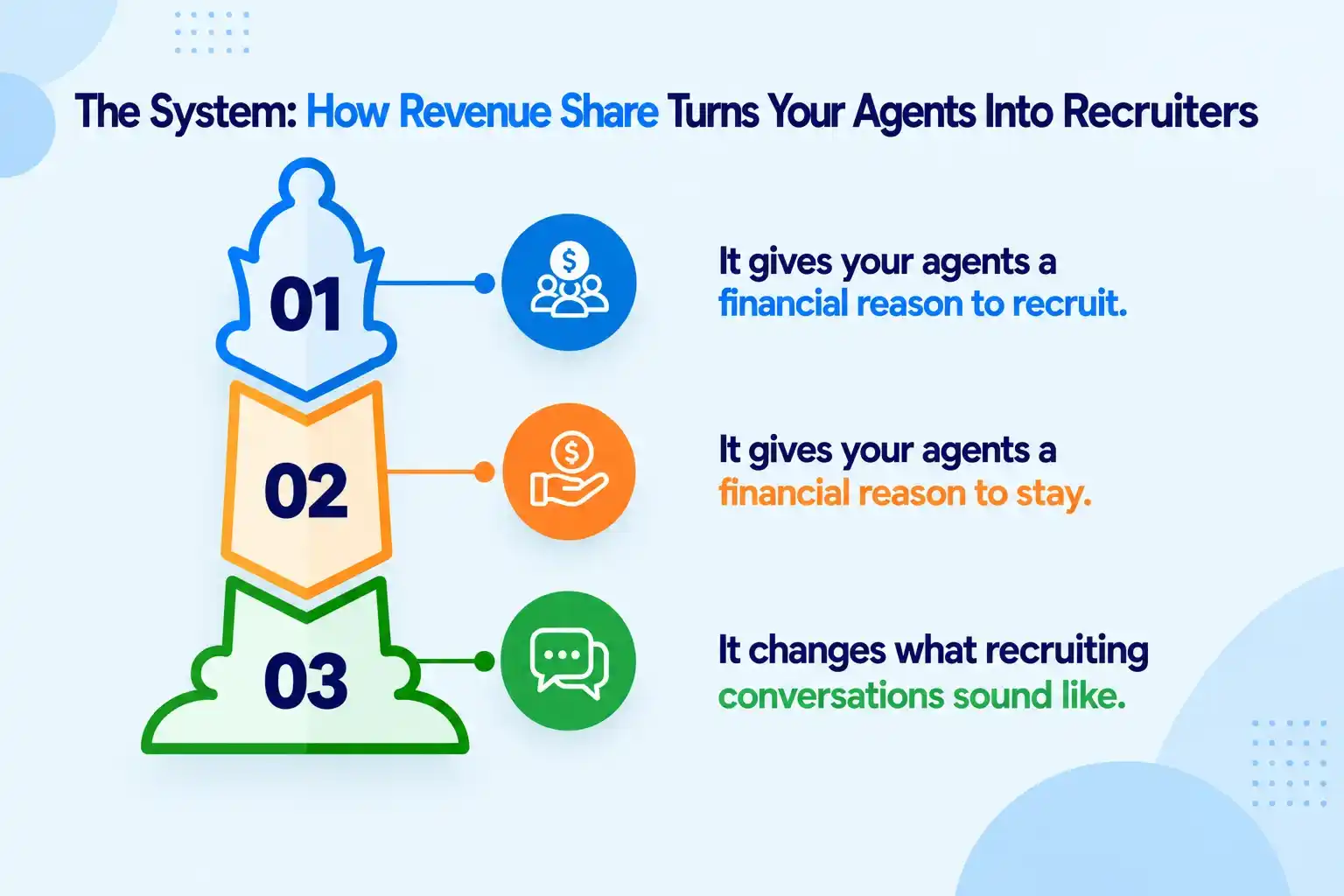
It gives your agents a financial reason to recruit- Not because you asked them to. Because every introduction they make generates ongoing income for them. An agent who introduces two strong producers to your brokerage is building a passive income stream alongside their commission income. That is a financial incentive that no recruiting conversation, no commission bump, and no office perk can replicate.
It gives your agents a financial reason to stay- An agent who has built meaningful revenue share income does not walk away from it easily. Walking away means losing an income stream they spent months or years building. That changes the calculation every time a competitor recruiter calls. Split offers become less compelling when they come at the cost of passive income.
It changes what recruiting conversations sound like- When one of your agents introduces a colleague, they are not delivering a sales pitch. They are sharing a programme they are personally invested in. That personal advocacy is more credible than anything you can say about your own brokerage. The referred agent talks to someone who has lived it, not someone trying to sell it.
The result is a brokerage that grows through relationships rather than through one person’s cold outreach. Your agents recruit the people they know — agents in their network, former colleagues, people they have worked with in the field. These are warmer conversations with better conversion rates than any call list you could build.
And you did not have to make a single call to start them.
See what a revenue share programme generates for your specific brokerage — your agent count, your market, your goals. Takes 3 minutes.
Run Your Numbers →Revenue Share vs. Traditional Recruiting at a Glance
| Factor | Traditional Cold Recruiting | Revenue Share Model |
|---|---|---|
| Who does the recruiting | Mostly the broker-owner | Broker-owner + any agent on the roster |
| Agent incentive to refer | None beyond loyalty | Ongoing share of company dollar per referral |
| Typical lead source | Cold calls, events, ads | Warm introductions from existing agents |
| Effect on retention | No direct effect | Leaving means forfeiting future revenue share income |
| Time to see an effect | Ongoing, effort-dependent | Typically several months to build momentum |
What Actually Changes When the System Is Running
The financial outcomes are real. But they are not the first thing broker-owners notice when revenue share starts working.
The first thing they notice is the language. Agents who are connected through a revenue share network start referring to the brokerage as “ours” rather than “mine.” They talk about colleagues in the network differently — with a stake in their success rather than as separate contractors who happen to share an address. That shift is not manufactured by a culture initiative. It is a direct result of agents having a financial interest in each other.
The second thing that changes is the broker-owner's week. Not immediately — it takes three to six months for the recruiting shift to become visible. But by month six, broker-owners consistently describe spending less time on cold outreach and more time in warm conversations. Referrals from agents inside the programme replace a meaningful portion of the cold calls that used to define recruiting.
(Timelines vary by brokerage size and market — treat "three to six months" as a general pattern, not a fixed guarantee for every roster.)
Industry recruiting data confirms what broker-owners experience: top brokerages that recruit agents for every one they lose still achieve minimal net growth because the agents coming in are less productive than the ones leaving. The recruiting treadmill — constant effort, minimal compounding — is the default for brokerages without a retention structure. Revenue share is what gets brokerages off the treadmill.
(This reflects a general industry pattern rather than a single verified statistic — figures on agent turnover and net growth vary by source, brokerage size, and market, so use it directionally.)
The broker-owners who built this system early are not running harder. They are running a different race.
Download the Checklist (free, one page) →
Quick Reference: Core Decisions Before You Launch
| Decision | Why it matters |
|---|---|
| Payout percentage | Too low won't motivate referrals; too high erodes brokerage margin |
| Eligibility rules | Determines who can refer and who qualifies as a new introduction |
| Payout duration | Whether the share continues indefinitely or for a capped period |
| Compliance review | Confirms the structure meets state licensing and disclosure requirements |
| Rollout communication | How the program is introduced to your current roster shapes early adoption |
Build This at Your Brokerage
The broker-owner adding three agents a month through agent referrals is not doing something you cannot do. They built a structure that creates the incentive. You can build the same structure — inside your own brokerage, without joining their platform, without replacing the CRM or transaction management system you already use.
Frequently Asked Questions
A traditional referral fee is usually a one-time payment tied to a single closed transaction. Revenue share is ongoing — it pays out on a percentage of company dollars for as long as the referred agent keeps producing, which is what creates the retention effect.
No. It's a separate structure layered on top of your existing commission split model — it doesn't change how individual agents are paid on their own transactions.
Costs vary by provider. RightAlly advertises a starting price of $20 per agent per month for setup, in addition to the revenue share payouts themselves. Confirm current pricing directly with any provider before committing.
A commonly cited range is three to six months before referral-driven recruiting becomes a noticeable share of new agent additions — though this depends on roster size and how actively the program is promoted internally.
RightAlly helps independent broker-owners launch revenue share in 14 days. No technology replacement. No platform to join. Starts at $20 per agent per month.
Book a 20-minute call. We will design the programme structure for your specific brokerage, model the economics, and tell you whether it makes sense. No sales deck. No pressure. Just the conversation.
Book a CallShare this blog


Popular topics
Efficiency
Growth
Compliance
Technology
Agents
Trends




 +1 (765) 896-5271