


 Home
Home Blog
Blog
Table of Content
Key Takeaways
- Revenue Share Transforms Brokerage Growth Over Time: Revenue share typically progresses through four stages: initial curiosity in Month 1, early agent introductions in Months 2–3, visible cultural and retention improvements in Months 4–6, and compounding growth through second-tier introductions in Months 7–12.
- Agents Become Active Contributors to Brokerage Growth: Instead of relying primarily on the broker-owner for recruitment, agents gain a financial incentive to introduce new agents and support their success. This gradually creates a more self-sustaining recruitment engine.
- Revenue Share Can Improve Agent Retention and Culture: Shared financial interests encourage agents to collaborate, share market intelligence, support colleagues, and develop a stronger sense of ownership. By Months 4–6, this can contribute to improved early-tenure retention.
- Broker-Owners Gradually Depend Less on Cold Recruiting: Revenue share does not eliminate recruiting work immediately. However, as agents begin generating warm and second-tier introductions, the broker-owner's recruiting workload can shift away from cold outreach toward higher-quality conversations.
- Compounding Growth Depends on Proper Programme Design: Revenue share does not automatically compound. Clear eligibility rules, adequately funded payouts, consistent communication, and positioning the programme around recruitment, retention, and culture—not recruitment alone are essential for long-term success.
The question I hear most from broker-owners who are close to launching revenue share is not about the economics. It is a simpler and more personal question: “But what actually changes?”
Most revenue share content — including our own foundational guides — focuses on the financial structure. How the programme is funded. What percentages work. How to model Year 1 versus Year 3. Those answers matter, and broker-owners need them before they commit to anything.If you haven't yet decided whether the model fits your brokerage at all, that's a separate — and earlier — question: see Is Revenue Share Right for Your Brokerage?
But they are not the question broker-owners are really asking when they say “what actually changes.” The real question is: what does my brokerage feel like six months in? What do my agents do differently? What does my day look like? What becomes possible that isn’t possible right now?
This article answers those questions in the most honest and specific way possible — through observable behaviours and patterns across the first year.These patterns are drawn from what we consistently see across the independent brokerages RightAlly has helped design and launch revenue share programmes for — not hypothetical projections or a single invented case study, but recurring behaviour we track across many launches. What actually happens in a brokerage when revenue share is running and working.
The answer is worth knowing. In a market where national platforms are scaling at unprecedented speed through revenue share, and where top-producing agents are actively evaluating their options, the independent broker-owner who understands what this mechanism creates — not just what it costs — is operating with a significant advantage.
The First Year at a Glance
The table below summarizes the structural, cultural, and personal changes at each stage of Year 1. Read it first if you want the whole arc before the detail.
| Timeframe | Structural Change | Cultural Change | Broker-Owner Change |
|---|---|---|---|
| Month 1 | Programme document distributed; first informal introductions begin | Agents start asking about the brokerage's future direction | Starts fielding warm enquiries from outside the brokerage |
| Month 2–3 | First formal introductions convert to new agents | Agents shift language from "I" to "we" | Cold recruiting workload begins to ease slightly |
| Month 4–6 | Payouts become regular and measurable | Agents collaborate more, cover for colleagues, share market intelligence | Early-tenure attrition pattern starts to change |
| Month 7–12 | Second-tier introductions appear (agents introduced by agents who were introduced) | Culture is replicable enough to discuss expansion | No longer the sole origin of every new agent relationship |
Before the Launch: The Honest Starting Point
Before describing what changes, it is worth being precise about what the starting point looks like for most independent brokerages before revenue share.
This description is not a criticism. It is the honest reality of most independent brokerages operating without a structured retention incentive. The broker-owner has built real relationships, a real culture, and a real local brand. What they are missing is the financial architecture that turns those strengths into a self-sustaining growth mechanism.
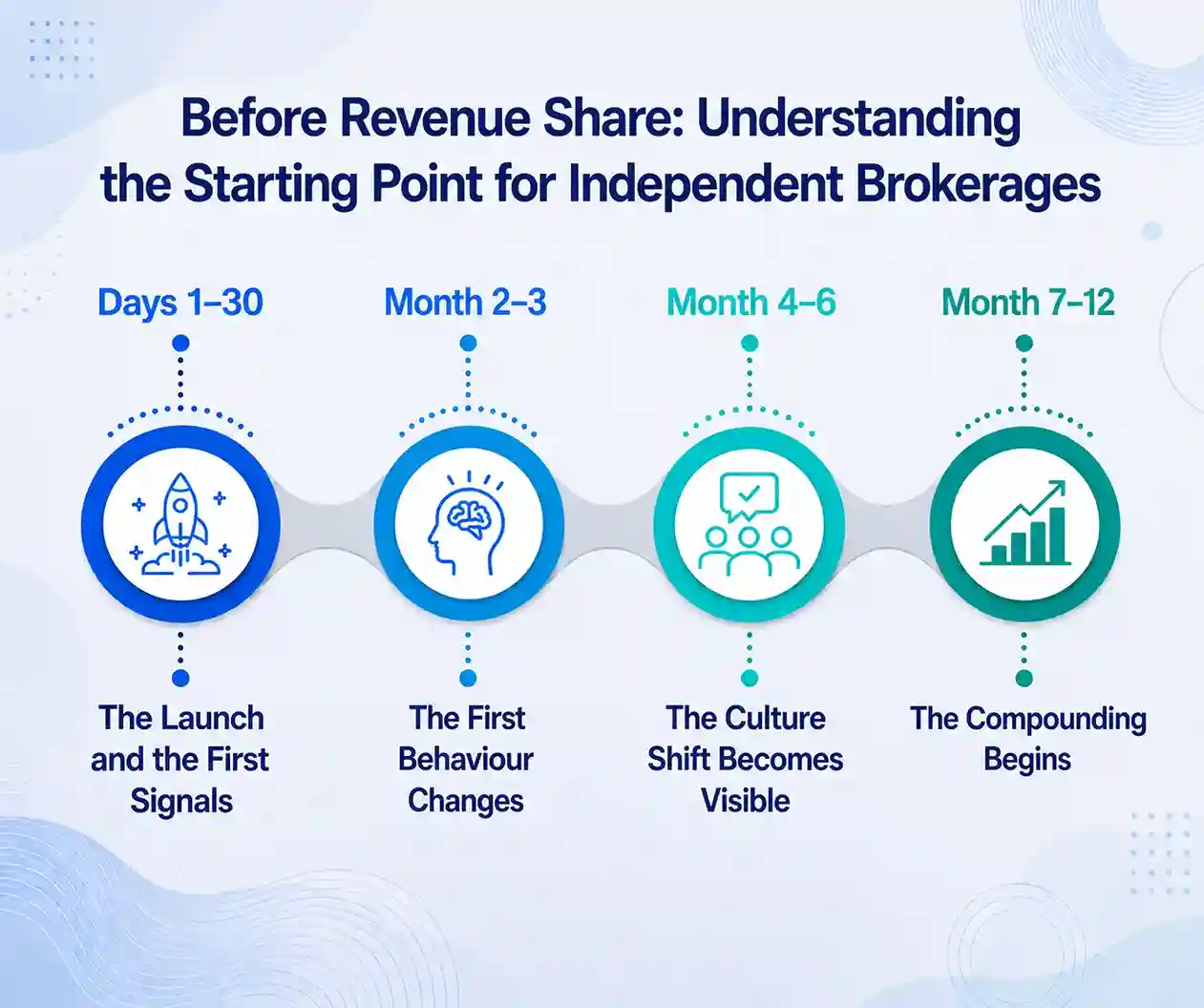
The first month is quieter than most broker-owners expect. The programme document goes out to agents — ideally a one-page summary they can read and understand in three minutes. Some agents are immediately curious. A few are sceptical and want to understand the specifics before they engage. And then there are the agents who light up almost immediately: typically the ones who have been informally referring to colleagues for years without any financial recognition, who see immediately that revenue share formalises something they were already doing naturally.
The first introductions happen informally. An agent mentions the programme to a contact from a previous office. Another brings it up at a networking event. These early conversations are exploratory — agents are still feeling out what the programme means in practice. But something has already shifted in how they talk about the brokerage.
The broker-owner notices this first. Agents are asking questions about the brokerage’s future — questions about where the programme is going, how it will grow, what it will look like in two years — that they were not asking before. The programme has given them a reason to think about the brokerage as something they are building together rather than something they work within. That shift in perspective is subtle in Month 1 but becomes significant by Month 6.
The broker-owner also begins fielding a different kind of enquiry from outside the brokerage: the warm conversation from an agent who has heard about the programme from someone already inside. These conversations are qualitatively different from cold recruiting calls. The agent already has context, already has a positive impression, and is asking more specific questions about their future at the brokerage rather than simply comparing splits.
The early signal period. By the second and third months, the agents who engaged immediately are starting to produce visible results. A few formal introductions have been made. Some of those introductions have resulted in new agents joining. The referring agents are tracking their programme income and talking about it — both within the brokerage and outside it.
The language shift begins here. This is the change that surprises broker-owners most when they look back on Month 2–3. Agents who are participating in the revenue share programme start saying “we” instead of “I” when they talk about the brokerage. Not because anyone told them to. Because they have a shared financial stake in the people around them — and that stake changes how they relate to those people and to the brokerage itself.
Early-tenure agents who joined through a revenue share introduction also experience something different from typical new-agent onboarding: the agent who introduced them has a financial reason to help them succeed. That built-in support relationship improves the new agent’s first-year experience in ways that are hard to measure but easy to observe. They feel more connected to the brokerage from day one. They are less likely to drift in the direction of a quiet departure.
The broker-owner notices the cold recruiting workload beginning to ease slightly. It is not dramatic in Month 3 — but the ratio of warm conversations to cold outreach has shifted. Some of the most productive conversations are now happening because an agent on the roster made an introduction rather than because the broker-owner worked a referral network personally.
See What This Generates for Your Specific Brokerage
Model your Year 1, Year 2, and Year 3 revenue share projections based on your agent count and production profile. Takes about 3 minutes.
Run Your NumbersThis is the period most broker-owners describe as the moment they felt the programme had genuinely taken hold. The financial changes are becoming measurable. The programme is paying out regularly. Agents who have built even modest revenue share income are actively talking about it with their professional networks.
But the most significant change in Month 4–6 is not financial. It is cultural. Agents who are connected through revenue share relationships start collaborating differently. They share market intelligence. They refer clients to each other when capacity is a factor. They are more likely to cover for a colleague during a difficult transaction because that colleague’s production directly affects their own income.
The brokerage starts to feel, from the inside, like a team with shared financial interests rather than a collection of independent contractors who happen to share an office or a platform. This distinction matters significantly for both recruitment and retention.
For recruitment, the culture change is visible to candidates who are evaluating the brokerage. When a prospective agent has a conversation with a current agent during a site visit, what they hear is qualitatively different from what they would have heard a year earlier. Agents describe the brokerage as “ours” and talk about their colleagues’ success as something they care about. That authenticity is more compelling than any recruiting pitch.
For retention, Month 4–6 is when the early attrition pattern begins to change. Agents who have been at the brokerage for less than a year — historically the highest-risk group — are staying at higher rates because they are connected to the brokerage through both relationship and financial architecture. An agent with a developing revenue share income has a direct financial cost to leaving that a split-only arrangement does not create.
The second half of the first year is where revenue share shows its most distinctive quality: it compounds. The agents who joined through revenue share introductions in Months 1–3 have now settled into the brokerage. They are producing. And a subset of them — the ones who saw the programme’s potential immediately — have started making their own introductions.
The recruiting dynamic has shifted structurally. The broker-owner is still involved in recruiting conversations, but they are no longer the sole origin of every new agent relationship. Some of the most productive new additions in Month 7–12 arrive through second-tier introductions — agents who were introduced by a current agent, who were then introduced by someone that first agent brought in. The network is beginning to generate its own momentum.
The warm-to-cold ratio in recruiting conversations has shifted meaningfully. The broker-owner is spending proportionally more time in conversations with agents who already have positive context about the brokerage — because someone they trust told them about the programme — and proportionally less time in cold outreach to agents who have no existing connection to the brokerage or its people.
For brokerages that have built a stable first-year foundation, Month 7–12 is also when expansion becomes a realistic conversation. The first market is producing consistently. The programme is running smoothly. The culture it has created is replicable. The broker-owner who has been thinking about a second office or a second market finds that the conditions for that conversation have materially improved: the retention foundation is strong enough that growth in a new location does not require abandoning what has been built in the first.
There is a financial dimension to this that is worth naming directly. Retention is widely cited by valuation professionals as a key driver of EBITDA stability at independent brokerages, and EBITDA stability is a major factor in how a brokerage is valued at sale. A broker-owner who builds revenue share in Year 1 is not just improving their competitive position for agents. They are building enterprise value. The retained, productive agent base they are developing through the programme is the most significant asset a brokerage can demonstrate to a future buyer or strategic partner.(Valuation outcomes depend on many factors beyond retention — market conditions, transaction volume, and overall brokerage financials among them. This is a directional observation, not a valuation guarantee.)
What the Broker-Owner Stops Doing
The changes described above are mostly about what the brokerage becomes. But for broker-owners who have been carrying the weight of a growing brokerage largely alone, the more personal changes are about what they stop doing.
| Behaviour | Before Revenue Share | By Month 9–12 |
|---|---|---|
| Recruiting | Broker-owner is the sole or primary source of every new agent relationship | A meaningful share of new agents arrive through agent-to-agent introductions, including second-tier ones |
| Growth responsibility | Growth depends entirely on the broker-owner's personal effort | Agents with programme income have a direct financial reason to contribute to growth |
| Early-tenure retention | Broker-owner personally invests significant time supporting new agents | The introducing agent has a financial incentive to support the new agent, sharing that load |
They stop cold-recruiting at the same volume
Not immediately. And not completely. But the proportion of the broker-owner’s time spent in cold recruiting conversations shifts as the programme matures. The warm introductions generated by programme participants gradually replace some of the outreach that previously had to come from the broker-owner alone. By Month 9–12, many broker-owners describe their recruiting mix as qualitatively different from what it was before the programme launched.
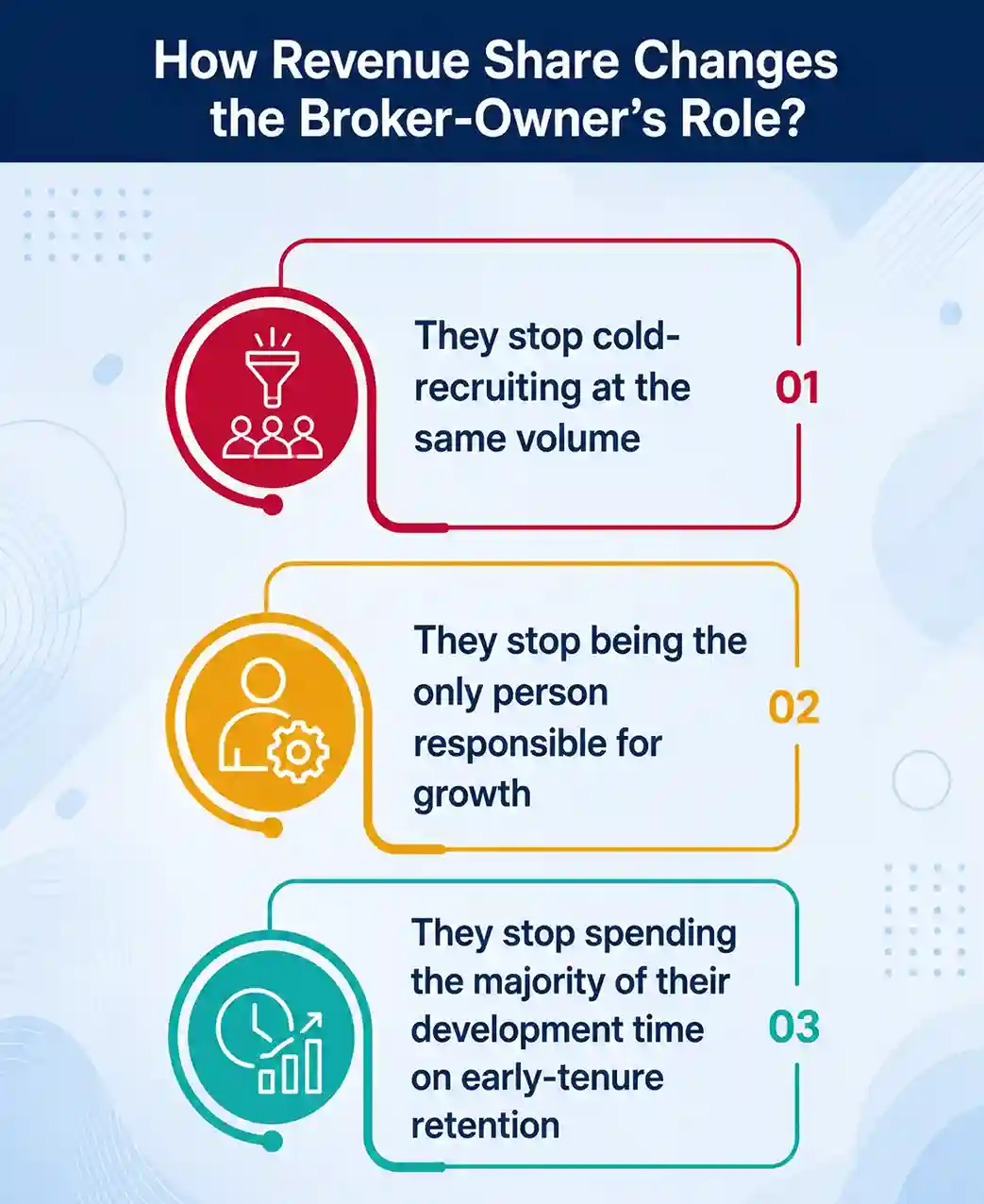
They stop being the only person responsible for growth
This is the change broker-owners describe most emotionally when they look back on Year 1. The weight of a brokerage’s growth does not have to sit entirely with the broker-owner. Revenue share distributes that responsibility — not by assigning it to someone, but by creating a financial incentive that aligns agents’ interests with the brokerage’s growth. Agents who are building passive income through the programme have a direct reason to contribute to the brokerage’s recruiting success. That shared responsibility is both practically useful and personally meaningful to broker-owners who have been running alone for years.
They stop spending the majority of their development time on early-tenure retention
Early-tenure attrition is expensive in both time and money. The agents most likely to leave are the ones who have not yet built enough of a financial connection to the brokerage to feel the cost of going. Revenue share changes that connection from day one for agents who join through a programme participant’s introduction. The broker-owner who used to spend significant energy on early-tenure support finds that some of that energy is now handled by the programme’s structure itself — the agent who made the introduction has a financial reason to support the new agent’s success.
Download the Complete Revenue Share Blueprint
The complete 28-page guide to designing, pricing, and launching a revenue share programme at your independent brokerage — programme structures, economics modelling, legal considerations, and a step-by-step launch sequence.
When the First Year Doesn't Go This Way
Not every brokerage experiences the arc described above on the same timeline, and some programmes stall. The most common reasons we see are worth naming honestly rather than glossing over:
- Unclear eligibility rules- If agents aren't sure exactly who qualifies for a payout and under what conditions, enthusiasm from Month 1 fades by Month 3 instead of converting into introductions.
- Underfunded payout structure- A programme priced without a realistic model of Year 1 cash flow can create payout delays that damage trust faster than no programme at all.
- No communication after launch- Broker-owners who send the programme document once and don't revisit it in team meetings or one-on-ones see slower adoption than those who keep it visible.
- Treating it as a recruiting tool only- Programmes framed purely as "bring us agents and get paid" without connecting to retention and culture tend to plateau after the first wave of easy introductions dries up.
None of these are reasons to avoid launching — they're reasons to get the structure right before you do, which is what the foundational guide and starter checklist above are built to help with.
The First Year Starts When You Decide to Start It
The question was: what actually changes?
The honest answer is that the changes are structural, cultural, and personal — in that order, across four stages. The structure of the brokerage shifts when revenue share is in place, because agents now have a financial architecture that connects them to the brokerage and to each other. The culture follows because shared financial interests create genuine collaboration. And the broker-owner’s own experience changes because they are no longer the sole engine of growth in a brokerage that is beginning to grow itself.
None of this happens overnight. Month 1 is quieter than expected. Month 3 shows the first signals. Month 6 is where the culture shift becomes visible. Month 12 is where the compounding begins. The patience required is real. But so is the compound effect of building a brokerage where agents have a financial reason to stay, to recruit, and to care about each other’s success.
The market context for this decision has never been more compelling. Top-producing agents are actively evaluating their options right now — and what they are looking for is exactly what an independent brokerage with revenue share offers: a personal environment AND a financial stake. The broker-owners who have that programme in place when those conversations happen are the ones who win them.
The first year starts when you decide to start it.
Map Your Programme Structure With Our Team
Book a call and we will design your revenue share programme, model your specific brokerage’s Year 1 economics, and map the path to going live in 14 days — without replacing a single system you already use.
Book a CallFrequently Asked Questions About Independent Brokerage Revenue Share
In the first year, an independent brokerage typically focuses on building the foundation for long-term growth. The brokerage can use revenue sharing to attract agents by offering them an additional income opportunity based on the production or referrals generated within their organization. As more agents join and become productive, the brokerage can begin developing a recurring revenue stream while strengthening its agent network. The first year is generally about recruiting the right people, establishing trust, and creating the structure needed for sustainable growth.
Revenue share gives agents a reason to look beyond the traditional commission split when evaluating a brokerage. Instead of receiving value only from their personal transactions, agents may have an opportunity to earn additional income by referring other productive agents to the brokerage. This can make the brokerage more attractive to growth-oriented professionals and can improve retention by giving agents a longer-term financial incentive to remain within the organization.
A well-designed revenue share program can encourage a more collaborative and growth-oriented culture. Agents have an incentive to introduce qualified professionals, support newer agents, and contribute to the growth of the overall brokerage rather than focusing exclusively on their own production. When the program is transparent and aligned with agent performance, it can promote collaboration, mentorship, and a stronger sense of shared success.
Yes, it can reduce reliance on the broker-owner personally handling all recruitment activities. With a revenue share structure, existing agents can become an additional source of referrals by introducing other professionals to the brokerage. Over time, this creates a distributed recruiting model where the agent network contributes to expansion. However, revenue share does not eliminate the need for active recruiting; broker-owners still need a strong value proposition, onboarding process, and agent experience.
Revenue share can create a compounding effect because new agents can contribute to both brokerage production and future recruitment. As the network grows, existing participants may introduce additional agents, expanding the potential revenue base without requiring the broker-owner to generate every new relationship directly. The effect becomes stronger when agents are productive, retained, and actively referring qualified professionals. This makes revenue share a long-term growth mechanism rather than simply a short-term recruiting incentive.
Share this blog


Popular topics
Efficiency
Growth
Compliance
Technology
Agents
Trends




 +1 (765) 896-5271