


 Home
Home Blog
Blog
Table of Content
- Introduction
- What is a Revenue Share Program at a Real Estate Brokerage?
- Why Revenue Share Feels Complicated When It Isn’t
- Revenue Share vs. Traditional Recruiting at a Glance
- Launch timeline at a glance
- What Happens After You Make These Five Decisions
- Start the Programme You Already Decided to Build
- Frequently Asked Questions
Key Takeaways
- A successful revenue share program starts with clearly defining the percentage, eligibility, payout schedule, agreement terms, and launch approach.
- Set a sustainable revenue share percentage that motivates agents while supporting the brokerage’s financial goals.
- Clearly communicate eligibility requirements, payout terms, and departure conditions to avoid confusion.
- Introduce the program strategically to existing agents to encourage understanding and participation.
- Independent brokerages can launch a revenue share program without replacing their existing technology or joining a national platform.
Quick answer
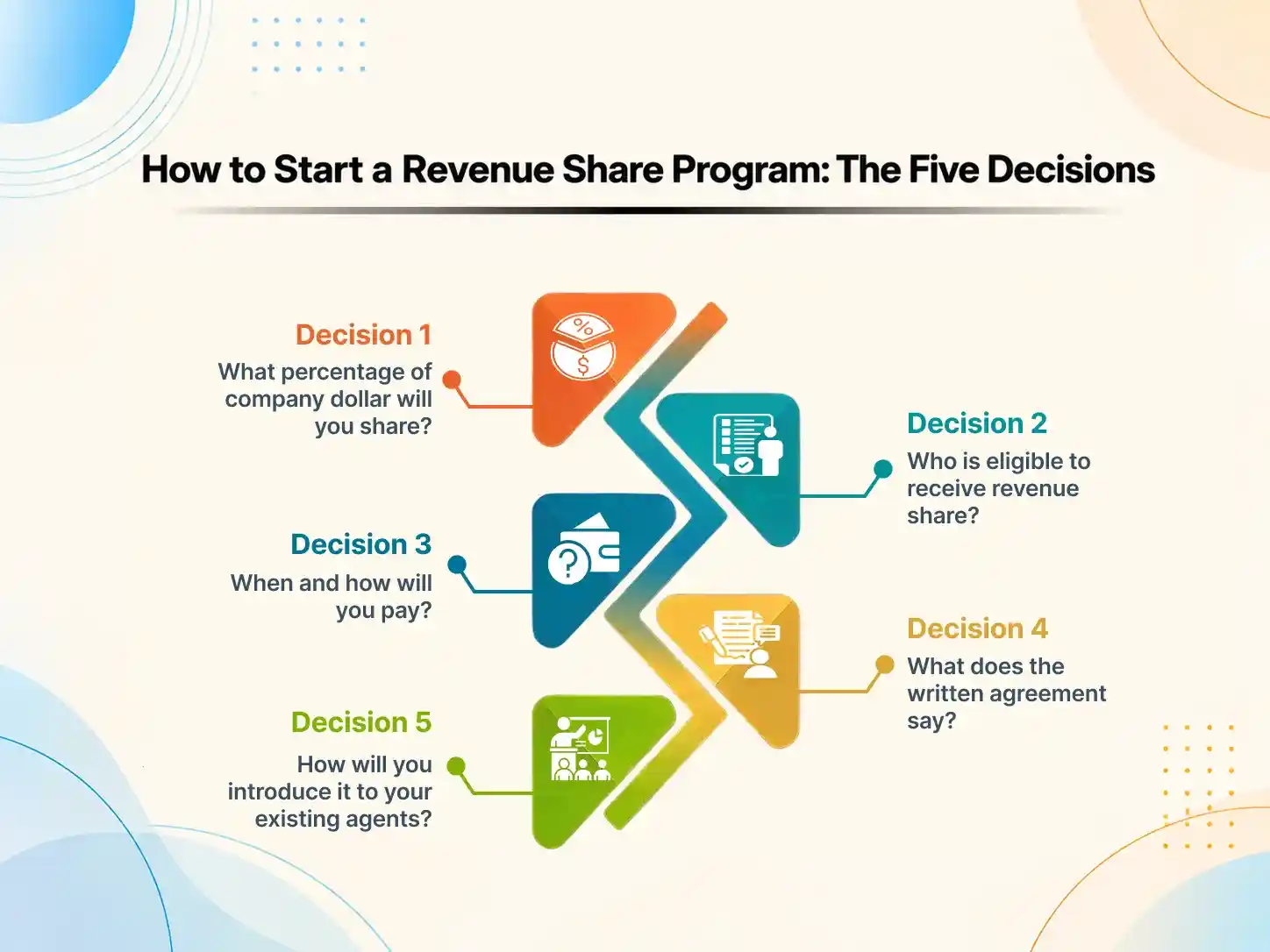
To start a revenue share program at an independent brokerage, make five decisions in order:
- How much company dollar to share, across how many tiers and with what cap.
- Who is eligible and how you record who introduced whom.
- When and how you pay.
- What the written agreement says, including departure and vesting terms.
- How you introduce it to your existing agents. You can draft all five in an afternoon.
Attorney review and setup take most of the remaining launch time, often around two weeks. You do not need to join a national brokerage to offer revenue share.
Many independent broker-owners decide to offer revenue share, draft a document, and then stall. The decision is not the problem. The problem is not knowing which choice to make first. This guide gives you the order, a worked example of the economics, and the compliance points to raise with your attorney.
You made the decision to launch revenue share. You know why you want it — agents leaving for brokerages that offer it, a recruiting dynamic where you are doing all the work alone, the sense that other brokerages have a structural advantage you don’t. The decision was not difficult.
That was three months ago. The document is still in your drafts folder. The decision has not changed. The programme has not launched.
This is the most common pattern in independent brokerages that want revenue share: the decision gets made, and then nothing happens. Not because the broker-owner changed their mind. Because nobody told them which decision to make first.
Here is the roadmap. Five decisions, in order. You can make all five in a single afternoon.
Why Revenue Share Feels Complicated When It Isn’t
Most broker-owners treat launching revenue share like a big project. They imagine months of legal review, technology implementation, and structural reorganisation. They push it to next quarter. Next quarter arrives and they push it again.
The reality is different. Revenue share is not a complicated programme. It is five decisions. Once those decisions are made, everything that follows is execution — and execution is what the right platform handles for you.
The broker-owners who launched revenue share inside their own independent brokerage almost universally say the same thing when they look back: “I thought this was going to be much more complicated than that.” It was not. They made five decisions and went live.
Here is the first decision — and the four that follow it.
Revenue Share vs. Traditional Recruiting at a Glance
Revenue share is paid from the company dollar your brokerage keeps after the agent's split, not from the agent's commission. That means the cost scales with new production from introduced agents rather than cutting into your margin on existing agents' deals. It is still a real margin, so model it before you commit.
First, define company dollar precisely: is it measured before or after franchise fees, transaction fees, and any agent cap? Write that definition into the agreement. Then make three choices:
Percentage: Too low and agents don't feel the incentive. Too high without modeling and you create cash flow risk.
Tiers: A single-tier program pays only the agent who made the introduction. Multi-tier programs also pay on agents introduced further down the chain. Multi-tier pays more but is harder to track and explain, and can invite comparisons to multi-level marketing. Most independents find single-tier far simpler to launch.
Cap: A limit per transaction or per year on what one introduced agent's production can pay out keeps costs predictable.
Recommendation: Start single-tier at 3–5% of company dollar per transaction from introduced agents, with a clear company dollar definition and an annual cap. You can add a second tier later; taking one away damages trust.
Worked example: what revenue share costs and earns
This is a hypothetical example to show the math. Replace the numbers with your own.
| Item | Assumption | Amount |
|---|---|---|
| Average GCI per transaction | Given | $12,000 |
| Company dollar per transaction | 80/20 split | $2,400 |
| Revenue share per transaction | 4% of company dollar | $96 |
| Transactions from introduced agents per year | 10 agents × 8 deals | 80 |
| Company dollar from those deals | 80 × $2,400 | $192,000 |
| Total revenue share paid | 80 × $96 | $7,680 |
| Company dollar retained | Before other operating costs | $184,320 |
The key question is not the $7,680. It is whether those 10 agents would have joined, and stayed, without the program. To model this for your own agent count and GCI, use the RightAlly ROI Calculator.
The programme should be open to agents, not to unlicensed staff or outside referrers. State real estate license laws generally prohibit brokers from paying compensation for real estate activity to unlicensed people, and many states require payments to licensees to flow through their sponsoring broker. Keep payments tied to the introduced agent's production, not to the act of recruiting itself.
Beyond the licensing requirement, you need to decide whether to set a production minimum for participation. A production requirement (for example, at least one closed transaction per quarter) protects the brokerage from paying revenue share on agents who are not actively producing. It also creates a slight motivation for introduced agents to stay active.
You also need attribution rules. Decide how an introduction is recorded (for example, the sponsoring agent is named on the new agent's onboarding form), when it is locked in, and how disputes are settled if two agents claim the same recruit. Ambiguity here causes more internal conflict than the percentage does.
Recommendation: Open to all actively licensed agents at your brokerage from Day 1. No production minimum at launch — you want early engagement. Add a minimum in Year 2 once the programme is established.Record the sponsoring agent on the onboarding form, and treat that record as final.
The payment schedule determines how visible and motivating the programme feels to agents. Agents who see passive income arrive on a predictable schedule develop a financial connection to the programme faster than agents who receive occasional lump sums.
Monthly payouts tied to the prior month’s closed transactions keep the programme visible without creating excessive administrative burden. Quarterly payouts reduce administration but reduce motivational impact — An agent who introduces a colleague in January and receives nothing until April has had three months to lose interest.
Recommendation: Monthly payouts, calculated on closed transactions from the prior month, distributed on a fixed day each month. Set the date before you launch and hold to it.Send each agent a statement showing which transactions generated their payment.
A written, agent-signed revenue share agreement is standard practice and reduces both legal exposure and agent disputes. It does not need to be long.It should cover:
- Eligibility and attribution: who can participate and how introductions are recorded.
- Payout calculation: your company dollar definition, the percentage, tiers, and cap.
- Departure terms: what happens when an introduced agent leaves (payments on that agent's future deals stop) and what happens when the sponsoring agent leaves.
- Vesting: whether a departing or retiring sponsor keeps earning, and after how long. This is a policy choice, and in some states paying a licensee who is now affiliated with another brokerage raises compliance questions, so decide it with your attorney.
- Changes and termination: how you can change or end the program, and how much notice agents get.
- Tax treatment: agents who are independent contractors typically receive revenue share reported on Form 1099-NEC. Under the One Big Beautiful Bill Act, the reporting threshold rose from $600 to $2,000 for payments made after December 31, 2025. Confirm current rules with your CPA.
One more compliance point: the Real Estate Settlement Procedures Act (RESPA), Section 8, restricts paying anyone for referring consumers' settlement service business, such as mortgage or title work. Revenue share for introducing agents to your brokerage is a different thing, but keep it clearly separate from any payment connected to consumer referrals to lenders, title companies, or other affiliates.
Recommendation: A short written agreement covering the six points above, reviewed by a real estate attorney in your state before launch. This is the one decision where getting professional input is worth the time it takes.
The internal launch determines whether the programme gains momentum or launches quietly and fades. A common mistake is announcing the program to everyone at once in a group meeting without preparation. Agents who hear about something for the first time in a group setting tend to look around the room to gauge the reaction rather than forming their own view.
The better approach: start with one-on-one conversations with your top three producing agents before the group meeting. These are your first advocates. Their understanding of the programme — and their visible enthusiasm — will shape how the rest of your roster receives it. An agent who has a personal conversation with the broker-owner and understands their specific earning potential arrives at the group meeting ready to answer their colleagues’ questions.
Recommendation: One-on-ones with top three agents first. Group meeting second. Written programme summary handed out at the meeting — not emailed afterward. For talking points and the questions agents usually ask, see the Agent Conversation Guide.
Launch timeline at a glance
| Step | What happens | Typical time |
|---|---|---|
| Draft decisions 1–5 | Percentage, tiers, cap, eligibility, attribution, payout date, rollout plan | An afternoon |
| Model the economics | Run your agent count and GCI through a calculator | An hour |
| Attorney review | Agreement and state compliance check | Depends on your attorney; often several days |
| Set up tracking and payouts | Record sponsors, connect transaction data, set the payout date | Varies by tool |
| Internal launch | One-on-ones, then group meeting | About a week |
Download the Guide (free) →
What Happens After You Make These Five Decisions
The first thing broker-owners notice after launching is which agents engage immediately. They are almost always the same agents — the ones who have been informally referring colleagues to the brokerage for years without any financial recognition. They see the programme, understand what it means for them, and act within days. These are your first advocates, and they were already there. The programme gives them a reason to do what they were already inclined to do.
The second thing that changes is the conversation an agent has when a competitor recruiter calls. Before the programme, the agent compares splits. With the programme, they compare splits plus the passive income they have built at your specific brokerage — income that would be lost if they left. That is a different calculation. It does not guarantee the agent stays. It does change what the competitor has to offer to make leaving worth it.
By month three, agents start asking about the programme status rather than waiting to be reminded. They are tracking their own network. They are thinking about introductions. The brokerage starts growing in a way the broker-owner did not have to generate personally.
The urgency to move quickly is real. National platforms using revenue share as a retention and recruiting mechanism are scaling at rates that were not possible through traditional recruiting methods. Independent broker-owners who build the same mechanism inside their own brokerage are not just competing more effectively for agents — they are building a brokerage that grows through its own people rather than through constant personal effort from the broker-owner alone.
The five decisions are the only thing standing between a broker-owner and that outcome. Most broker-owners who launch tell us the hardest part was starting. Not the programme itself.
Start the Programme You Already Decided to Build
Once the five decisions are made, the ongoing work is tracking sponsors, calculating payouts, and sending statements every month. RightAlly handles that for independent brokerages without replacing your existing systems or requiring you to join a national brokerage. Pricing starts at $20 per agent per month.
Book a 20-minute call. We will walk through your five decisions, model the economics for your brokerage, and tell you honestly whether revenue share makes sense for you.
Book a Call →Frequently Asked Questions
Make five decisions in order: how much company dollar to share (including tiers and a cap), who is eligible and how introductions are recorded, when to pay, what the written agreement covers, and how to introduce the program to existing agents. Have the agreement reviewed by a real estate attorney in your state before launch.
Revenue share is generally permitted when payments go only to actively licensed agents, flow through the brokerage, and are tied to production rather than to recruiting itself. State license laws vary, so confirm your structure with a real estate attorney. For a fuller answer, see our guide to revenue share for independent brokerages.
A practical starting range is 3–5% of company dollars per transaction from introduced agents, in a single tier, with an annual cap. Model the cost against your own agent count and GCI before finalizing.
Single-tier pays only the agent who made the introduction and is simpler to track, explain, and keep compliant. Multi-tier pays more levels and is more attractive to active recruiters, but adds administration and can invite multi-level marketing comparisons. Most independents start single-tier.
The five decisions can be made in a single afternoon. With RightAlly, the programme goes live in under 14 days from the first call. No technology replacement is required — RightAlly works alongside existing CRM and transaction management systems.
No. RightAlly is a layer that sits on top of existing brokerage operations. It integrates with the systems already in place and handles the tracking, calculation, and payout administration automatically. No CRM replacement. No transaction management replacement.
When an agent leaves, revenue share payouts from that agent's future transactions stop. However, payouts from other agents they introduced — who remain at the brokerage — continue for as long as those agents produce. This should be clearly stated in the written revenue share agreement before launch.
Yes. Independent broker-owners can build a revenue share programme inside their own brokerage without joining any national platform, surrendering their brand, or paying franchise fees. RightAlly is built specifically for independent brokerages and costs approximately $20 per agent per month.
Share this blog


Popular topics
Efficiency
Growth
Compliance
Technology
Agents
Trends




 +1 (765) 896-5271