


 Home
Home Blog
Blog
Table of Content
- Introduction
- What Are the Best Exit Strategies for Independent Broker-Owners?
- How Does Agent Retention Affect Brokerage Valuation?
- The Cloud Brokerage Succession Pitch—And Why It Isn’t the Only Answer
- Revenue Share as a Succession Strategy: The Three-Layer Framework
- How to Build a Brokerage Succession Strategy in 4 Steps
- The Window Is Shorter Than It Feels
- Frequently Asked Questions
Key Takeaways
- Broker-owners are aging fast — median Realtor age is now 57, with 44% over 60, making succession planning urgent industry-wide.
- Traditional exits often fall short — selling nets only 0.5–1.5x GCI (with a 25–35% discount for weak retention), family succession needs a rare ready successor, and "just keep working" isn't really a plan.
- Revenue share decouples income from personal production — it keeps paying even after the owner steps back, since it's tied to the agents they've developed.
- Strong retention directly boosts sale value — buyers pay more when agents stay for structural reasons (revenue share, systems) rather than personal loyalty to the owner.
- The earlier you start, the more it compounds — building revenue share and transferable systems years in advance (not 1–2 years before exit) maximizes both income and brokerage valuation.
This demographic shift is creating one of the largest succession challenges the real estate industry has faced in decades .The typical independent broker-owner is 57 years old. Nearly half the Realtor membership is 60 or older. And most of them are running a business worth significantly less than they think—because the moment they step back, most of its value walks out the door with them.
The NAR 2025 Member Profile confirmed what most experienced observers already suspected: the real estate industry is aging rapidly. The median age of Realtors jumped from 55 to 57 in a single year. The share aged 60 or older surged from 35% to 44%. Those aged 65 and older increased 7% year over year to 29%. Only 11% of members are now under 40.
This is not a trend. It is an accelerating demographic reality—and for independent broker-owners, it has a specific financial implication that most succession planning conversations fail to address honestly: when you are ready to exit, your brokerage is probably worth less than you expect, the exit options available to you are probably worse than you’ve been told, and the window to change that is shorter than you think.
This guide explains why traditional exit strategies often reduce brokerage value and how revenue share can improve succession planning through stronger agent retention and recurring income.
An exit strategy is a long-term plan that allows a broker-owner to transition ownership, retire, or reduce daily involvement while preserving brokerage value, retaining agents, and maintaining recurring income.
What Are the Best Exit Strategies for Independent Broker-Owners?
When an independent broker-owner starts thinking seriously about succession, they typically encounter three paths. Understanding exactly why each one falls short is the starting point for building something better.
| Exit Strategy | How It Works | Advantages | Challenges | Best For |
|---|---|---|---|---|
| Sell the Brokerage | Sell the business to another brokerage, investor, or acquisition firm based on its valuation. |
• Immediate liquidity • Potential lump-sum payout • Complete ownership transfer |
• Lower valuation if agent retention is weak • Buyer due diligence can be lengthy • Brand and company culture may change after the sale |
Broker-owners with a well-established brokerage, strong financials, and documented systems. |
| Internal Succession (Family or Leadership Team) | Transfer ownership to a family member, business partner, or senior manager already involved in the brokerage. |
• Preserves company culture • Smooth transition for agents • Maintains client relationships |
• Requires a qualified successor • Financing the buyout can be difficult • Success depends on leadership readiness |
Brokerages with experienced internal leaders and a long-term succession plan. |
| Continue Operating Without a Formal Exit Plan | Delay succession planning and continue managing the brokerage until retirement or an unexpected event forces a transition. |
• No immediate structural changes • Continued control over daily operations |
• Business remains dependent on the owner • Higher risk of reduced valuation • Unexpected health or market events can force an unfavorable exit |
Broker-owners who are not yet ready to retire but should begin planning within the next few years. |
| Build a Revenue Share–Backed Succession Strategy (Recommended) | Create recurring revenue through a structured revenue share program while strengthening agent retention and reducing owner dependency before transitioning the business. |
• Creates passive income before retirement • Improves agent retention • Can increase brokerage valuation • Maintains brand independence • Provides greater flexibility in choosing when and how to exit |
• Requires strategic planning and consistent implementation over several years • Needs technology, systems, and leadership commitment |
Broker-owners seeking long-term business value, recurring income, and a flexible exit strategy without giving up their brokerage brand. |
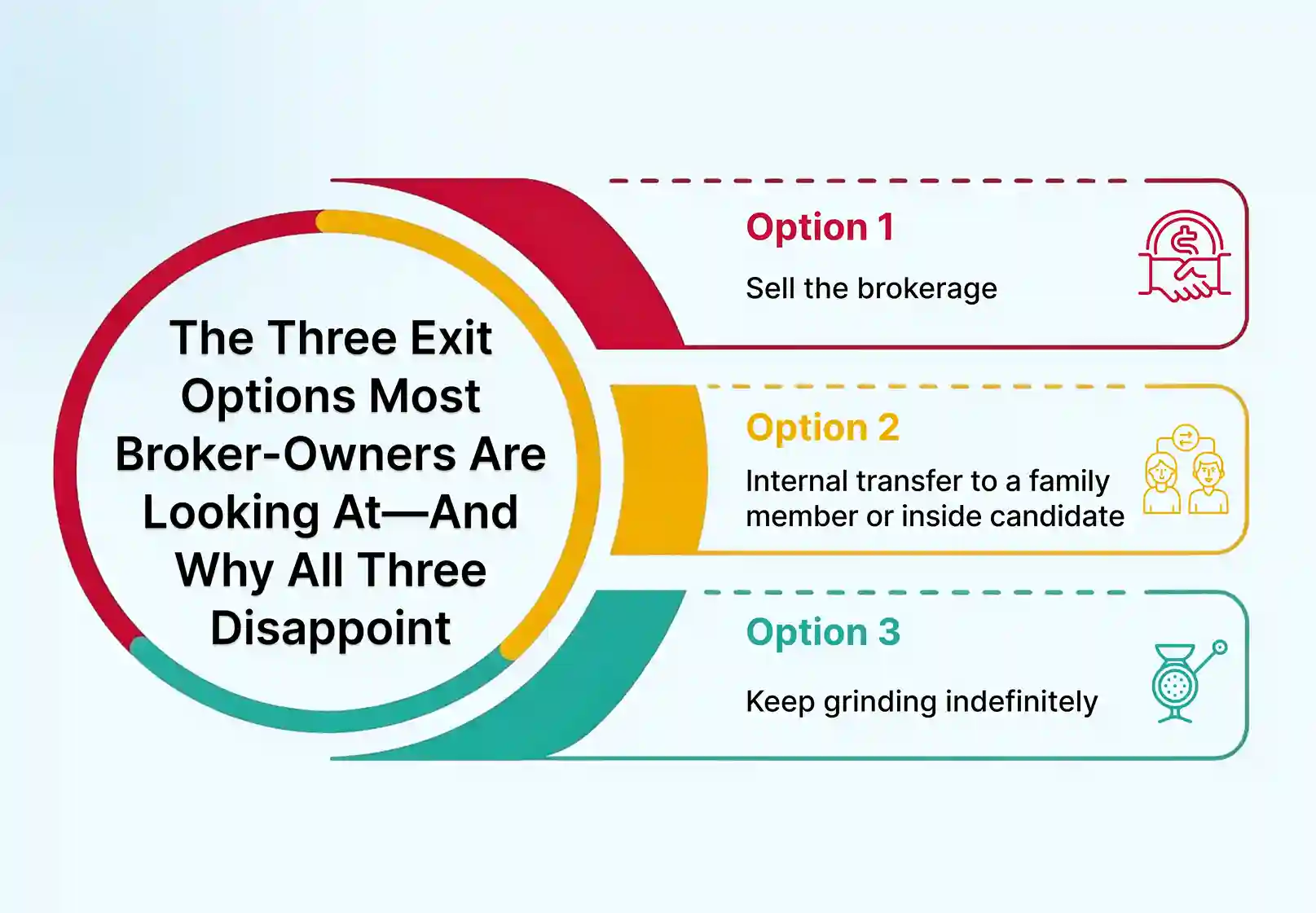
Option 1: Sell the brokerage
The valuation reality of a 2026 independent brokerage sale is sobering. According to CT Acquisitions’ July 2026 Brokerage Valuation Guide, independent brokerages typically trade at 0.5–1.5x GCI or 3–5x EBITDA. Post-NAR-settlement compression has pushed that lower: deals that cleared at 4x EBITDA before the settlement now regularly settle at 2.5–3.5x for the same brokerage. And the valuation is brutally sensitive to agent retention: brokerages with poor retention face 25–35% valuation discounts—because every buyer’s first question is “what happens to the agents when the owner leaves?”
The deeper problem is that for most independent brokerages, the honest answer to that question is “we don’t know.” The brokerage’s value—its relationships, its culture, its recruiting pipeline, its agent loyalty—is tied to the owner. When the owner exits, much of that value exits with them. Buyers know this and price accordingly.
Option 2: Internal transfer to a family member or inside candidate
This sounds appealing but is rarely straightforward. The successor needs to be operationally ready, financially capitalised, culturally aligned, and genuinely capable of holding the agent base together through a transition. Most broker-owners who take an honest look at their bench find it thinner than they’d like. And the brokerages where this works best are almost always the ones that have built documented systems, transferable infrastructure, and an agent retention model that doesn’t depend on the founder’s personal relationships.
Option 3: Keep grinding indefinitely
This is the most common path—not by choice, but by default. Broker-owners who haven’t built a succession strategy find that there’s no clean moment to step back, so they don’t. The brokerage is profitable, the relationships are meaningful, and the alternative options are worse. So they keep working. The problem is that this is not a succession strategy. It is the absence of one—and it leaves the broker-owner exposed to health, capacity, and market changes that could force an exit on much worse terms than a planned one.
How Does Agent Retention Affect Brokerage Valuation?
The 25–35% valuation discount for poor agent retention is not an abstraction. Run the numbers on what it means for a specific brokerage.
Consider an independent brokerage producing $800,000 in EBITDA. At a 3x multiple—the midpoint of the post-settlement range—that is a $2.4 million exit value. Apply a 30% retention discount, and the effective exit value drops to $1.68 million. That is a $720,000 gap between what the broker-owner expects and what a buyer will actually pay—driven entirely by the measurable risk that agents will leave when the owner does.
Now consider what changes if that same brokerage has spent three years building a revenue share programme, an internal mobility system, and team infrastructure that demonstrably retains its highest producers independent of the founding broker. The retention discount disappears. The multiple may improve. And the buyer’s underwriting question—“what happens to the agents when the owner leaves?”—has a documented, data-backed answer rather than a shrug.
The connection to the brokerage profitability and retention work we have covered in this series is direct: every profitability leak that compresses current EBITDA also compresses exit valuation. And every agent lost to the independent black hole is one more retention risk a buyer has to price in. Succession planning is not a separate conversation from brokerage operations. It is the long-term financial outcome of every operational decision you make today.
Model Your Revenue Share Passive Income Trajectory
What could your revenue share income look like in 3 and 5 years if you started building now? The ROI Calculator runs your specific brokerage numbers in minutes.
Model Your IncomeThe Cloud Brokerage Succession Pitch—And Why It Isn’t the Only Answer
In the past few months, a specific narrative has gained traction in broker-owner circles: that the cleanest succession strategy for an independent broker-owner is to transition their brokerage to a cloud model, capture the revenue share upside, and let the brand infrastructure handle what happens after they step back.
This pitch has genuine appeal. Revenue share income that grows with your agents’ production, a brand that doesn’t depend on your personal presence, and an ongoing income stream that doesn’t require a sale to unlock. If you are an independent broker-owner who has never built a revenue share programme, that sounds like everything you don’t have.
But the pitch has a structural flaw: it solves the succession problem by ending the independent brokerage. You get the revenue share income—but you give up your brand, your culture, your agent relationships (now belonging to the parent organisation), and your independence. The income stream continues, but everything you built the brokerage to be does not.
The more important question is whether an independent brokerage can build the same passive income architecture—revenue share income that grows with your agents’ production and continues regardless of your personal activity level—without requiring a transition to another brand. The answer is yes. And the broker-owners who build it are developing a succession strategy that is fundamentally more valuable than the cloud transition model, because they retain ownership of the asset while building the income stream.
Revenue Share as a Succession Strategy: The Three-Layer Framework
Understanding why revenue share functions as a succession mechanism requires seeing it as more than a recruiting tool. A properly implemented revenue share programme creates three distinct succession advantages that no other brokerage incentive model provides.
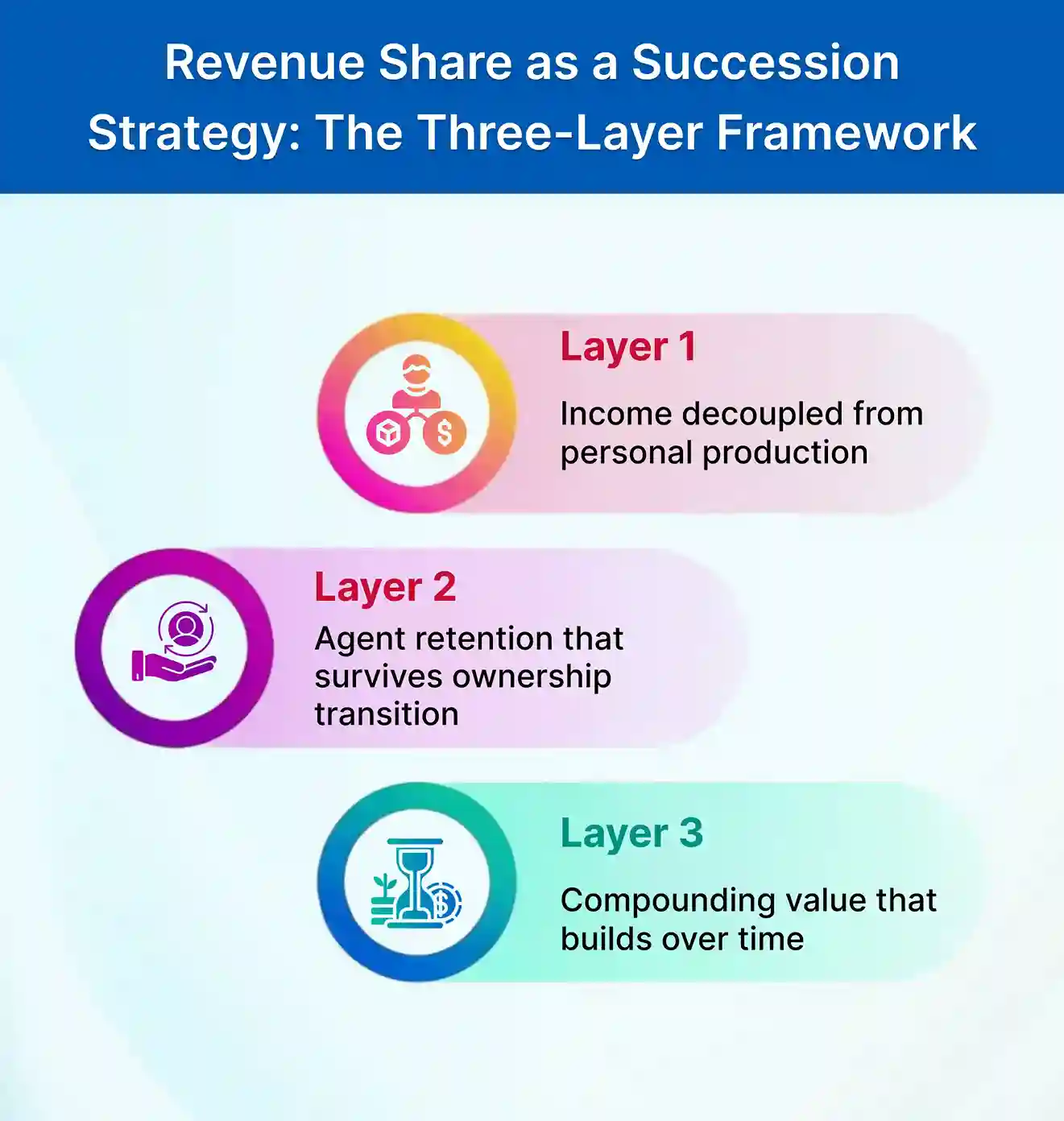
Layer 1: Income decoupled from personal production
The foundational succession problem for most broker-owners is that their income is tied to their personal activity. They produce, they earn. They step back, the income drops. Revenue share breaks this linkage by creating an income stream tied to the production of others—agents they have recruited, developed, and retained inside their brokerage ecosystem. As those agents grow their production, the broker-owner’s revenue share income grows with them. As the broker-owner steps back from personal production, the revenue share income continues. This is the passive income architecture that makes a genuine succession timeline possible.
Layer 2: Agent retention that survives ownership transition
The buyer’s core underwriting question at brokerage sale is agent retention risk. A brokerage where agents stay because of the owner’s personal relationships scores poorly. A brokerage where agents stay because of a revenue share programme—because their income is tied to the agents around them and the ongoing production of the team infrastructure they have built—scores well. The 89% retention rate we documented for internally mobile agents is not just an operational advantage. It is a valuation premium. Buyers pay more for a brokerage whose retention is demonstrably structural rather than personality-dependent.
Layer 3: Compounding value that builds over time
The critical insight about revenue share as a succession strategy is that it is not something you implement 18 months before you want to exit. It is something you build over years—and the earlier you build it, the more it compounds. The team infrastructure and internal mobility systems that drive production also expand the revenue share pool. The agents who build sub-networks inside the brokerage create compounding layers of production. And the broker-owner who has been running a revenue share programme for five years at the point of exit has demonstrably more transferable value than one who implemented it recently.
Broker-owners should ideally begin succession planning 5–10 years before retirement to build recurring income, document business systems, and maximize long-term business value.
How to Build a Brokerage Succession Strategy in 4 Steps?
A revenue share–backed succession strategy isn't built overnight. It requires a structured approach that strengthens your brokerage's value while reducing owner dependence. Follow these four steps to create a more transferable, profitable, and exit-ready business.
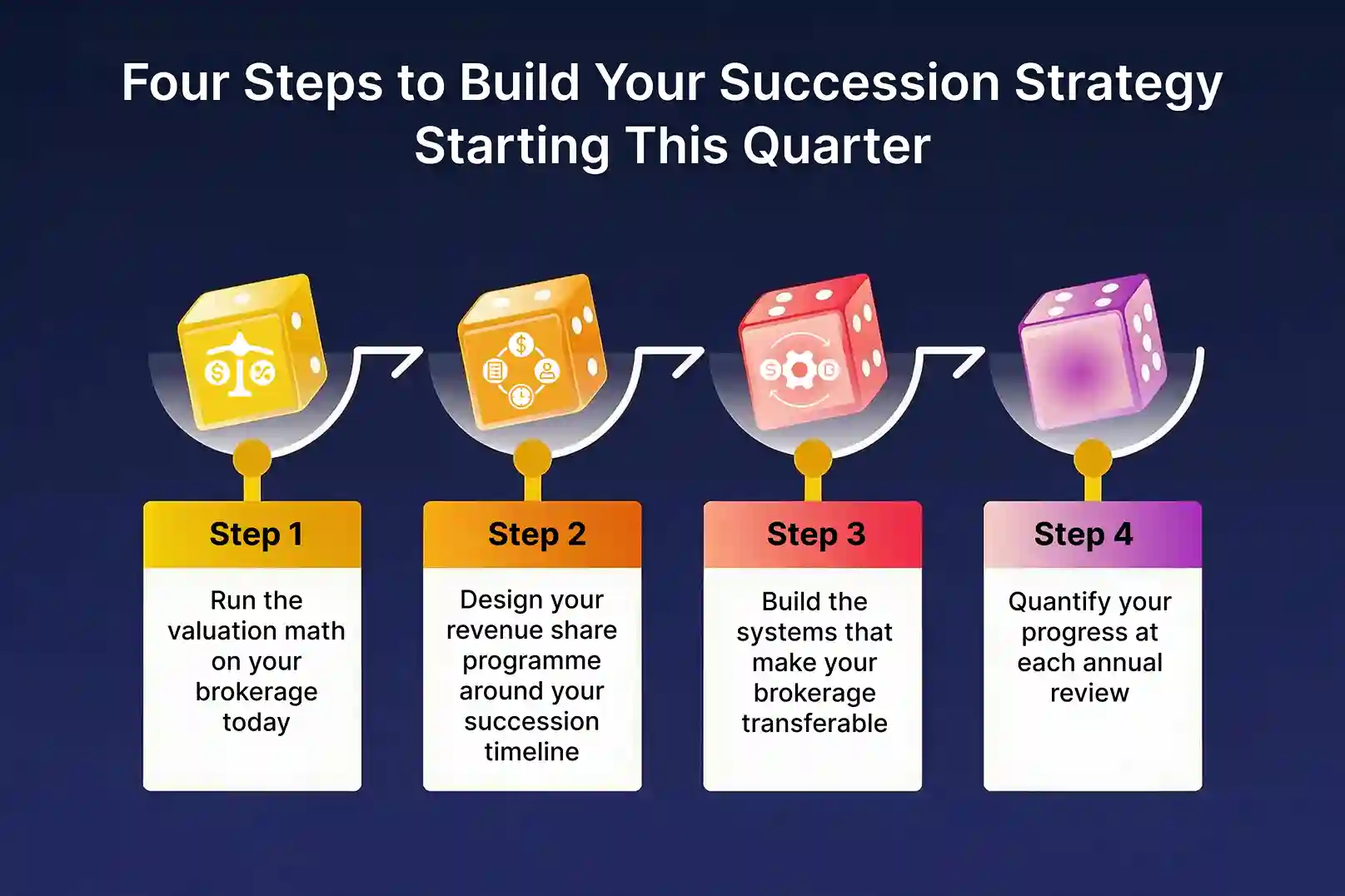
Evaluate Your Brokerage's Current Exit Value
Before implementing any succession strategy, understand where your brokerage stands today. Calculate your current EBITDA, estimate your business valuation, and identify the factors that could reduce its market value, such as owner dependence, weak agent retention, outdated technology, or inconsistent profitability. Establishing your baseline helps you measure future improvements and prioritize the areas that will have the greatest impact on your exit value.
Action
- Calculate your current EBITDA and estimated brokerage valuation.
- Identify major valuation risks, including agent retention, owner dependence, and operational gaps.
- Document your current business metrics.
Expected Outcome
- Clear understanding of your brokerage's current market value.
- Identification of the biggest factors limiting your exit valuation.
- A measurable starting point for your succession plan.
KPI to Track
Build a Revenue Share Program That Supports Your Exit Timeline
Design your revenue share program with succession in mind rather than simply using it as a recruiting incentive. Reward long-term contributors, encourage agent retention, and create recurring income that continues beyond your personal production. Align the program with your retirement or ownership transition goals, whether your timeline is three, five, or ten years.
Action
- Define your desired retirement or transition timeline.
- Design revenue share rules that reward retention and team growth.
- Model projected passive income over the next 3–5 years.
Expected Outcome
- Sustainable recurring income before retirement.
- Increased agent loyalty and engagement.
- Reduced dependence on personal sales production.
KPI to Track
Create Systems That Make Your Brokerage Transferable
A brokerage becomes more valuable when it operates independently of its founder. Standardize recruiting, onboarding, compliance, CRM management, training, and daily operations through documented systems and automation. Buyers place higher value on businesses with repeatable processes because they reduce operational risk and simplify ownership transitions.
Action
- Document all core business processes.
- Implement CRM and workflow automation.
- Standardize recruiting, onboarding, compliance, and training procedures.
Expected Outcome
- Reduced owner dependency.
- Improved operational consistency.
- Increased buyer confidence during due diligence.
KPI to Track
Measure and Improve Your Exit Readiness Every Year
Succession planning should be treated as an ongoing business strategy rather than a one-time project. Conduct an annual review of your brokerage's financial performance, agent retention, revenue share growth, and operational maturity. Regular benchmarking allows you to identify weaknesses early and steadily improve your brokerage's long-term value.
Action
- Conduct an annual business valuation review.
- Compare retention, profitability, and revenue share growth year over year.
- Update your succession roadmap based on business performance.
Expected Outcome
- Continuous improvement in brokerage value.
- Better preparation for ownership transition.
- Data-driven decision-making for long-term growth.
KPI to Track
Download the Revenue Share Blueprint
The complete 28-page Revenue Share Decision Guide walks through the financial architecture, programme structures, and implementation frameworks for building passive brokerage income that doesn’t require a sale to unlock. Built specifically for independent brokerage economics.
The Window Is Shorter Than It Feels
There is a specific cognitive trap that makes succession planning difficult: the brokerage feels operational today, so the need feels abstract. The agents are there, the income is there, the relationships are intact. Why build an exit strategy when there is nothing to exit from yet?
The answer is that revenue share compounds. The broker-owner who starts building a programme at 57 and runs it for eight years arrives at 65 with a meaningfully different passive income position than the one who starts at 63. The team infrastructure built over five years retains agents at 89% rather than 76%—and that retention difference, compounded over a valuation period, is the difference between a discounted sale and a premium one.
The demographic data is not an alarm. It is a planning variable. The median-age-57 moment is not the moment to exit—it is the moment to build the mechanism that makes a genuine exit possible on your own terms, at your own timeline, with your brokerage’s value intact.
The broker-owners who will have the most options at 65 are the ones who started the succession strategy at 57. Not because they wanted to leave sooner—but because they understood that the exit strategy and the growth strategy are the same thing, built with the same tools, producing the same compounding results.
Map Your Succession Timeline With Our Team
Book a call to walk through your current brokerage position, model your revenue share passive income trajectory, and map what the succession strategy looks like for your specific situation—not a generic framework, but your numbers and your timeline.
Book a CallFrequently Asked Questions
An exit strategy is a long-term plan that lets a broker-owner transition ownership, retire, or step back from daily involvement while preserving the brokerage's value, retaining agents, and maintaining recurring income — rather than letting value erode because it was never planned for.
Independent brokerages typically trade at 0.5–1.5x GCI or 3–5x EBITDA, and that multiple compresses further — by 25–35% — when agent retention is weak. Buyers price in the risk that agents leave once the founding broker exits, so a brokerage whose value is tied to the owner's personal relationships is discounted accordingly.
Revenue share creates income tied to the production of agents a broker has recruited and developed, rather than to the broker's own personal output. That means income continues — and even grows — as the broker steps back, and it gives buyers a structural (not personality-dependent) reason to believe agents will stay through an ownership transition.
No. While cloud brokerage models offer revenue share income tied to a larger brand, that comes at the cost of the owner's independent brand, culture, and direct agent relationships. A properly structured in-house revenue share program can create similar passive income architecture without giving up ownership or independence.
As early as possible — ideally years before an intended exit. Revenue share and retention infrastructure compound over time, so a broker who starts at 57 and builds for eight years arrives at 65 in a meaningfully stronger financial and retention position than one who starts just a year or two before stepping back.
Share this blog


Popular topics
Efficiency
Growth
Compliance
Technology
Agents
Trends




 +1 (765) 896-5271