


 Home
Home Blog
Blog
Table of Content
You trained that agent. You invested in them through a slow first year when they weren’t producing enough to justify the support. You reduced their split during a stretch when the market was punishing new agents. You gave them leads from your own pipeline when theirs was empty.
They left last month.
Not for more money. For a brokerage that offered revenue share — passive income that compounds every time one of the agents they introduce closes a transaction. They now have a financial reason to stay somewhere else. And the passive income they are building there will grow every month they remain.
They are not coming back.
And right now, sitting at your desk, you are already thinking about which of your current agents is having the same conversation with a competitor this week. Because you know at least one of them is.
The Problem Is Not the Split
Most broker-owners respond to this situation by raising the split. Sometimes it works for a few months. Then the agent leaves anyway, or they stay and produce less because they know they can leave whenever a better offer arrives.
The instinct is understandable. If an agent leaves for more money, the solution is more money. But that is the wrong diagnosis.
The agents who stay long-term at any brokerage stay because they have built something there that they would lose if they left. A client base. A team. A reputation. Or a financial stake in the brokerage itself.
Revenue share creates that financial stake. An agent who has built passive income at your brokerage has a direct financial cost to leaving that no split offer from a competitor can easily replace. That cost is not a penalty. It is the natural consequence of building something over time — and it is the one retention mechanism that competitors cannot copy by offering a bigger number.
Split Increase vs. Revenue Share at a Glance
| Factor | Split Increase | Revenue Share |
|---|---|---|
| Can a competitor match it? | Yes, usually within days | Harder — the income is tied to your brokerage specifically |
| Cost to the brokerage | Recurring, on every transaction | Typically a smaller shared percentage plus a flat platform fee |
| Grows with tenure? | No — stays flat | Yes — compounds as referred agents produce more |
| What the agent loses by leaving | Nothing | Passive income already built up |
The Financial Architecture That Makes Agents Stay
Here is why revenue share works as a retention mechanism when splits and perks do not.
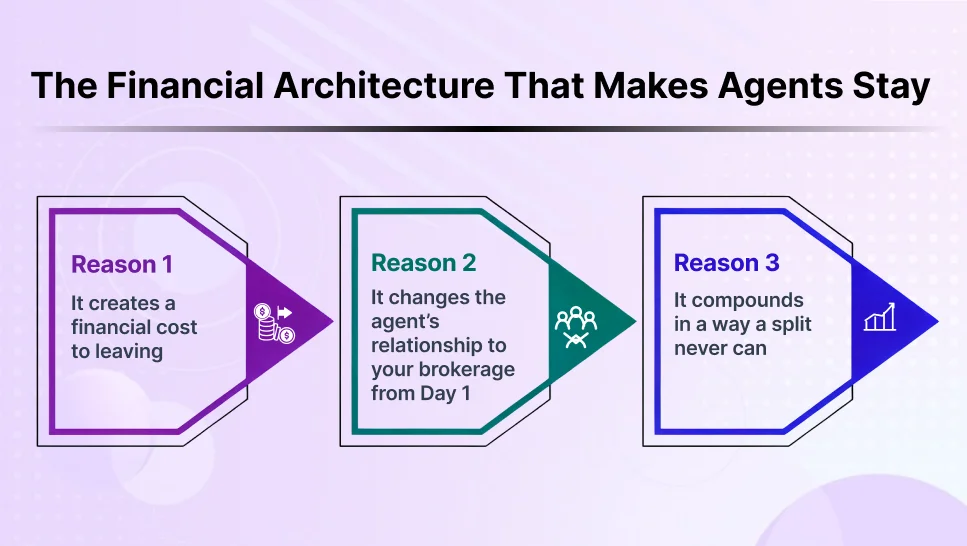
An agent comparing your brokerage to a competitor is usually comparing splits. 80/20 here versus 85/15 there. That is a straightforward calculation and it rarely favours staying. But an agent with revenue share income is making a different calculation: your split plus their passive income versus a competitor’s split alone. The passive income is not transferable. It does not move with them. If they leave, they leave it behind. That changes the number they are comparing and changes the conversation they have with a competitor recruiter.
An agent who joins through a revenue share introduction arrives with a financial connection to the brokerage already in place. The agent who introduced them has a stake in their success. That relationship — built into the financial structure of the brokerage — is qualitatively different from a new agent who simply joins through a recruiting conversation. They feel connected rather than contracted. That feeling does not require culture initiatives or management effort. It exists because the financial architecture exists.
A split is flat. An agent on an 80/20 split produces at 80/20 in year one and at 80/20 in year five. The financial relationship to the brokerage does not deepen over time. Revenue share compounds. An agent who introduced two colleagues in year one and four in year two has built passive income that grows with every transaction those colleagues close. The longer they stay, the more they have built. The more they have built, the more expensive leaving becomes. That is a retention mechanism that strengthens itself over time — without requiring any additional effort from the broker-owner.
Note: Revenue share strengthens retention, but it isn't a substitute for competitive splits, good leads, coaching, and a brokerage culture agents actually want to be part of. It also needs to comply with your state's real estate licensing rules and, where relevant, RESPA — have a real estate attorney review your specific program structure before launch.
Independent broker-owners can build this inside their own brokerage without joining a national platform, without replacing existing technology, and without a restructuring of operations. It is a layer that sits on top of what already exists.
RightAlly also connects revenue share to agent recruiting — when agents have a financial reason to stay, they also have a financial reason to bring colleagues to the brokerage. Retention and recruiting become the same mechanism.
See what revenue share generates for your specific brokerage — and what it changes about your agent retention economics. Takes 3 minutes.
Model Your Numbers →What Changes When the Architecture Is in Place
The first change broker-owners notice is not financial. It is the nature of the recruiting conversations their agents are having. Agents who are connected through a revenue share network start introducing colleagues — not because they were asked to, but because every introduction builds their passive income. The brokerage begins growing through relationships rather than through the broker-owner’s personal effort alone.
The second change is the recruiting conversation with competitors. An agent who receives a better split offer from a competitor has a different calculation to make. They are not comparing splits. They are comparing splits plus passive income to a split alone. That calculation, for many agents, resolves in favour of staying.
The third change is early-tenure retention. Agents who join through a revenue share introduction arrive with a financial connection already in place. Their early-tenure experience is structurally different from agents who join through a cold recruiting conversation. The data on early-tenure attrition reflects this.
And the data on what attrition costs without this architecture is specific. Agent turnover costs the average brokerage between $15,000 and $50,000 per agent lost, accounting for recruiting expenses, training investment, and the productivity gap during vacancy.(These figures are widely cited in industry commentary; we were unable to verify a single authoritative source, so treat this as a planning estimate and calculate your own number where possible — see the table below.) For a 25-agent brokerage losing five agents per year, that is up to $250,000 in annual drag on profitability — before a single transaction is counted. Roughly 50,000 brokerage changes are projected nationally for 2026, with agent mobility accelerating 25% quarter over quarter. And in a study of twelve brokerage models, more than 30% of departing agents skipped competitors entirely and went independent. They did not leave for a better split. They left because they no longer needed what the brokerage gave them.
Estimate Your Own Turnover Cost
| Input | Example (25-agent brokerage) | Your Brokerage |
|---|---|---|
| Agents lost per year | 5 | ___ |
| Estimated cost per departure | $15,000–$50,000 | ___ |
| Estimated annual cost | up to $250,000 | ___ |
Revenue share creates something they need. Something they built over time at your specific brokerage. Something they cannot take with them.
Download the Checklist (free) →
Build the Financial Reason for Your Best Agents to Stay
The agent who left last month made a rational decision. They chose a brokerage that gave them a financial stake in staying and growing. You can build the same stake inside your own brokerage — without joining their platform, without replacing your existing technology, without giving up your independence.
RightAlly helps independent broker-owners launch revenue share in 14 days. No technology replacement. No platform to join. Starts at $20 per agent per month.
Book a 20-minute call. We will design the programme structure for your specific brokerage, model the economics, and tell you whether it makes sense. No sales deck. No pressure. Just the conversation.
Book a Call →Frequently Asked Questions
No. It's a supplement to your split, not a replacement for one — agents still compare splits, revenue share just changes what's on the other side of the comparison.
It can be, depending on your state's licensing rules and how payments are structured. Have a real estate attorney confirm compliance before launch.
Timelines depend on brokerage size and legal review. Treat any advertised timeline (e.g., 14 days) as a best case and confirm it with your provider and counsel.
Share this blog


Popular topics
Efficiency
Growth
Compliance
Technology
Agents
Trends




 +1 (765) 896-5271